- Peter Njigira Mathiangani has expressed scepticism that CBC will eradicate Kenya’s obsession with white-collar jobs.
- He has called for the elevation of the status of vocational and practical skills training to ensure that trainees are equipped with relevant market-ready skills
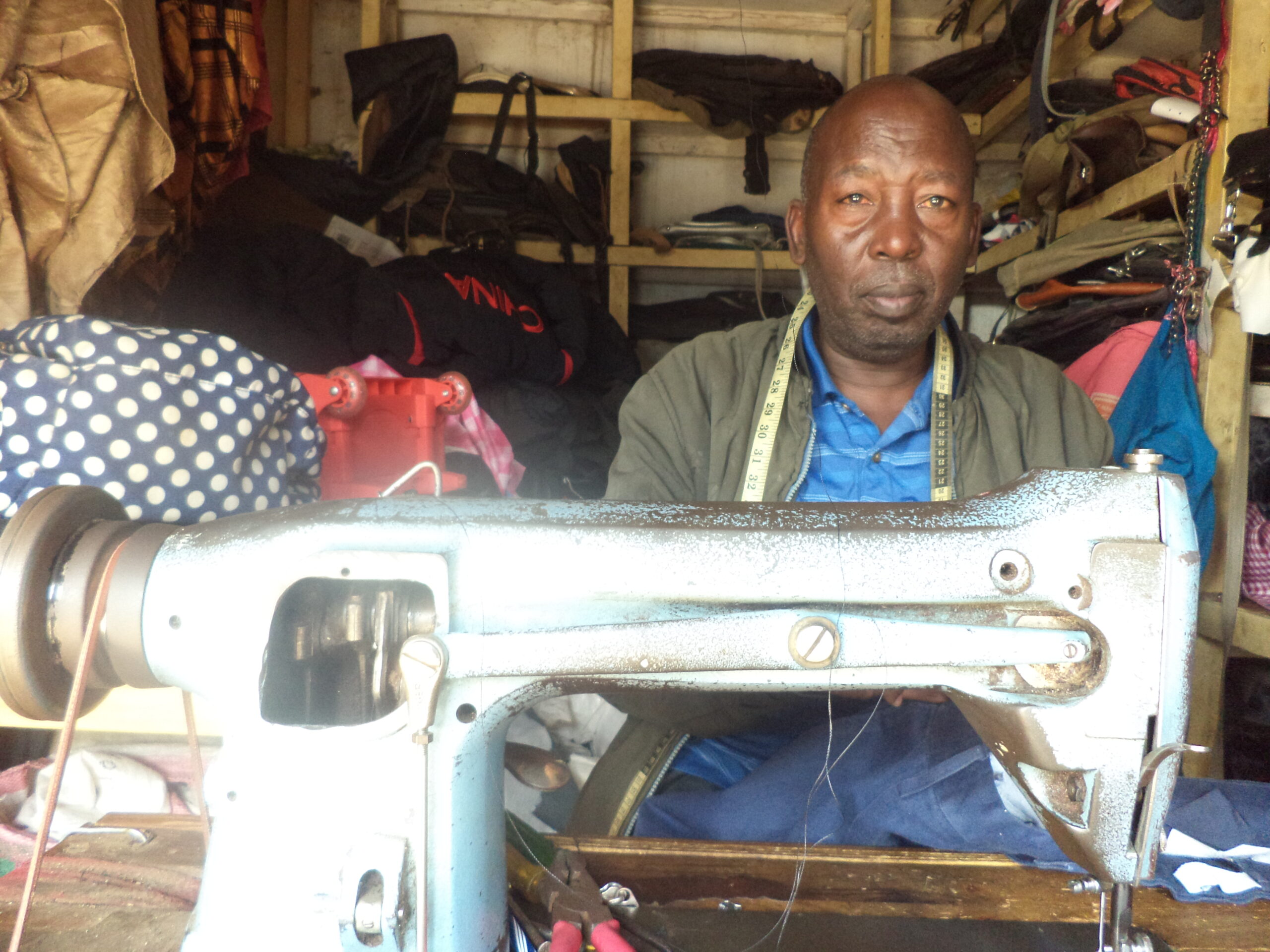
Peter Njigira Mathiangani, fondly known as “Fundi wa Bag,” is a celebrated tailor based in Eldama Ravine, Baringo County, renowned for repairing complex bags and zippers. Through sheer hard work and a single gifted sewing machine, Mathiangani educated three graduate teachers and a plumber, acquired land, and bought a light commercial vehicle.
Speaking in an exclusive interview with Education News, Mathiangani remains sceptical that Kenya’s Competency-Based Curriculum (CBC) will eradicate the obsession with white-collar jobs, arguing that the system misses the mark by burdening parents with heavy homework instead of sparking true hands-on genius.
Growing up in Nyeri’s Nyakahuho village, Peter Njigira Mathiangani, born in 1965, experienced firsthand the generational fallout of the fight against British colonialism. With his father constantly absent as an active Mau Mau freedom fighter, the family lacked the wealth required to keep him in school.
“My father was an active member of the Mau Mau movement, and for that reason, he was always absent from home and unable to create wealth that would see us complete our education. That is the reason I was forced to drop out of Karindi Secondary School in the year 1981,” Mathiangani recalled during an interview with Education News at Eldama Ravine.
Kwale parents urged to take greater responsibility in protecting children
Moving to Nairobi in search of survival, Mathiangani landed work at a busy Uhuru Market tailoring shop, mastering the basics of the trade. By 1988, he joined his brother Githongo in Nanyuki. Tasked with collecting payments, Mathiangani seized the opportunity to fix torn clothes, discovering his innate talent. He later earned renown across Eldama Ravine as “Fundi wa Bag” for his unmatched mastery of school bags and zippers — a skill so precise that kindergarten children know the exact route to his workshop. Despite village polytechnics offering him instructor roles, Mathiangani declined, noting that formal institutional compensation could never match the earnings of his private business.
Mathiangani’s fortunes soared when he met Mrs Rhoda at Uhuru Market, who engaged him in mass-producing school bags for Indian merchants. When the family later relocated, Mathiangani briefly pivoted to selling fruits at Kenyatta Market, serving prominent figures like former KNUT boss Ambrose Adongo and Senator Beth Mugo. In 2003, Mathiangani relocated to Eldama Ravine to practice farming under the reintroduced Shamba System. When his benefactors learned of his struggles, they kept a promise to gift him a sewing machine they had left behind in Kenya, personally bringing it to his new home in Maji Mazuri.
“The sewing machine has helped me produce three teachers in my household, all because someone saw potential in me and gifted me a sewing machine. The sewing machine also bought me a piece of land to settle my family and a light commercial vehicle, the one famously known as Probox,” Mathiangani shared with Education News.
Reflecting on Kenya’s educational landscape during the interview, Mathiangani shares deep views on what the real actualisation of CBC should look like. True CBC, he asserts, is about a student making a cupboard from scratch, crafting a giraffe carving from the soapstones of Kisii, or building a miniature fishing dhow in Kisumu. In his vision, such student competitions must progress right from the school, zone, division and county levels, all the way to the national level, where high-level government officials and international education stakeholders come to marvel at what young minds have achieved. The best students, he says, must take a photograph with the President and high-ranking education officers simply because they excelled in creativity and the work of their hands.
To breathe true life into CBC, Mathiangani believes that competitions must also entail mechanical students dismantling and reassembling a car engine under the watchful eyes of global automotive giants such as Toyota, Isuzu, and Nissan. For agriculture students, competitions must involve practical farm management to see which student produced the largest number of bags of maize, scaling right from the village level to the national stage.
Furthermore, Mathiangani champions national fashion competitions for tailors and cloth makers of his kind, to see who can mass-produce several shirts, trousers, or school bags within the shortest time possible, with the winning tailor taking a photograph with the Head of State and receiving a prestigious national award.
ICT Authority opens 400 slots for Digital Talent internship cohort XI
He also envisions polytechnics, village craft centres, and TVET institution graduation ceremonies being graced by the Head of State and nationally televised live. According to Mathiangani, live coverage of graduation ceremonies will ensure that young Kenyans have a positive view of polytechnics, while the presence of the Head of State during such graduation ceremonies will instil their importance, putting polytechnic students into the same league as university students, police officers, and Kenya Army recruits whose graduations are broadcast live throughout the country.
Right now, however, Mathiangani remains critical because current practices force parents to teach and help children with homework at home instead of letting students explore and solve problems through independent creativity, the exact way he mastered his craft without a formal teacher. He also expresses sorrow that none of his children wants to inherit his trade due to a persistent societal bias that views manual work as a path for failures in life. Drawing from his own journey, Mathiangani emphasises that Kenya’s primary barrier is not a lack of talent or knowledge, but a deficit of production infrastructure and tools, and that true reform means celebrating practical mastery on the highest national platforms.
By Jeremiah Chamakany
You can also follow our social media pages on Twitter: Education News KE and Facebook: Education News Newspaper for timely updates.
>>> Click here to stay up-to-date with trending regional stories
>>> Click here to read more informed opinions on the country’s education landscape
>> Click here to stay ahead with the latest national news.