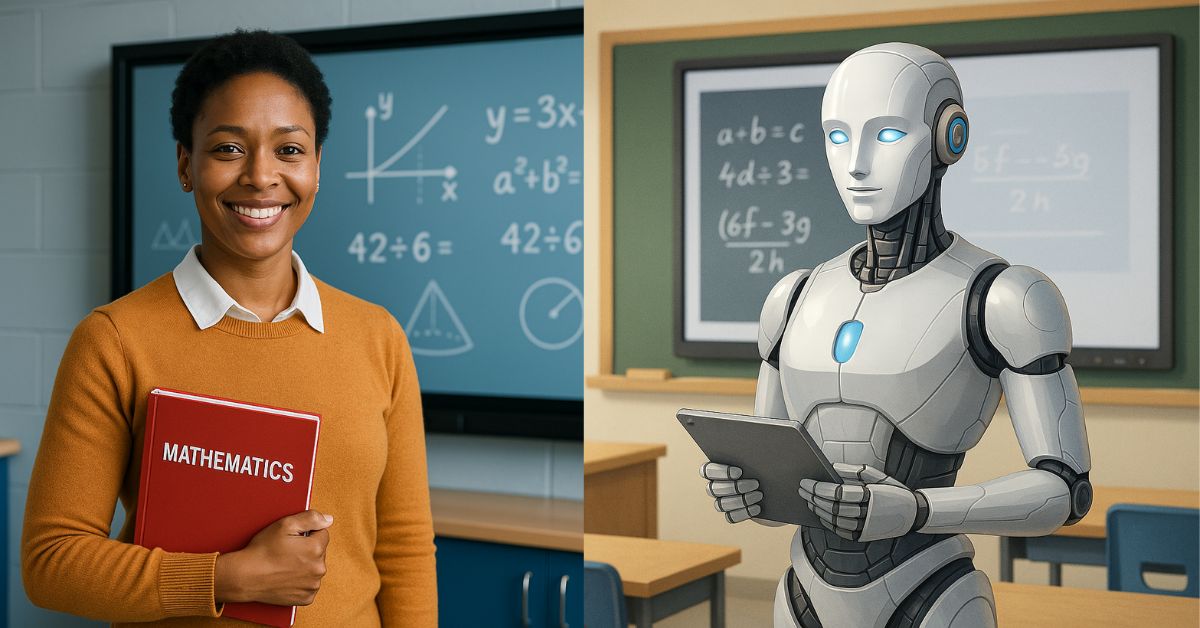
- The writer has argued that AI can process data and generate content, but teachers remain irreplaceable because they interpret the human story behind a learner’s performance.
- Muhalya has called for AI to augment rather than replace teachers, freeing them from administrative tasks to focus more on mentorship, judgement and character-building.
- Muhalya has also warned that unchecked reliance on AI-generated answers could weaken learners’ critical thinking, making the teacher’s guiding role more important, not less.
Artificial intelligence (AI) is rapidly transforming education, reshaping how teachers prepare lessons, assess learners, access information and respond to individual learning needs. Intelligent tutoring systems, automated assessment, personalised learning platforms and generative AI are creating possibilities that were unimaginable only a few years ago, raising an important question: what happens to the teacher when machines become exceptionally intelligent? The answer is neither complex nor purely technological.
The teacher remains indispensable because education is not simply about transferring information; it is about shaping human beings.
AI can generate content, analyse data, identify patterns and provide instant responses, but teaching requires empathy, professional judgement, mentorship, moral responsibility, emotional intelligence and the ability to recognise potential within a human being. The future of education should therefore not be defined by teachers competing with machines, but by teachers leveraging machines to become more effective.
Data shows performance; Teachers see the learner behind it
A learner’s academic performance can be represented through marks, grades, attendance records and assessment data, and AI can analyse these indicators with remarkable speed and accuracy. But behind every figure is a human story.
A learner who suddenly performs poorly may not have lost academic ability; they may be facing challenges at home, struggling with confidence, dealing with bullying or financial hardship, or simply losing motivation. A digital system can detect the decline, but only a teacher can ask what has changed, drawing on relationships built over time through observed facial expressions, body language, silence and shifts in behaviour that cannot be fully captured through data alone. The teacher does not merely see the score; the teacher sees the learner behind it.
This same human insight allows teachers to recognise potential before it becomes measurable. A learner who performs poorly in one subject may possess exceptional creativity, a quiet student may show strong leadership potential, and a child who struggles academically may demonstrate remarkable practical intelligence. While AI can only analyse existing information, teachers can envision possibilities not yet reflected in the data, which is why some of the most impactful educators are remembered not just for what they taught, but for the potential they helped uncover in learners others had overlooked.
Over 62,000 JSS teachers demand answers over delayed June ICT training allowances
Encouragement from a teacher carries a different weight
A machine can generate an encouraging message, but a teacher cultivates a relationship in which encouragement carries genuine meaning. When a teacher tells a struggling learner, “you can do this,” those words are grounded in sustained interaction — the teacher has observed the learner’s effort, understands their challenges, has witnessed their progress over time and knows when to challenge and when to encourage. This human authority is difficult for technology to replicate, and it explains why many adults can recall a teacher who changed the trajectory of their lives, whether through instruction, discipline, mentorship, or simply by refusing to give up on them.
Schools also exist to shape more than academically competent individuals; they play a critical role in forming responsible citizens. Teachers contribute to values such as honesty, discipline, empathy, perseverance, cooperation, respect and responsibility, largely through relationships and example rather than instruction alone. A teacher who demonstrates integrity teaches integrity, one who treats learners fairly teaches fairness, and one who responds to failure with resilience teaches resilience. AI can explain these values, but teachers embody them, and learners often remember what their teachers did long after they have forgotten what was written on a board.
The classroom still requires human judgement
A carefully prepared lesson plan can change within seconds — a concept may prove confusing, an unexpected question may arise, a conflict may develop, or a learner may suddenly become distressed. An effective teacher adapts in real time: adjusting pace, reframing explanations, introducing alternative examples, or pausing the lesson altogether. This professional judgement, developed through experience and continuous engagement with learners, is something AI can support but not exercise; the teacher remains responsible for interpreting the situation and determining the appropriate response. Experienced teachers also develop a form of professional intuition, sensing that something is not right in a classroom before anything is said, and eventually uncovering that a learner is facing a disagreement, difficulties at home, a loss of confidence, or bullying. Technology can collect behavioural data, but the teacher interprets the human reality behind it.
AI should free teachers to focus on what matters most
The greatest opportunity AI presents is not the replacement of teachers but the creation of more space for them to teach. Administrative tasks, lesson preparation, assessment analysis and routine content generation consume significant time, and AI can assist with many of these responsibilities — identifying learning gaps, preparing differentiated materials, generating practice exercises and organising information efficiently. Used responsibly, this can free teachers to dedicate more time to individual learners, mentorship, dialogue, creativity and problem-solving. The goal should be augmentation rather than substitution, with AI extending the teacher’s capacity rather than diminishing their presence.
Young people also learn significantly through observation, watching how teachers respond to pressure, interact with colleagues, keep commitments and respond to mistakes. A teacher’s daily conduct therefore becomes a powerful form of instruction in itself, modelling not just a subject but adulthood, responsibility and character in real life — a role AI cannot serve in the same way. This makes teacher professionalism especially important in the AI era, since as machines become more capable of delivering information, the human example set by teachers becomes even more significant.
The emergence of AI should therefore encourage education systems to invest more intentionally in teachers, equipping them with training in digital technologies, AI literacy, assessment, ethics and data protection, alongside the professional autonomy to determine where technology adds value and where direct human interaction is essential. Teachers also need adequate working conditions, since technology cannot compensate for an education system that undervalues its educators; a sophisticated digital platform placed in the hands of an unsupported teacher will not automatically produce quality education.
ALSO READ:
TSC to factor co-curricular activities into teacher career progression guidelines
Guarding against AI thinking about learners
AI also introduces a significant challenge: if learners can access instant answers, they may bypass the intellectual struggle through which deep learning develops. This makes the teacher’s role even more critical in equipping learners to question AI-generated information, verify claims, identify errors, think independently and use technology ethically. The goal is not to produce learners who simply know how to ask AI for answers, but to develop learners who understand which questions to ask, why those questions matter, and whether the answers they receive are valid — a form of critical thinking that remains a core responsibility of the teacher.
The most effective way to understand AI in education is not as a replacement for teachers but as a powerful partner: AI offers speed, teachers offer judgement; AI offers analytical capacity, teachers offer empathy; AI offers vast information, teachers offer context; AI can personalise content, teachers personalise relationships; AI can identify patterns, teachers interpret human behaviour. The strongest education systems will be those that integrate these complementary strengths rather than treating one as a substitute for the other.
PSC defends contributory pension transition, denies discriminatory dual-pension system
Artificial intelligence will continue to grow in capability, transforming classrooms, institutions and educational systems, and reshaping how teachers work and how learners learn. Yet education will remain fundamentally human because learners are human; they require knowledge but also encouragement, information but also wisdom, assessment but also understanding, instruction but also inspiration. Above all, they require someone capable of seeing beyond their current limitations, and that person is the teacher.
A teacher’s most meaningful impact may never appear in an examination report; it may be the learner who developed confidence because a teacher believed in them, the student who discovered a talent because an educator created an opportunity, or the future leader, scientist, entrepreneur or professional whose journey began with one teacher who recognised potential others overlooked. AI may become extraordinarily intelligent, but the teacher embodies a different and profoundly human form of intelligence: the ability to recognise potential, nurture character and inspire transformation. That is why the AI era should not signal the decline of the teacher; it should mark the beginning of an era in which technology handles routine tasks while teachers are empowered to focus more deeply on what only humans can do.
By Hillary Muhalya
You can also follow our social media pages on Twitter: Education News KE and Facebook: Education News Newspaper for timely updates.
>>> Click here to stay up-to-date with trending regional stories
>>> Click here to read more informed opinions on the country’s education landscape