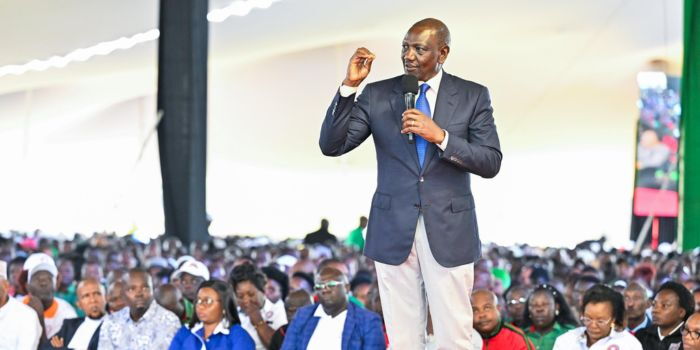
- The government’s decision to double teacher promotion funding from Sh1 billion to Sh2 billion has offered fresh hope to thousands of educators.
- However, the allocation may only reduce rather than eliminate the long-standing backlog of teachers awaiting career progression.
- The government now faces pressure to develop a properly funded, long-term strategy covering promotions, recruitment, interns, medical care and JSS staffing.
The decision to double teacher promotion funding is welcome, but it cannot be presented as a solution to a problem that is far bigger than the money currently placed on the table.
If thousands of teachers remain stagnant, the responsibility ultimately lies with the government, not the Teachers Service Commission (TSC).
President William Ruto’s decision to increase funding for teacher promotions from Sh1 billion to Sh2 billion is undoubtedly a step in the right direction.
But it would be premature to celebrate it as though Kenya has solved the teacher promotion crisis.
It has not.
The additional Sh1 billion may allow more teachers to move up the career ladder, but it does not answer the most fundamental question facing the profession: What happens to the thousands of qualified teachers who will remain outside the promotion list because the available money cannot accommodate them?
That is the uncomfortable question the government must confront.
The problem is not simply that teachers need promotions.
The problem is that Kenya has created a teaching workforce in which career advancement has, for years, been constrained by limited opportunities and limited funding.
And if the government genuinely wants to end that cycle, then Sh2 billion should be viewed as the beginning of the solution — not the solution itself.
It is easy to direct public frustration towards the Teachers Service Commission whenever teachers fail to secure promotions.
But that would miss the central issue.
TSC can identify teachers who qualify. It can develop promotion mechanisms. It can conduct interviews, evaluate candidates and process appointments.
What TSC cannot do is create money.
If the government allocates Sh2 billion for promotions, the Commission must operate within that financial ceiling.
It cannot simply decide that because 100,000 teachers qualify, it will spend Sh5 billion.
That is why blaming TSC for every promotion disappointment is misplaced.
The government controls the purse, and therefore the buck stops with government.
If the number of qualified teachers exceeds the number that can be supported by the available allocation, then the government must either accept continued stagnation or provide additional resources.
There is no administrative shortcut around that reality.
The government’s target of promoting 50,000 teachers is impressive when compared with the previous annual target.
But the question should not be whether 50,000 sounds like a large number.
The question should be whether it is enough.
If the teaching profession has a much larger pool of educators who have stagnated in their grades, promoting 50,000 teachers this year may only reduce the backlog rather than eliminate it.
And while those teachers are being promoted, another group will continue becoming eligible for advancement.
That means the backlog can reproduce itself.
Kenya could therefore find itself celebrating 50,000 promotions every year while still having tens of thousands of teachers waiting.
That is not a permanent solution.
It is backlog management.
Government must fund the problem it wants to solve
There is a simple principle that should guide the debate: policy without funding is only an aspiration.
If the government has determined that teacher stagnation is a problem, it must determine the financial cost of solving it.
If clearing the backlog requires more than Sh2 billion, then the government should provide more than Sh2 billion.
If the exercise must take several years, then the government should publish a credible multi-year financing plan.
Teachers deserve to know whether they have a realistic chance of promotion next year, in three years or in five years.
They should not have to wait for another presidential meeting before learning what the government intends to do.
The Treasury may understandably be concerned about the cost of promotions.
But that argument should be balanced against the cost of career stagnation.
A teacher who sees no meaningful professional progression may become demoralised.
A system that fails to reward additional qualifications can discourage professional development.
A workforce that feels undervalued may eventually lose motivation.
Promotions should therefore not be viewed merely as an increase in the government wage bill.
They should be regarded as an investment in retaining experienced professionals and strengthening the quality of education.
The question is not simply, “How much will promotions cost?”
It should also be: “How much does Kenya lose when experienced teachers feel that their careers have nowhere to go?”
The review of the Career Progression Guidelines provides an opportunity to address some of the structural weaknesses behind teacher stagnation.
But revised guidelines will achieve little if they are not backed by adequate funding.
A teacher can meet every professional requirement and still remain stagnant if there is no money to facilitate the corresponding promotion.
That is why the government must align the career structure with the budget.
There should be a direct relationship between qualification, experience, responsibility, promotion and remuneration.
If one link is missing, the system becomes frustrating.
Teachers should not be told that they qualify for advancement while simultaneously being informed that there is no money to promote them.
Promotions are part of a much bigger funding challenge
The promotion debate is also closely linked to the implementation of the 2025–2029 Collective Bargaining Agreement.
Teachers want the negotiated salary improvements implemented within the agreed framework and, where possible, faster.
But again, the same problem emerges.
Higher salaries require money.
Promotions require money.
Recruitment requires money.
Permanent employment requires money.
Medical cover requires money.
JSS expansion requires money.
Housing support requires money.
The government cannot negotiate commitments on one side and then provide insufficient resources on the other.
If the State enters into an agreement with teachers, it must budget realistically for the consequences of that agreement.
The demand for permanent employment for qualified teacher interns further demonstrates the scale of the challenge.
Thousands of young educators have entered schools through internship arrangements while unions continue demanding their absorption into permanent and pensionable employment.
There is a strong argument for providing qualified teachers with greater job security.
But permanent employment also comes with salaries, pension obligations and other employment costs.
Again, the solution lies with government financing.
The State must decide whether it wants to maintain a large pool of temporary teachers or progressively absorb qualified educators into a stable workforce.
Either choice has a cost.
But continuing indefinitely with temporary arrangements also has a cost — in morale, retention and professional confidence.
Junior Secondary School presents another example of why funding must accompany policy.
Kenya cannot successfully implement Competency-Based Education by simply changing the structure of education on paper.
JSS requires teachers, classrooms, laboratories, learning materials and administrative systems.
Teachers cannot be expected to carry an expanding education system without adequate resources.
If the government wants JSS to succeed, it must fund it properly.
Otherwise, the pressure will continue falling on teachers and schools that have little control over national budgetary decisions.
The same argument applies to teachers’ medical welfare.
A teacher who is sick or whose child requires treatment needs a functional medical system — not promises about future reforms.
The transition to SHA has made healthcare a significant concern for many public servants, including teachers.
Government must ensure that medical arrangements provide practical access to treatment and adequate protection for teachers and their dependants.
A teacher should not have to choose between seeking medical care and meeting basic household expenses.
Special Needs Education teachers also carry responsibilities that are fundamentally different from many conventional classroom assignments.
They work with learners requiring specialised interventions, individual attention and additional professional expertise.
Recognising their contribution through improved career progression is therefore justified.
But recognition must be accompanied by resources.
If the government creates a policy promising better grading or career advancement for specialised teachers, the necessary funds must follow.
Otherwise, the policy becomes symbolic rather than transformative.
Affordable housing is another area where the government’s intentions must be tested against implementation.
Teachers need houses they can actually afford — not merely allocations announced at conferences.
The programme must provide realistic financing arrangements, transparent eligibility criteria and accessible repayment structures.
Otherwise, affordable housing risks becoming affordable only in name.
Recruitment and promotion must be balanced
There is another danger that policymakers must avoid.
If the government concentrates exclusively on promotions, schools could face staffing gaps as teachers move into higher positions or retire.
If it concentrates exclusively on recruitment, experienced teachers may remain stagnant.
Kenya therefore needs a comprehensive workforce strategy.
The government must know how many teachers are required, how many are currently employed, how many are eligible for promotion, how many will retire, how many new teachers must be recruited and how much the entire system will cost.
Without that data-driven approach, teacher policy will continue to operate reactively.
Ultimately, the teacher promotion debate is not only about accounting.
It is about priorities.
Government budgets reflect choices.
If the country can identify resources for other national priorities, then it must also decide how much it is willing to invest in the people responsible for educating millions of Kenyan children.
Teachers cannot implement curriculum reforms, prepare learners for national assessments, mentor young people and manage increasingly complex classrooms while simultaneously fighting for basic professional recognition.
Investment in teachers is investment in education.
And investment in education is investment in Kenya’s future.
Sh2 billion must become a floor
The government should therefore resist the temptation to treat Sh2 billion as the final answer.
It should become the minimum foundation for a larger, multi-year strategy.
The allocation should be reviewed annually against the number of qualified teachers awaiting promotion.
Where the demand exceeds available funding, Treasury should increase the allocation.
Where the backlog is reducing, the government should maintain sufficient resources to prevent it from rebuilding.
That is how Kenya can move from managing the promotion problem to actually solving it.
At the end of the day, teachers will not judge the government by the size of its announcements.
They will judge it by their promotion letters.
They will judge it by their payslips.
They will judge it by whether interns are absorbed.
They will judge it by whether medical cover works.
They will judge it by whether JSS is properly staffed.
They will judge it by whether their retirement benefits arrive on time.
And they will judge it by whether additional qualifications actually translate into career growth.
That is the difference between policy and implementation.
The Sh2 billion promotion allocation is a positive development.
But if the government genuinely wants to end teacher stagnation, it must be prepared to go further.
TSC cannot solve a funding problem with administrative procedures.
Teachers cannot solve it through patience.
Unions cannot solve it through negotiations alone.
Only government can provide the financial foundation required to meet the scale of the demands.
The State has promised teachers a better career path.
Now it must finance that promise.
READ ALSO: Runda school land row raises alarm over protection of public education land
Because when the resources are insufficient, the responsibility cannot be pushed down to TSC.
The buck stops with government.
By Hillary Muhalya
You can also follow our social media pages on Twitter: Education News KE and Facebook: Education News Newspaper for timely updates.
>>> Click here to stay up-to-date with trending regional stories
>>> Click here to read more informed opinions on the country’s education landscape