
- Ibrahim Adan explores the remarkable transformation of NEP Girls High School through visionary leadership and strategic investment.
- The feature examines how infrastructure, partnerships and sound management have reshaped one of Northern Kenya’s oldest girls’ schools.
- It also highlights how sustained improvements are creating better learning opportunities while redefining educational excellence in the region.
Long before devolution redrew Kenya’s administrative map, North Eastern Province Girls’ Secondary School, known throughout the region as NEP Girls, carried a burden few institutions anywhere in the country have had to bear. It was the first girls’ school established to serve the whole of North Eastern Province, and it remains the only national girls’ school in Garissa County. For a generation of families across Garissa, Wajir and Mandera, it was not one option among several. It was the option.

That distinction cut two ways. It made NEP Girls a symbol of what was possible for a girl born where the odds of completing secondary school have historically been steep. It also meant the school absorbed a level of demand and a weight of expectation that no single institution can comfortably bear.
Today, the school sits on a campus that looks materially different from the one older alumnae would remember. Much of that change has come since 2023, under the current principal, Ahmed Aden Noor, and it has been less a single dramatic intervention than an accumulation.
Building for a school that outgrew itself
The most visible change is vertical. A three-storey dormitory with a capacity of 600 students now stands where the school’s bed shortage was most acute, in a boarding institution whose catchment stretches across three counties.
Alongside it, a modern library and dining hall, each with a capacity of 200 students, have given the school something it conspicuously lacked: places for students to be other than a classroom or a bed. Every classroom, dormitory and ablution block on the compound has been given a facelift.
The dormitory, library and dining hall were supported by the school’s alumni network together with the Constituencies Development Fund. Later work was financed internally through the board of management and the school administration—resources the school itself controls, directed towards capacity rather than running costs.
Water, in a place where water is the whole argument
In Garissa, a school’s water storage is not a footnote to its infrastructure. It is its infrastructure.
NEP Girls has moved from precarity to resilience in two stages. The first, supported by the alumni network and the Constituencies Development Fund, delivered a 50,000-litre steel overhead tank and five PVC tanks of 10,000 litres each. The second, undertaken through the board of management and the school administration, added two further 10,000-litre PVC overhead tanks and a 50,000-litre underground concrete reservoir. The school now holds about 170,000 litres of water, and the compound is connected to a piped water supply.
The mix matters. Overhead tanks deliver pressure without pumping, keeping taps and ablution blocks operational when power is unavailable. The underground reservoir stores a larger volume at a stable temperature, serving as the reserve of last resort. A school with one has storage; a school with both has resilience. In a county where dry-season water shortages are a recurring emergency, that resilience keeps several hundred boarders on campus rather than sending them home.
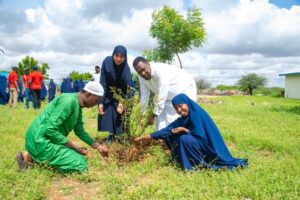
The same logic underpins the tree-planting programme, which has, over successive seasons, begun creating a microclimate on the compound, providing shade and ground cover in a place where neither comes naturally.
The parts that do not photograph well
Infrastructure is the easiest part of a school to point to. It is rarely the part that determines whether a girl completes Form Four.
The school has established a dispensary on site, a significant intervention in a boarding institution far from the referral facilities that urban schools often take for granted. It is particularly important for adolescent girls’ health. A guidance and counselling programme runs alongside it, and enrolment has risen.
The school has also achieved full compliance with national school safety standards during Noor’s tenure, a requirement that carries particular weight given the region’s security history.
A school that hosts
Some of the clearest evidence of what has changed is not a structure but an event.
In late March 2026, Garissa hosted the 62nd Kenya Science and Engineering Fair, the national STEM competition, for the first time since 2004. The week-long event drew students and teachers from across the country, with NEP Girls among the participating institutions alongside Garissa High School, where the opening ceremony was held. The school has also hosted regional music festivals, attracting adjudicators from well beyond the county.
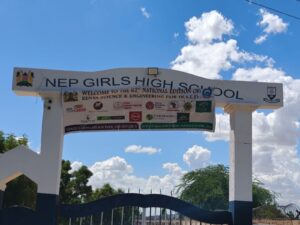
Hosting on that scale is its own kind of test. A participating school must accommodate visitors, feed and water them, provide sanitation, and meet the safety requirements that come with having large numbers of young people on one campus for days. Everything described above makes that possible. The hosting record is the practical proof of the wider investment, not a separate achievement alongside it.
At the fair, the school recorded the highest number of projects nationally, a result that speaks to the depth of its science teaching as much as the size of its entry. It also maintains a vibrant co-curricular programme across sport and the arts.
The significance was not lost on the Ministry of Education. Opening the fair, Basic Education Director General Elias Abdi described the event as a milestone for a region that had witnessed considerable growth in educational institutions and infrastructure. According to The Star, he said it would “open up the region” to learners arriving from elsewhere in Kenya. Hosting a national event of that scale, he added, demonstrated the region’s capacity and helped reshape perceptions of it.

That final point deserves emphasis. Garissa and the wider region remain largely defined, in the national conversation, by security concerns. It is only a partial picture, and one that a week of visiting students quietly challenges. Hundreds of learners and teachers travelled there, stayed for several days and returned home, many arriving with expectations shaped entirely by headlines. Few communication strategies achieve what such direct experience can
Technical fixes and adaptive work
Leadership scholarship, particularly the work of Ronald Heifetz and Marty Linsky, distinguishes technical problems from adaptive challenges. A technical problem has a known solution and yields to expertise and resources: a school short of beds needs a dormitory; one short of water needs storage tanks. An adaptive challenge has no solution on the shelf. It requires shifts in attitudes and behaviour and cannot be solved through procurement alone.
Much of what has happened at NEP Girls falls into the second category. Persuading families across a dispersed region that a daughter belongs in a boarding school far from home is adaptive work. So is building a culture in which girls remain in school through Form Four, and so is changing what the country assumes when it hears the name Garissa. None of these challenges was solved by the dormitory, though none could have been addressed without it.
The financing tells the same story. Adaptive leadership is characterised, in part, by giving the work back to those with a stake in it rather than carrying it alone. The rebuilding has drawn on the Constituencies Development Fund, an active alumni network and the board of management. That represents a distribution of ownership as much as of cost, and an institution rebuilt by several constituencies is more likely to be sustained by them. The technical achievements are visible and measurable; the adaptive ones are not. Yet it is usually the latter that determine whether the former endure.
What the numbers will say
| Year | Candidature (Entry) | KCSE Mean Score |
| 2023 | 85 | 7.20 |
| 2024 | 120 | 7.33 |
| 2025 | 109 | 7.40 |
KCSE candidature and mean score at NEP Girls, 2023–2025.
Why the buildings matter to the marks
It is tempting to treat infrastructure and academic performance as separate stories: the first a matter of budgets and the second of teaching. The research does not support that separation.
A 2019 World Bank synthesis by Peter Barrett and colleagues concluded that the physical condition of a school measurably affects how well children learn, with the strongest effects arising from basic adequacy: whether a school is safe and healthy, whether learning spaces are fit for purpose, and whether the environment supports rather than obstructs teaching.
The evidence is even stronger for girls. Reviews of school water, sanitation and hygiene provision, including work published by UNICEF and the WHO/UNICEF Joint Monitoring Programme, consistently associate reliable water and private, gender-appropriate sanitation with improved attendance and retention among adolescent girls, particularly in relation to menstrual hygiene management.
A 2025 study of Tanzanian schools, published in the Journal of Water, Sanitation and Hygiene for Development, found a strong link between gender-segregated toilets and girls remaining in school, while identifying year-round water availability as important in its own right.
Set against that body of evidence, the works at NEP Girls read less as a construction programme than as an academic intervention conducted in concrete and PVC. They are the conditions under which teaching can do its work. Whatever the mean score records, it has been built on that foundation.
A tenure worth marking
Ahmed Aden Noor took charge of NEP Girls in 2023. Any one of the achievements of the past three years—the dormitory, the expanded water reserve, the dispensary, compliance with school safety standards or hosting the national science fair—would represent a creditable return during a headship. Together, in a school carrying the expectations of an entire region, they represent an unusual concentration of effort and deserve to be recorded as such.
Institutions of this kind are rarely transformed by one person, and Noor has drawn in the alumni network, the Constituencies Development Fund and the board of management rather than attempting to work alone.
READ ALSO: Why schools need comprehensive employment contracts beyond appointment letters
But someone has to convene that effort and give it direction, and for the past three years that person has been the principal.
By Ibrahim Adan
By Ibrahim Hish Adan is a former TSC North Eastern Regional Director, education policy analyst and leadership commentator.
You can also follow our social media pages on Twitter: Education News KE and Facebook: Education News Newspaper for timely updates.
>>> Click here to stay up-to-date with trending regional stories
>>> Click here to read more informed opinions on the country’s education landscape