- AGC Tenwek Hospital has successfully performed Kenya’s first thoracoscopic repair of esophageal atresia with tracheoesophageal fistula on a newborn.
- The landmark surgery highlights the impact of advanced international specialist training on Kenya’s healthcare system.
- Six-day-old Baby Carline Bett has made a full recovery after the life-saving minimally invasive procedure.
Kenya has entered a new era of specialised paediatric healthcare after AGC Tenwek Hospital successfully performed the country’s first thoracoscopic (keyhole) repair of esophageal atresia with tracheoesophageal fistula (EA/TEF) on a newborn.
The landmark operation not only saved the life of Baby Carline Bett but also demonstrated how advanced international specialist training is strengthening Kenya’s capacity to deliver world-class healthcare locally.
At the centre of the historic achievement is Dr Daniel Tamirat Cherkos, whose advanced fellowship training in thoracoscopic paediatric surgery at Wilhelmina Children’s Hospital, UMC Utrecht, in the Netherlands equipped him with the expertise to perform the highly specialised procedure.
The skills acquired during the fellowship have now been translated into life-saving care in Kenya, significantly advancing the country’s ability to treat complex congenital conditions affecting newborns.
The groundbreaking surgery was performed on six-day-old Baby Carline Bett, who was born with esophageal atresia with tracheoesophageal fistula (EA/TEF), a rare and life-threatening congenital condition in which the oesophagus fails to connect properly to the stomach while part of it forms an abnormal connection with the windpipe.
Without urgent surgical intervention, newborns with the condition are unable to feed normally and face life-threatening complications, including aspiration pneumonia, severe malnutrition and death.
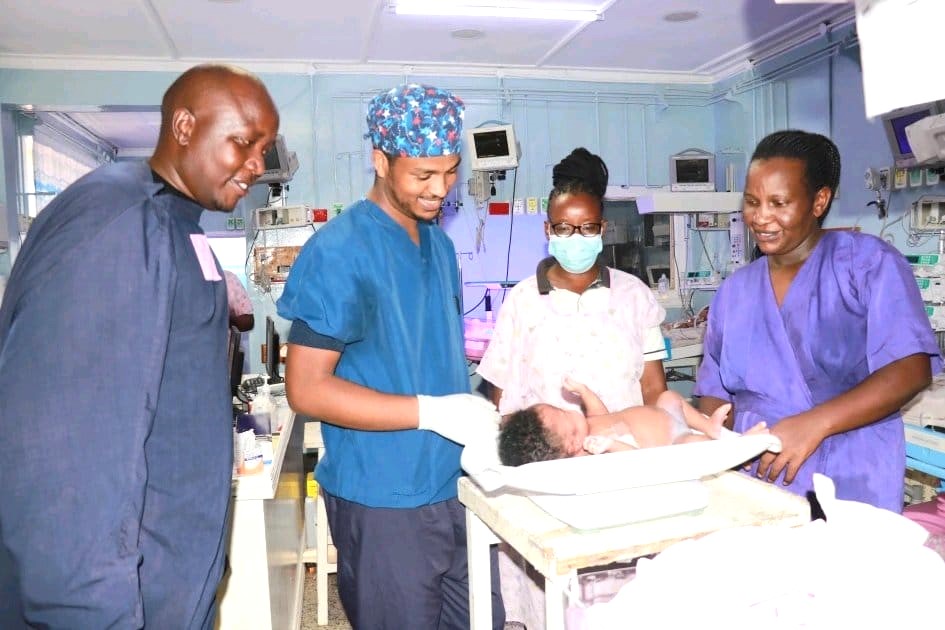
Following the successful minimally invasive procedure, Baby Carline made an excellent recovery and was discharged from AGC Tenwek Hospital feeding normally.
She is now the first child in Kenya to benefit from the advanced keyhole technique, placing the country among a select group of nations capable of performing the highly specialised paediatric operation.
Training transforming healthcare
For many years, children diagnosed with such complex conditions often required referral to specialised medical centres outside the country.
However, Dr Cherkos’ advanced fellowship in the Netherlands has enabled Kenya to perform the procedure locally, marking a major milestone in the transfer of specialist medical knowledge.
Unlike conventional open-chest surgery, thoracoscopic surgery is performed through tiny keyhole incisions using high-definition cameras and specialised instruments.
The minimally invasive approach reduces pain, minimises surgical trauma, lowers the risk of infection, shortens hospital stays and enables faster recovery while improving long-term outcomes.
Medical experts have described the operation as a significant leap forward for Kenya’s healthcare system, demonstrating that local hospitals can successfully undertake some of the world’s most technically demanding paediatric surgical procedures.
A race to save Baby Carline
Baby Carline was born on June 4 in Kericho County to Violah and Hillary Bett.
Soon after birth, doctors diagnosed her with Type C esophageal atresia—the most common form of the disorder—in which the upper portion of the oesophagus ends in a blind pouch while the lower section abnormally connects to the trachea.
The condition made feeding impossible and required immediate specialist intervention.
Recognising the severity of the case, clinicians at Kericho County Referral Hospital promptly referred the newborn to AGC Tenwek Hospital, where she was admitted on June 8 under the care of a multidisciplinary paediatric team.
The delicate operation brought together paediatric surgeons, anaesthetists, paediatricians, theatre nurses, neonatal intensive care specialists and other healthcare professionals whose coordinated expertise ensured the baby’s successful treatment and recovery.
‘A victory for teamwork’
Speaking after the operation, Dr Cherkos said the achievement reflected the strength of teamwork and Kenya’s growing specialist capacity.
“This achievement is not about one surgeon. It reflects the strength of a dedicated multidisciplinary team committed to giving every child the best chance at life. It also demonstrates that Kenya can provide world-class, minimally invasive paediatric surgery close to home,” he said.
His remarks reflect the broader transformation taking place in Kenya’s healthcare sector, where investment in specialist training abroad is translating into improved patient outcomes at home.
For Baby Carline’s parents, the successful surgery ended days of fear and uncertainty.
“When we arrived, I was so afraid because my baby could not feed. The doctors, nurses and everyone who cared for us gave us hope. Today, seeing my daughter recovering is a miracle. We thank God and the AGC Tenwek Hospital team for giving our baby a second chance at life,” said Violah Bett.
Her husband, Hillary Bett, praised the prompt referral by doctors at Kericho County Referral Hospital and the specialised care provided at Tenwek Hospital.
“Immediately after our daughter was born in Kericho, the doctors referred us to AGC Tenwek Hospital because they knew she would receive the best care. Looking at our daughter today, we know they made the right decision. We are forever grateful to the entire Tenwek team,” he said.
The family’s medical expenses were fully covered through the Social Health Authority (SHA) under the teachers’ medical scheme, highlighting the growing impact of universal health coverage in enabling access to advanced specialised treatment.
Positioning Kenya as a regional leader
AGC Tenwek Hospital also acknowledged the contribution of Wilhelmina Children’s Hospital, UMC Utrecht, whose fellowship programme equipped Dr Cherkos with the expertise that made Kenya’s first thoracoscopic repair of EA/TEF possible.
Hospital officials said the partnership demonstrates how international collaboration can strengthen local healthcare systems by building specialist capacity rather than exporting patients abroad.
The successful surgery is expected to pave the way for wider adoption of minimally invasive paediatric surgery across Kenya.
Beyond improving survival rates, the technique is expected to reduce treatment costs, shorten recovery periods and spare families the financial and emotional burden of seeking complex surgical care overseas.
READ ALSO: How candidates can access digital KCSE certificates and verify their credentials online
More importantly, the landmark procedure signals Kenya’s emergence as a regional centre for advanced paediatric surgery, demonstrating that investment in specialist training, modern technology and multidisciplinary teamwork can deliver world-class healthcare at home.
By Hillary Muhalya
You can also follow our social media pages on Twitter: Education News KE and Facebook: Education News Newspaper for timely updates.
>>> Click here to stay up-to-date with trending regional stories
>>> Click here to read more informed opinions on the country’s education landscape
>>> Click here to stay ahead with the latest national news.