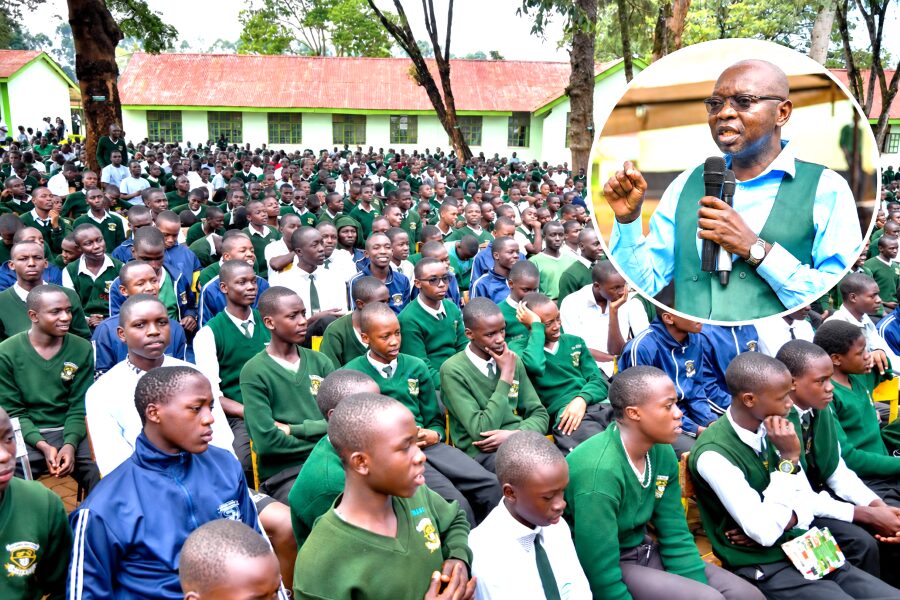
- Career educator Victor Ochieng’ explains the three Senior School pathways under the Competency-Based Education curriculum.
- He urges Grade 9 learners to align their subject choices with their career aspirations, abilities and interests.
- The opinion outlines opportunities under the Arts and Sports Science, Social Sciences and STEM pathways.
According to the Guidelines for Implementation of Senior School Education (2025), Senior School (SS) comprises 3 years of education (Grades 10-12). It is the next level after Junior School (Grades 7-9); marking the end of Basic Education. Senior School (SS) targets learners in the age bracket of 15 to 17 years. It is the stage for Specialisation, Pre-Career and Pre-University or College.
In case you are standing in front of people who are sitting in rows in a hall, and you yearn to walk to the back, the best way to do it, is to use the aisle, which is the prepared path. By the same token, learners joining Senior School in Grade 10 have the three Pathways that can lead them to their preferred professions or careers of choice at tertiary levels of education. Meaning, after Senior School, haply, it may not be possible to pursue a career that may not be in line with the pathway of choice. No wonder, learners should be visionary. For the 16th President of the United States (POTUS) Abraham Lincoln advised, “The best way to predict your future is to create it.”
Likewise, in The 7 Habits of Highly Effective People, Dr. Stephen Covey mentioned “having-an-in-mind” as one of the habits of highly effective people. Meaning, it is important to have a mental picture of the future. In that regard, according to Basic Education Curriculum Framework (2017), there are 3 Career Pathways available in Senior School (SS), which include: Arts and Sports Science, Social Sciences, and Science, Technology, Engineering and Mathematics (STEM).
- Arts and Sports Science Career Pathway
Foremost, Arts and Sports Science Career Pathway has two Tracks: Arts and Sports Science. Subjects in the Arts Track include: Music and Dance and Theatre and Film, and Fine Art. Subjects in the Sports Science Track include: Physical Education (PE), and Sports and Recreation. Somewhat, framers and architects of CBE envisioned that this Career Pathway is to take care of 15% of learners in Senior Schools. It is to nurture their talents, creativity and physical abilities. Learners that oft opt for Arts and Sports Science in Senior Schools, later can proceed to universities, colleges and conservatories; specialising in arts, music, dance, sports or related fields.
Ideally, this Career Pathway exposes learners to oodles of opportunities in the world of entertainment such as acting (thespian), music production, dance performance, choreography and media production. Career opportunities in the Arts Track include: Fine arts, graphic designs, fashion design, animation, film and media production, theatre, music performance and arts management. The Sports Track exposes learners to: Professional sports, sports coaching, teaching Physical Education (PE), sports management, fitness training and sports medicine.
- Social Sciences Career Pathway
Secondly, Social Sciences Career Pathway has two Tracks: Languages and Literature, and Humanities and Business Studies. Subjects in Languages and Literature Track include: Literature in English, Indigenous Languages, Sign Language (KSL), Fasihi ya Kiswahili, Arabic, French, German, Mandarin (Chinese). Subjects in Humanities and Business Studies Track include: Religious Education (CRE or IRE or HRE), Business Studies, History and Citizenship and Geography.
So, Social Sciences Pathway should take care of 25% of CBE learners in Senior Schools. This is the Career Pathway that assist learners to understand society, human behaviour and global issues or systems. This Career Pathway aligns learners for career opportunities in law, education, public administration, international relations, diplomacy, global issues, economics, social work, community development, counselling, social services, et cetera.
- STEM Career Pathway
Consequently, the STEM Career Pathway has three Tracks: Pure Sciences, Applied Sciences and Technical Studies. Subjects in the Pure Sciences Track include: Physics, Chemistry, Biology and General Science. Subjects in Applied Sciences Track include: Computer Science, Home Science and Agriculture. Then, Learning Areas in Technical Studies Track include: Aviation, Building Construction, Electricity, Metal Work, Power Mechanics, Woodwork, Media Technology and Marine and Fisheries Technology.
Actually, STEM Career Pathway should cater for 60% of CBE learners at Senior School. The Career Pathway is to equip learners with requisite knowledge, skills and competencies — they require to excel in scientific and technical disciplines. After Senior School, the Career Pathway of STEM will allow CBE learners to join institutions of higher learning and explore smorgasbord of opportunities in engineering, information technology, computer science, medicine, health sciences, environmental science and sustainability, data science and analytics, research and development in various scientific disciplines.
Advisedly, in the STEM Career Pathway should take the Core-Mathematics. Whereas those pursuing either Social Sciences and Arts and Sports Science Career Pathways should take Essential Mathematics. Albeit, it is instructive to note, a learner in a non-STEM Career Pathway may be permitted to do the Core-Mathematics so long as their Junior School (JS) assessment results depict ability. This is because learners aspiring to venture into professions such as accounting, actuarial science, banking, et cetera, should be strong in Mathematics. Withal, to the core learning areas, the learner should select 3 more subjects.
READ ALSO: One KCSE, four different journeys: Are we testing ability or privilege?
Finally, according to the August, 8, 2025 Ministry of Education (MoE) circular titled Implementation of the Competency-Based Education (CBC) at Senior School, learners should take at least 2 subjects from the chosen Career Pathway. Meaning, a learner may take up to 3 more subjects from the chosen Career Pathway. Or take 2 subjects from the chosen Career Pathway and 1 subject from another Career Pathway. Choice of subjects abuts on learners’ abilities, aptitude, career choice, interests and personalities. This is should be anchored on good guidance and advice by the leadership of the Senior Schools. It is also important to the robust support of career counsellors, career educators and career specialists.
By Victor Ochieng’
Victor Ochieng’ is a Career Educator. He rolls out career talks and training services. He guides students on how to make informed career choices. vochieng.90@gmail.com. 0704420232
You can also follow our social media pages on Twitter: Education News KE and Facebook: Education News Newspaper for timely updates.
>>> Click here to stay up-to-date with trending regional stories
>>> Click here to read more informed opinions on the country’s education landscape
>>> Click here to stay ahead with the latest national news.