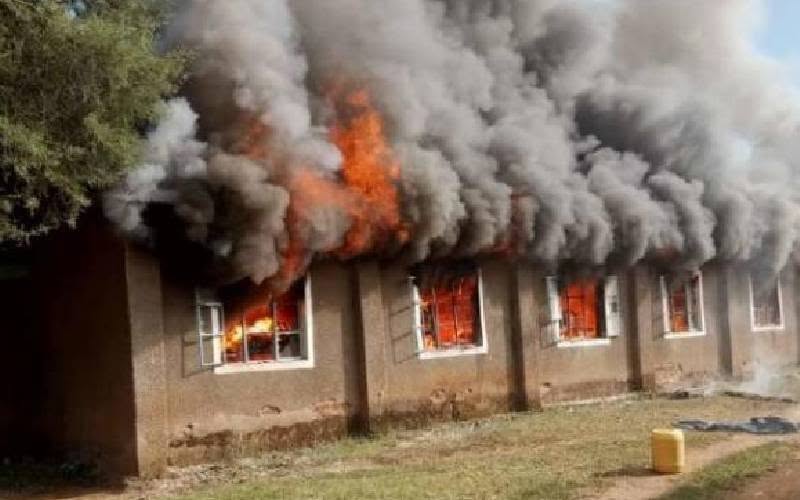
A deeply worrying pattern is unfolding across Kenya’s educational landscape. Hardly a day passes without distressing reports of another school fire—dormitories engulfed in flames, classrooms reduced to charcoal, laboratories ruined, and administrative blocks left in ashes.
What initially appeared to be isolated incidents of student indiscipline has rapidly mutated into a critical national crisis that threatens the stability of our education sector, diverts scarce public resources, and directly endangers the lives of our children. As stakeholders grapple with this trend, a timeless African proverb warns, “When you see the rain beating your neighbour, remember that it may soon beat you.” More pointedly, we must urgently ask another fundamental question: “Where did the rain start beating us?” Until we address that question with absolute honesty, we will remain trapped in a reactionary cycle of extinguishing physical flames without ever diagnosing the structural sparks that ignite them.
The government’s recent decision to establish a dedicated task force to investigate the root causes of these fires is both timely and highly commendable. This institutional intervention presents a rare opportunity not merely to penalise individual acts of arson, but to comprehensively examine the complex social, psychological, and institutional vulnerabilities driving this behavioural epidemic. The answers will undoubtedly be complex, matching the multifaceted nature of the crisis itself. While it remains tempting to scapegoat learners as the sole perpetrators, schools do not exist in a vacuum; they operate as microscopic mirrors of the wider society. The toxic values, unaddressed conflicts, and destructive behaviours witnessed outside the school gates inevitably find their way into classrooms and dormitories.
ALSO READ:
Massive fire razes boys’ dormitory at St. Maurice Mwira High School in Matungu
The Psychological and Digital Landscape
This systemic transmission of behaviour is deeply anchored in the work of psychologist Albert Bandura. His Social Learning Theory posits that young people develop behaviours primarily by observing and modelling the actions of influential figures around them. Today’s learners are constantly immersed in a digital ecosystem where destructive defiance can be sensationalised, viralized, and even celebrated on social media platforms. Concurrently, they watch the adult world resolve socioeconomic and political disagreements through confrontational, often destructive means. While there is no definitive empirical evidence showing that social media or the macro-political climate directly triggers arson, these external forces undeniably warp how some young minds perceive conflict resolution, protest, and accountability. This subtle cognitive conditioning deserves rigorous academic examination rather than dismissive condemnation.
This behavioural reality directly intersects with Abraham Maslow’s Hierarchy of Needs, which reminds us that unfulfilled emotional and psychological needs heavily dictate human action. Recognising these underlying frustrations does not excuse criminal acts like arson; rather, it empowers us to preemptively diagnose institutional friction before it manifests as catastrophic destruction. Public discussion has rightly raised questions regarding intense examination pressure, reported cases of exam malpractice, chaotic leadership transitions following the transfer or retirement of principals, and changing lifestyle expectations among modern learners. While none of these factors should automatically be labelled as standalone causes, they deserve careful, data-driven research because complex problems rarely yield simple explanations.
Reinforcing the Foundations of Home and School
Parents remain the foundational architects of human character. While schools can reinforce ethical boundaries, they can never fully replace the moral infrastructure of a stable home. Values such as respect for human life, personal responsibility, emotional self-control, and systemic accountability must be deliberately cultivated long before a child steps into a secondary school compound. Parents must transition from passive observers to proactive anchors, creating domestic safe spaces where adolescents can openly unpack academic anxiety, peer pressures, and internal emotional turbulence. Crucially, this requires active digital stewardship—monitoring the online content that silently shapes adolescent psychology.
Internally, our institutional systems must brave uncomfortable audits. Do our learners genuinely feel heard, or are we running rigid, hyper-bureaucratic silos? When formal communication networks collapse, structural frustration naturally seeks destructive outlets. Schools must urgently build robust, trusted pathways for grievance expression, including functional student councils, regular open-dialogue forums, and responsive suggestion boxes that receive genuine administrative action. When effective peer counselling programs are active, the feeling of collective helplessness drops significantly.
Consequently, guidance and counselling departments must be repositioned at the very centre of daily school operations. Early adolescence is a period of intense neurological and psychological upheaval. Learners require empathetic professionals capable of identifying early behavioural warning signs and providing timely psychological triage. Counselling cannot remain a dormant department that is only activated in the wake of a tragedy. The Teachers Service Commission (TSC) bears a monumental mandate here to continuously equip frontline educators with advanced competencies in adolescent psychology, restorative discipline, conflict mediation, and emotional intelligence. While academic excellence remains our primary benchmark, today’s classrooms desperately require teachers who can decode the complex emotional realities of contemporary youth.
ALSO READ:
Faith Odhiambo calls for urgent action as school riots escalate nationwide
A Framework for Restorative Leadership
School administrators also carry an immense operational burden. Institutions caught in repetitive cycles of unrest must conduct thorough autopsies of their internal safety protocols, communication networks, and overall institutional culture. Effective school leadership is never rooted in absolute intimidation; rather, it harmonises firm, unwavering discipline with humane, transparent engagement. As leadership expert John C. Maxwell wisely observed:
“Small disciplines repeated with consistency every day lead to great achievements gained slowly over time.”
A safe school environment is manufactured through the daily, consistent practice of mutual trust, institutional equity, and shared responsibility among learners and adults alike.
This holistic approach is heavily reinforced by both scriptural wisdom and cultural values. Scripture in James 1:19 urges us to be “quick to listen, slow to speak, and slow to become angry,” while Proverbs 22:6 reminds society to “train up a child in the way he should go, and when he is old he will not depart from it.” These are not merely abstract religious concepts; they serve as practical, enduring blueprints for sustainable parenting, empathetic leadership, and resilient nation-building. Every school facility reduced to ashes represents a tragic disruption of learning and a direct threat to young lives whose potential should be protected at all costs.
This dark moment calls for a profound national reflection that transcends mere arrests and criminal prosecutions. Policymakers must fund and support preventive, trauma-informed programs just as aggressively as they enforce punitive measures. Learners themselves must recognise that individual rights are structurally inseparable from civic responsibilities, and that destroying educational facilities ultimately sabotages opportunities for their own generation. Kenya has historically overcome deep systemic challenges because its people chose dialogue over division and collective responsibility over blame. The current wave of school fires must become our turning point—a moment when we actively recommit to raising a generation that values discipline, peaceful engagement, and respect for public institutions. The flames that have consumed our schools must not be allowed to consume our national hope.
By Astiba Kebongo
You can also follow our social media pages on Twitter: Education News KE and Facebook: Education News Newspaper for timely updates.
>>> Click here to stay up-to-date with trending regional stories
>>> Click here to read more informed opinions on the country’s education landscape
>>> Click here to stay ahead with the latest national news.