- The Ministry of Education (MoE) has directed all public basic education institutions to submit their electrification status through an online data collection exercise.
- Schools are required to provide registration details, location information and their current electricity connectivity status.
- Education officials say the exercise will support national planning for school electrification and digital learning infrastructure.
The Ministry of Education (MoE) has launched a nationwide data collection exercise requiring all public basic education institutions to submit information on their electricity connectivity as part of efforts to strengthen infrastructure planning across the education sector.
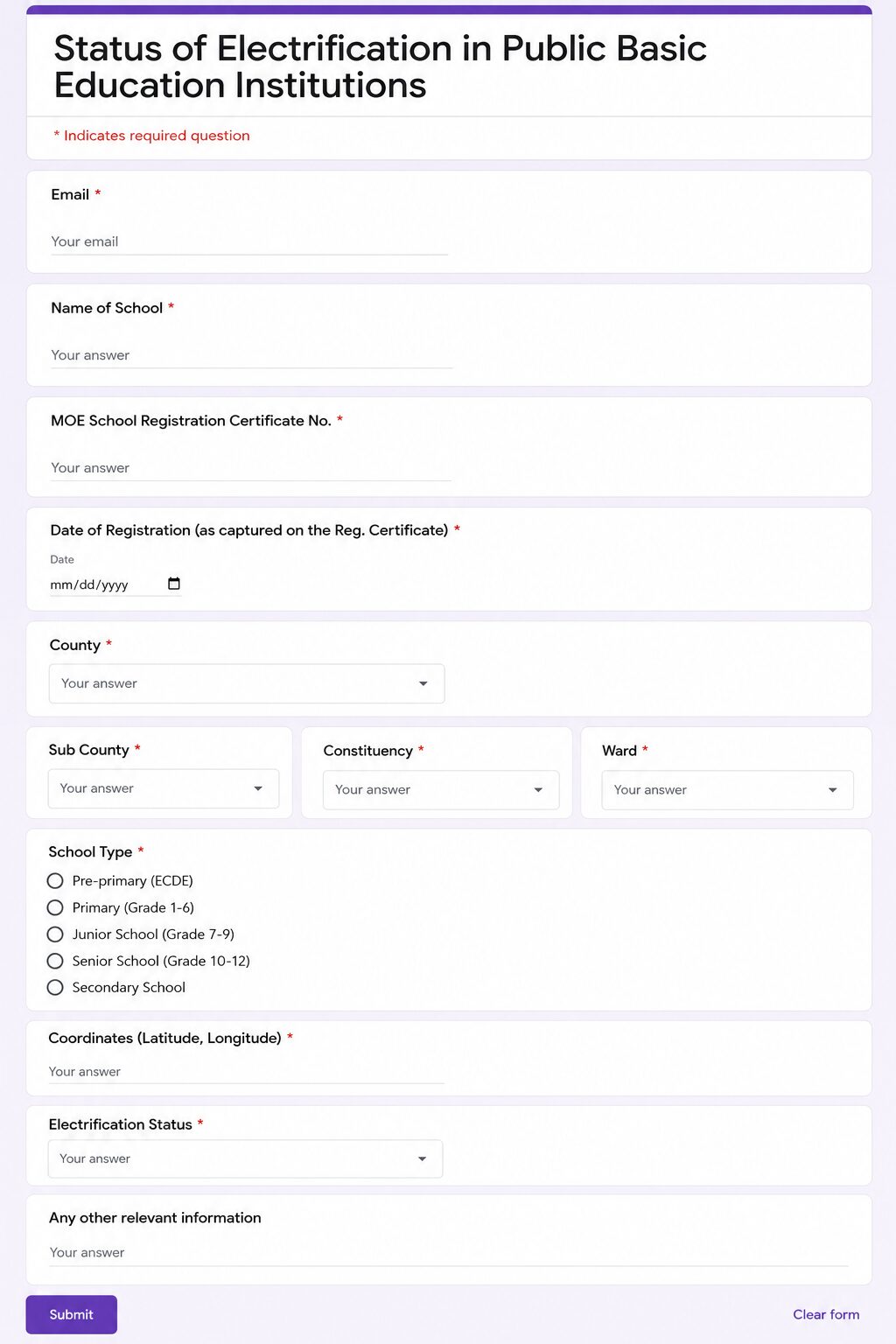
Headteachers and principals have been directed to complete an online questionnaire capturing the electrification status of their institutions alongside key registration and location details.
The exercise targets all categories of public basic education institutions, including Early Childhood Development Education (ECDE) centres, primary schools, junior schools, senior schools and secondary schools.
Among the information required are the school’s official name, Ministry of Education registration certificate number, registration date, county, sub-county, constituency, ward, school category, geographical coordinates (latitude and longitude), current electrification status and any other relevant information.
Education officials said the information will support planning for electricity connectivity and infrastructure development in learning institutions across the country.
Schools urged to comply
County and Sub-county Directors of Education have been instructed to ensure every public basic education institution under their jurisdiction completes the exercise within the stipulated timelines.
School heads have been urged to treat the exercise as a priority and submit accurate information to facilitate effective national planning.
The Ministry has also directed all public basic education institutions to complete the online electrification status form within the prescribed period.
Education officers have appealed to county, sub-county and zonal administrators to follow up with schools to ensure full compliance so that no institution is omitted from the national database.
Supporting digital learning
Reliable electricity has become increasingly important as Kenya expands the implementation of Competency-Based Education (CBE), the Digital Literacy Programme (DLP) and Information and Communication Technology (ICT)-supported learning.
Electrification enables schools to power computer laboratories, smart classrooms, internet connectivity, lighting systems, science laboratories, administrative operations and school security infrastructure.
Government policy continues to prioritise electricity and ICT infrastructure in learning institutions, particularly in underserved and remote areas. Through the Rural Electrification Programme, public institutions, including schools, remain priority beneficiaries for both grid and off-grid solar connectivity.
READ ALSO: Inside Kenya’s digital classroom revolution: Why powerful EdTech partnerships could define the future of CBE
Studies on Kenya’s school electrification programme indicate that electricity access has expanded considerably over the past decade, with both grid and solar installations improving school operations, learner retention and academic outcomes, particularly in marginalised regions.
By Joseph Mambili
You can also follow our social media pages on Twitter: Education News KE and Facebook: Education News Newspaper for timely updates.
>>> Click here to stay up-to-date with trending regional stories
>>> Click here to read more informed opinions on the country’s education landscape