-
Nigeria is proposing to abolish the separation between Junior Secondary School (JSS) and Senior Secondary School (SSS) is therefore more than a structural adjustment.
-
It is arguing that the current arrangement has created unnecessary transition points that contribute significantly to learner dropout.
-
The move depicts a clear sign that Kenya is on the right track, only with few flaws to polish for the success of the CBE sytem.
An education system succeeds not by the number of children who enrol in school but by the number who complete it. When millions of learners disappear between one level of education and the next, the problem is no longer individual failure—it is systemic failure.
Nigeria’s proposal to abolish the separation between Junior Secondary School (JSS) and Senior Secondary School (SSS) is therefore more than a structural adjustment. It is a recognition that the current arrangement has created unnecessary transition points that contribute significantly to learner dropout.
Nigeria’s Minister of Education, Tunji Alausa, has acknowledged this reality by proposing the merger of JSS and SSS into one uninterrupted six-year secondary education cycle.
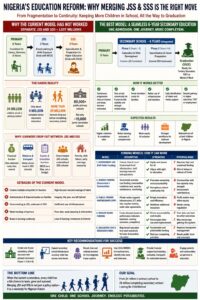
Speaking during the inauguration of the Ministerial Implementation and Monitoring Committee of the Universal Basic Education Commission (UBEC), the minister argued that the proposal, which will be presented to the National Council on Education, is intended to improve learner retention and reverse the country’s alarming dropout rates. His proposal reflects an important shift in educational thinking: schools should be organised around keeping learners in education rather than creating institutional barriers that push them out.
Under the existing structure, children spend six years in primary school before proceeding to three years of Junior Secondary School and another three years of Senior Secondary School. Educationally, the arrangement appears logical.
Primary school provides literacy, numeracy and foundational life skills. Junior Secondary broadens learners’ knowledge while exposing them to science, technology, business, agriculture, creative arts and vocational education. Senior Secondary allows learners to specialise according to their academic strengths and career aspirations before progressing to higher education or the labour market.
ALSO READ:
KMTC students to face costly academic repeat after failing supplementary exams
The difficulty lies not in the curriculum but in the transition between these stages. Junior Secondary was never intended to be a terminal level of education. It was designed as the first phase of a continuous secondary education programme.
Yet the requirement to move from JSS to SSS has become one of the biggest points of educational leakage. New admissions, examinations, additional expenses, transport challenges and limited places in senior secondary schools have combined to make progression difficult for millions of learners.
The statistics paint a sobering picture. About 24 million children enrol in primary schools, yet only around four million eventually complete senior secondary education. More than 20 million learners fail to reach the end of the secondary cycle. These numbers suggest that the separation between JSS and SSS has become an administrative obstacle rather than an educational advantage.
Infrastructure further compounds the challenge. Nigeria has over 80,000 public primary schools but only about 15,000 junior secondary schools. The imbalance creates congestion at lower levels and disrupts the smooth movement of learners through the system. Every bottleneck increases the likelihood that disadvantaged children will leave school permanently.
The government has already begun strengthening education management through the Learner Identification Number (LIN), which assigns every learner a permanent academic identity, and the Digital National Education Management Information System (DNEMIS), which will enable authorities to monitor enrolment, attendance and dropout patterns.
ALSO READ:
Daniel Cheruiyot takes over as Chepalungu Sub-County Education Director
These reforms provide valuable tools for improving accountability, but they will have their greatest impact when combined with a school structure that promotes continuous progression.
The most workable solution is not merely to merge JSS and SSS administratively but to establish one continuous six-year secondary school in which learners are admitted once after primary education and remain in the same institution until graduation.
Within that six-year programme, the first three years should retain the exploratory curriculum currently offered in Junior Secondary, while the final three years should focus on academic, technical and vocational specialisation. Internal assessments should guide learners’ subject choices and career pathways without becoming barriers to progression.
Equally important, government should expand secondary school infrastructure, recruit and train more teachers, strengthen guidance and counselling services, and ensure that no learner is forced to abandon school because of financial hardship. Data systems such as LIN and DNEMIS should be used to identify students at risk of dropping out so that timely interventions can be made before they leave the education system.
Ultimately, education systems should remove barriers rather than create them. Primary education, Junior Secondary and Senior Secondary should function as successive phases of one uninterrupted learning journey.
A child who successfully completes primary school should have a guaranteed pathway through six years of secondary education without facing avoidable institutional hurdles. If Nigeria implements this vision effectively, it will not simply be merging schools—it will be restoring continuity to the educational journey and giving millions more children a realistic opportunity to complete their education.
By Hillary Muhalya
You can also follow our social media pages on Twitter: Education News KE and Facebook: Education News Newspaper for timely updates.
>>> Click here to stay up-to-date with trending regional stories
>>> Click here to read more informed opinions on the country’s education landscape