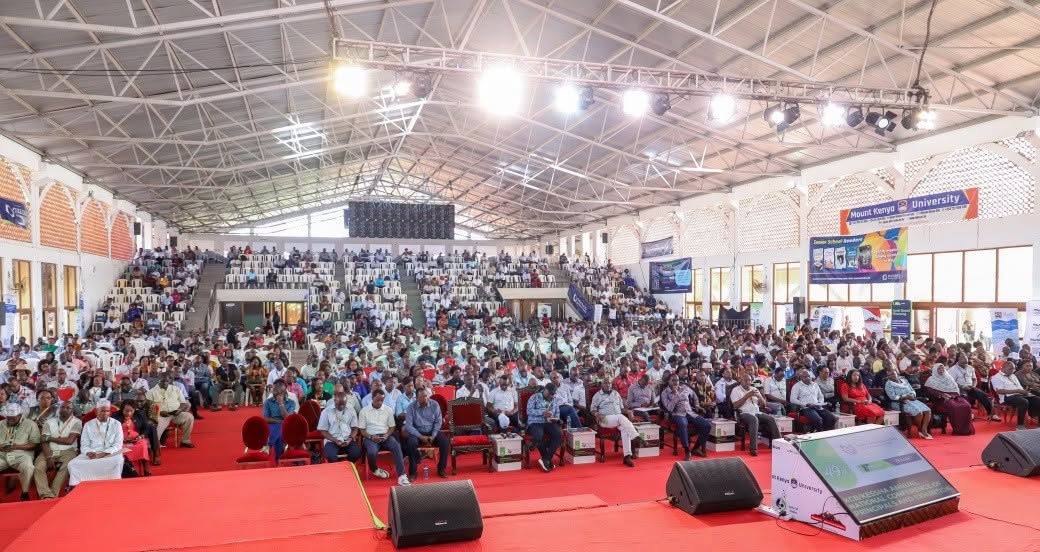
- More than 7,000 secondary school principals gathered in Mombasa to chart the future of Kenya’s education sector as the Competency-Based Education curriculum enters its implementation phase.
- The conference highlighted the need for greater investment in infrastructure, teacher preparedness, school leadership and education financing.
- Education stakeholders agreed that effective collaboration will determine the successful implementation of Senior School under the Competency-Based Education system.
The 49th Kenya Secondary School Heads Association (KESSHA) National Conference, held at PrideInn Paradise Beach Resort in Mombasa, will undoubtedly be remembered as one of the most significant gatherings in Kenya’s education sector. Far more than an annual meeting of school principals, it served as a national platform for education leaders to reflect on the current state of secondary education and outline a bold vision for its future.
Taking place at a time when Kenya is implementing the Competency-Based Education (CBE) curriculum and preparing for the transition to Senior School, the conference carried profound implications for principals, teachers, learners, parents and policymakers.
For five days, Mombasa became the centre of Kenya’s education discourse as more than 7,000 secondary school principals from across the country convened to deliberate on the challenges, opportunities and responsibilities ahead. Their presence underscored the pivotal role principals continue to play in shaping the nation’s future through education.
The conference brought together an impressive range of national leaders and education stakeholders. Education Cabinet Secretary Julius Migos Ogamba officially opened the event and reaffirmed the Government’s commitment to advancing education reforms. He was joined by Basic Education Principal Secretary Prof. Julius Bitok, who outlined the Ministry’s plans to ensure schools are adequately prepared for the implementation of Competency-Based Education.
The Teachers Service Commission was represented by Commissioner Evelyn Mitei, who engaged principals on teacher management, staffing, promotions, professional development and the Commission’s continued support during the curriculum transition. Also present were senior officials from the Kenya Institute of Curriculum Development (KICD), the Kenya National Examinations Council (KNEC), the Kenya Universities and Colleges Central Placement Service (KUCCPS), the Commission for University Education (CUE), development partners, university scholars, publishers, ICT firms, financial institutions and organisations supporting educational advancement.
One of the conference’s defining features was the rare opportunity it offered principals to engage directly with policymakers responsible for decisions affecting schools. Rather than relying solely on circulars, school heads interacted face-to-face with government officials, sought clarification on emerging reforms and shared practical experiences from institutions across the country. This direct engagement strengthened collaboration between policymakers and those implementing education reforms.
From policy to implementation
Unlike previous conferences that largely focused on introducing Competency-Based Education, the 49th edition shifted attention to implementation. Kenya is now entering one of the most critical phases of education reform as learners prepare to transition into Grade 10 under the Senior School structure. Consequently, discussions moved beyond policy to practical strategies for ensuring a smooth transition.
Throughout the conference, one message remained clear: the success of Competency-Based Education will depend largely on the preparedness of secondary schools and the quality of leadership provided by principals. School heads were reminded that they are no longer merely administrators overseeing examinations and discipline. They are strategic leaders, innovators, mentors, resource mobilisers and change managers entrusted with guiding one of the most consequential reforms in Kenya’s education history.
Delegates agreed that Competency-Based Education represents a decisive shift from an examination-centred system to one that equips learners with practical competencies, creativity, innovation, collaboration, communication, critical thinking and problem-solving skills. The objective is to nurture learners capable of thriving in an increasingly dynamic and technology-driven world.
Investing in infrastructure
Schools’ preparedness for Grade 10 pathways featured prominently throughout the conference. While delegates acknowledged the progress made so far, many institutions still require substantial investment before they can fully implement the curriculum.
Science laboratories, engineering workshops, agriculture demonstration farms, ICT laboratories, creative arts studios, technical workshops and innovation hubs were identified as essential learning facilities under Competency-Based Education.
Delegates observed that successful implementation cannot rely solely on curriculum documents or policy guidelines. Schools require modern infrastructure where learners can apply knowledge through experiments, projects and practical learning experiences relevant to the contemporary labour market.
Infrastructure development therefore emerged as one of the conference’s highest priorities. Principals appealed to both national and county governments, development partners and local communities to accelerate investment in classrooms, dormitories, libraries, sanitation facilities, sports complexes and specialised learning spaces capable of supporting learner-centred instruction.
Financing education reforms
Education financing also generated extensive discussion. School heads expressed concern over delayed capitation and rising operational costs that continue to strain institutional budgets. Increasing prices of food, electricity, transport, maintenance and learning materials have significantly raised the cost of managing schools.
Delegates urged the Government to ensure timely and adequate release of capitation funds to enable institutions to implement programmes without unnecessary financial constraints.
Teacher preparedness emerged as another central theme. Participants unanimously agreed that no curriculum reform can succeed without competent, motivated and adequately supported teachers. Continuous professional development was identified as a critical pillar of Competency-Based Education, with principals recommending regular in-service training on learner-centred pedagogies, competency-based assessment, technology integration and innovative instructional approaches.
Teacher staffing also remained a major concern. Many principals reported persistent shortages, particularly in science, mathematics, technical and vocational subjects, and appealed to the Teachers Service Commission to continue recruiting teachers while ensuring equitable deployment.
Career progression was equally emphasised, with delegates noting that transparent promotion processes improve motivation, morale and institutional performance. Mentorship programmes were also encouraged to prepare younger teachers for future leadership roles.
Leadership itself formed another major pillar of the conference. Delegates observed that the responsibilities of principals have expanded significantly over the years. Modern school leaders are expected to be strategic planners, financial managers, communicators, innovators, mentors, counsellors and institutional visionaries capable of leading schools through continuous transformation.
Participants further emphasised ethical leadership, urging principals to uphold integrity, accountability, transparency and professionalism in school management. Proper utilisation of public resources, prudent financial management and participatory decision-making were identified as essential foundations for effective educational leadership.
READ ALSO: CS Ogamba urges school principals to strengthen career guidance programmes
The conference also reaffirmed the importance of collaborative leadership. Delegates agreed that sustainable educational transformation cannot be achieved by principals working in isolation. Instead, schools perform best when teachers, Boards of Management, parents, learners, communities, development partners and government agencies work together towards shared goals.
By Hillary Muhalya
You can also follow our social media pages on Twitter: Education News KE and Facebook: Education News Newspaper for timely updates.
>>> Click here to stay up-to-date with trending regional stories
>>> Click here to read more informed opinions on the country’s education landscape