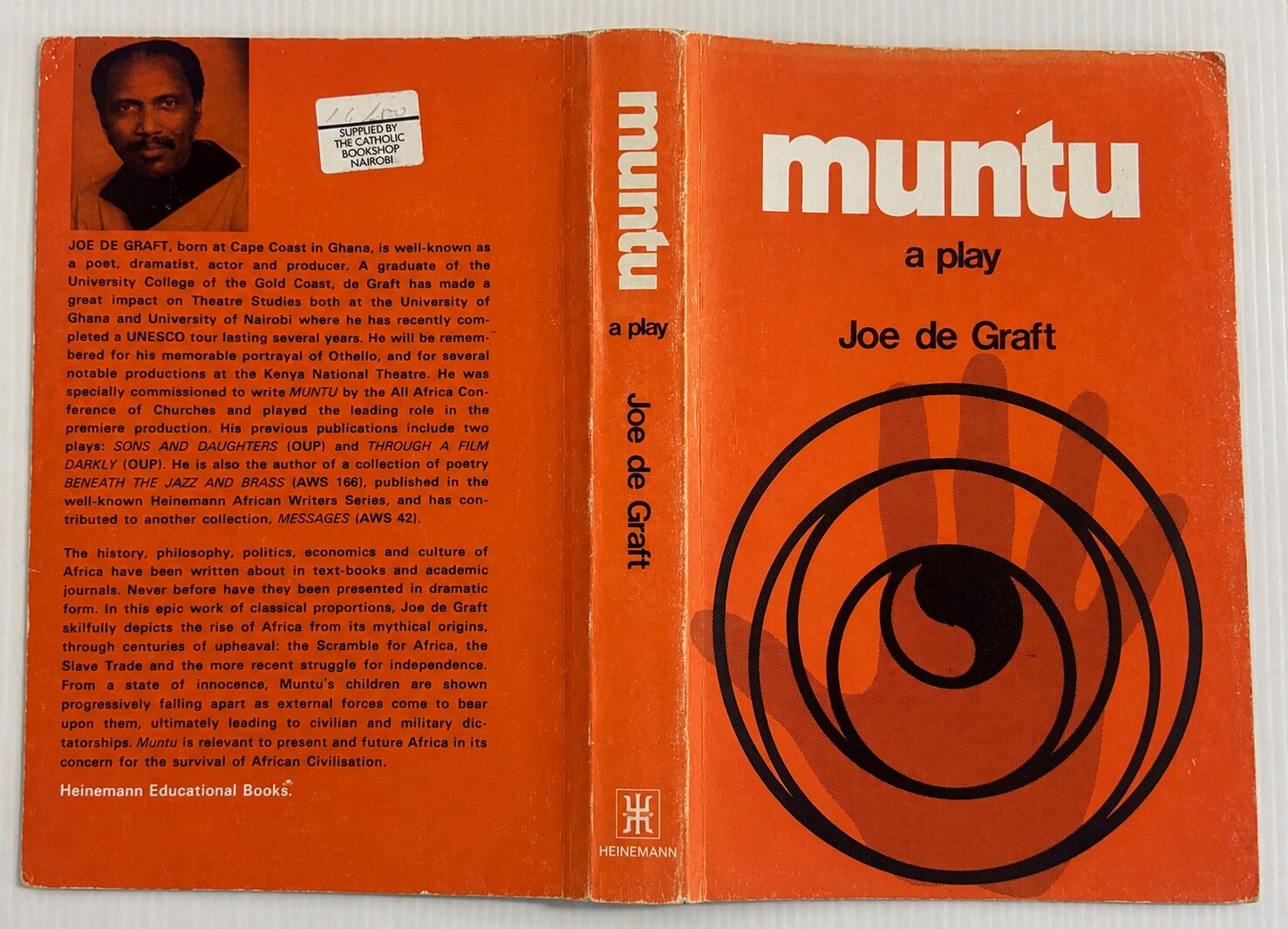
Enock Okong’o examines how Joe de Graft’s play Muntu reflects Kenya’s current political transition, leadership struggles, and questions of governance after Raila Odinga.
Joe de Graft’s play Muntu is a work that speaks directly to Kenya’s current political moment, especially following the death of Raila Odinga in October 2025.
The play, written in 1977, explores the tension between tradition and modern values in an African society, while questioning what happens when leadership becomes rigid and disconnected from the humanity it is meant to serve.
Its central idea, drawn from the Bantu concept of muntu or personhood, is that leadership should protect and enhance human dignity rather than sacrifice it for power, custom, or personal gain.
That question has become increasingly urgent in Kenya as the country adjusts to the end of an era defined by Raila’s political presence.
For more than three decades, Raila Odinga shaped the rhythm of Kenyan opposition politics.
He was imprisoned, exiled, and ran for president five times, becoming a symbol of resistance and reform for millions.
His authority held together ODM and the wider opposition, often determining when to confront the government, negotiate, or retreat.
Following his death in India on October 15, 2025, that unifying force weakened considerably.
The vacuum became visible during ODM’s 20th anniversary celebrations, where what should have been a commemorative event turned into public disputes over who had legitimacy to sustain Raila’s political arrangements.
In Muntu, de Graft warns against precisely such moments, where rigid attachment to personalities and old structures prevents the emergence of humane and effective leadership.
The play’s relevance lies in how it exposes the cost of leadership that values power over people.
Through its characters and dialogue, Muntu demonstrates how customs and poor leadership can harm communities when change is resisted.
De Graft does not reject tradition, but insists that tradition must serve people.
Kenya now faces a similar test.
Raila’s political career was marked by sacrifice and a willingness to pursue peaceful reconciliation without abandoning his core values, as noted by Barack Obama in his tribute.
Yet the scramble for his political base after his death reveals the danger of reducing politics to the preservation of political machinery rather than service to citizens.
The play therefore asks whether those stepping into the space left by Raila will cultivate muntu — a sense of shared humanity and responsibility — or deepen division and self-interest.
Muntu also speaks to the need to balance cultural identity with progress.
De Graft roots the play in African oral tradition through songs, drums, and communal performance, but its message remains forward-looking.
He belonged to a generation of African intellectuals in the 1970s who sought to reassert cultural identity after colonial disruption without retreating into rigid conservatism.
Kenya now stands at a similar crossroads.
Raila represented one of Africa’s second-generation left-of-centre, pan-African politicians who linked national politics to broader questions of dignity and self-determination.
His exit symbolically closes that chapter, and the challenge now is to define what comes next without losing sight of national identity and shared purpose.
A politics focused only on fighting over Raila’s legacy risks missing the opportunity to address the deeper issues of governance, inequality, and accountability.
Finally, the play’s emphasis on peace, unity, and sacrificial leadership resonates strongly with Kenya’s current uncertainty.
Muntu suggests that good leadership must be peace-loving, firm, and willing to place community interests above personal ambition.
President William Ruto acknowledged this when he observed that Raila’s political strength mattered significantly to Kenyan democracy and that ODM should not be alienated.
However, without Raila’s personal influence, the opposition appears to be struggling to maintain cohesion ahead of the 2027 elections.
The play reminds Kenyans that succession is not simply about inheriting a name or political structure.
It is about whether the next generation of leaders will embody the values of muntu — accountability, humility, and commitment to the common good.
In this sense, reading Muntu today becomes more than an academic exercise.
READ ALSO: The Samaritan: A bold Kenyan play that pits tech-driven justice against corrupt power
The play holds up a mirror to Kenya’s politics during a period of transition and asks a direct question: will the country repeat the cycle of personality-driven political struggles, or will it use this moment to renew a politics grounded in human dignity and collective purpose?
For students, citizens, and leaders alike, that question makes de Graft’s work urgently relevant.
By Enock Okong’o
You can also follow our social media pages on Twitter: Education News KE and Facebook: Education News Newspaper for timely updates.
>>> Click here to stay up-to-date with trending regional stories
>>> Click here to read more informed opinions on the country’s education landscape