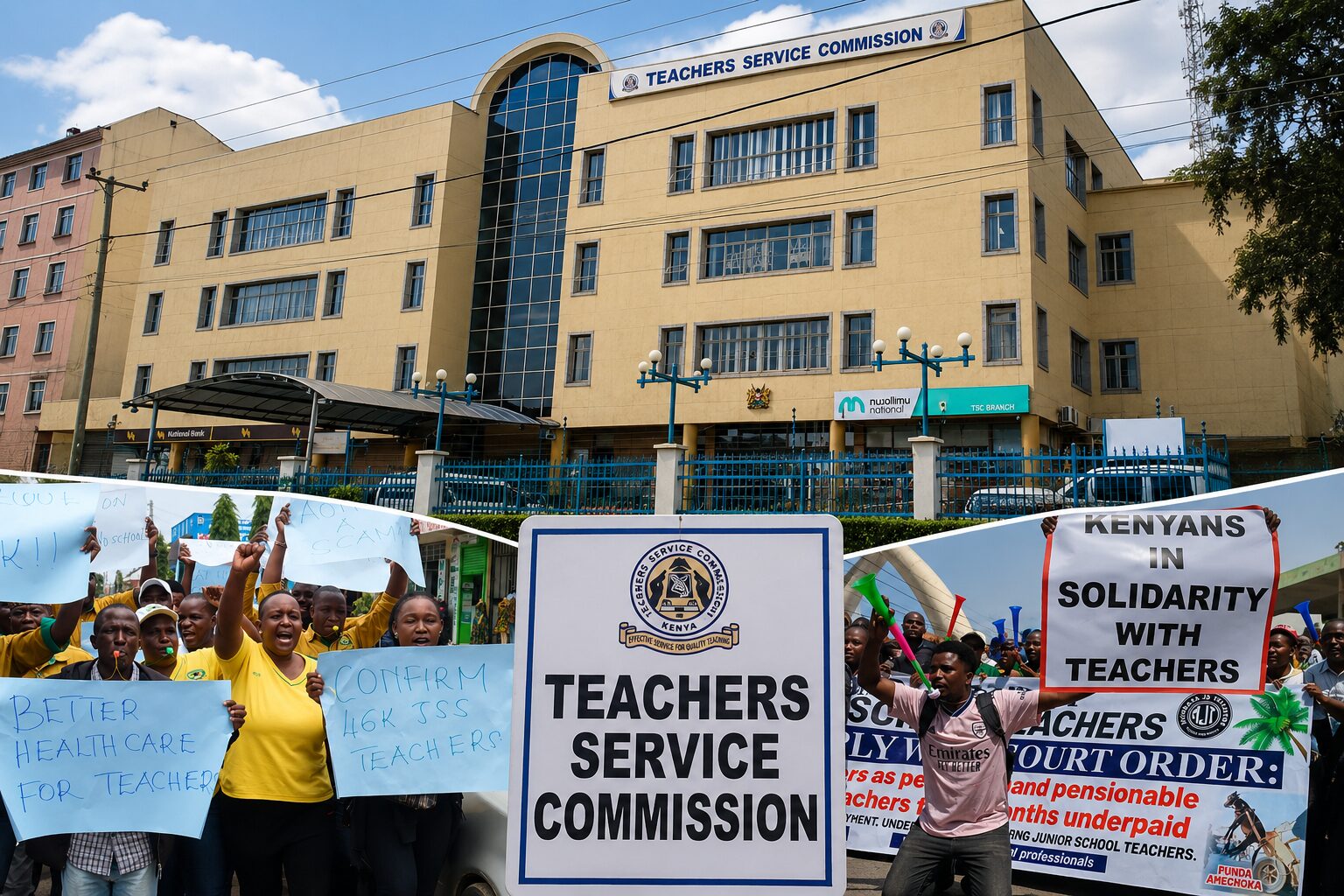
The leadership tensions emerging within the Junior Secondary School (JSS) framework are not accidental administrative inconveniences, nor are they isolated misunderstandings confined to individual schools.
They are visible symptoms of a deeper structural misalignment within Kenya’s basic education system—one that, if not urgently and rationally addressed, risks hardening into long-term institutional instability. Under the reforms being implemented by the Teachers Service Commission, the education system has expanded in ambition and scope, but its internal leadership architecture has not fully kept pace with the rapid transition from the long-established 8-4-4 structure to the Competency-Based Education (CBE) framework.
At the centre of the tension lies a difficult institutional reality: the integration of primary school leadership structures, newly created JSS administrative roles, and existing secondary school hierarchies has produced overlapping job groups whose authority lines are no longer consistently clear in practice. What should ideally be a seamless continuum of professional progression has instead become a patchwork of transitional designations where titles, job groups, departmental responsibilities, and institutional authority do not always align in a predictable or universally understood manner.
This is why situations are now emerging where a teacher promoted within the system and deployed to JSS as a Senior Master appears, in practical school governance terms, to operate alongside or even below officers occupying deputy headteacher positions in primary schools. The contradiction is not necessarily legal in intent, but it is structurally confusing in effect. It raises a fundamental question that is increasingly difficult to ignore: in a unified basic education system, why should leadership authority appear inverted depending on school category?
The problem becomes even more pronounced when serving headteachers or senior educators are redeployed into JSS under transitional designations such as Senior Master or related roles. In formal grading terms, their career progression remains intact and recognised. However, in institutional practice, their authority may appear compressed, diluted, or inconsistently interpreted when compared with substantive leadership positions in primary schools. This creates a growing perception that professional advancement and institutional authority are no longer moving in alignment, but instead running on parallel and sometimes conflicting tracks.
It is important to state clearly that under the framework of the Teachers Service Commission, job group grading does not automatically translate into universal administrative superiority across all school categories. Grading reflects career progression and remuneration structure, while deployment determines institutional function. However, when deployment frameworks differ significantly across school categories, the separation between grade and authority becomes blurred in lived school reality, even if it remains conceptually clear in policy documents.
This is where the current system reveals its greatest vulnerability. Schools are not abstract administrative units; they are living institutions that depend on clearly defined chains of command. Teachers require clarity on reporting structures, learners depend on consistent leadership direction, and parents expect identifiable authority figures who are accountable for institutional outcomes. When these structures vary between primary schools and JSS—even within the same locality—it introduces uncertainty into decision-making processes, weakens accountability, and undermines professional confidence.
The situation, therefore, cannot be dismissed as a temporary administrative inconvenience. It is more accurately described as a structural time bomb within education governance, not because collapse is imminent, but because gradual erosion is already underway. That erosion manifests in declining clarity of roles, increasing institutional friction, inconsistent perceptions of authority, and growing uncertainty around promotion pathways. Over time, these factors can weaken morale and create systemic fatigue within the teaching profession.
A rational examination of this challenge must begin with a clear acknowledgement: JSS is a newly inserted institutional layer within an existing education architecture. This intermediate structure was introduced to support curriculum reform under CBE, but it was not accompanied by a fully synchronised redesign of leadership hierarchies across primary, junior, and secondary levels. As a result, the system now operates with overlapping frameworks that were not originally designed to function together in a unified manner.
The first step toward resolving this structural tension is to distinguish clearly between substantive promotion and deployment designation. Much of the confusion currently observed in schools arises from the assumption that deployment titles represent permanent rank positions. In reality, they are functional assignments within a transitional system. Without consistent communication and standardised equivalence mapping across school categories, this misunderstanding will continue generating perceived contradictions between primary and JSS leadership structures.
The second step is a careful and honest evaluation of whether current grading structures accurately reflect actual institutional responsibility. Where JSS headteachers are managing full school operations—including staff coordination, learner discipline, curriculum implementation, resource management, and accountability frameworks—yet remain placed at relatively lower job groups such as C5, a structural question inevitably arises. Does the current grading system fully reflect the complexity and weight of the responsibilities being exercised at the school level? In many cases, there is a compelling argument that headship responsibility should align more logically with higher administrative equivalence, given the demands of managing a rapidly evolving education environment.
However, leadership structure alone is not sufficient to ensure the successful implementation of CBE. A second, equally critical dimension lies in the internal academic organisation of schools. Without strong departmental structures, curriculum implementation becomes fragmented, inconsistent, and overly dependent on individual teacher interpretation and effort rather than institutional coordination and oversight.
This is why the strengthening of academic departments is not optional but fundamental to system success. Key departments such as Sciences, Mathematics, Languages, Humanities, Technical and Applied Sciences, ICT, Guidance and Counselling, Games and Physical Education, and Career Guidance form the operational backbone of Competency-Based Education. Each of these departments plays a distinct role in shaping learner development, ensuring consistency in instruction, and maintaining academic standards across institutions.
The Sciences Department, for instance, must ensure structured progression in Physics, Chemistry, and Biology, supporting laboratory competence, inquiry-based learning, and conceptual development. The Mathematics Department must anchor logical reasoning, problem-solving skills, and numerical literacy, ensuring progression across grade levels. The Languages Department plays a foundational role in communication competence, comprehension skills, and literacy development, which underpin all other learning areas.
The Humanities Department contributes to civic understanding, ethical reasoning, and contextual awareness of society, shaping learners’ identity and social responsibility. The Technical and Applied Sciences Department is central to practical skill development, entrepreneurship orientation, and applied learning outcomes that reflect the vocational dimension of CBE. The ICT Department supports digital literacy and integration of technology into teaching and learning processes, which are increasingly essential in modern education systems.
Equally important are the Guidance and Counselling Department, the Games and Physical Education Department, and the Career Guidance Department, which together support holistic learner development beyond academics. The Guidance and Counselling function provides psychosocial support, discipline management, and emotional well-being structures necessary for adolescent learners navigating transition. The Games Department builds physical literacy, teamwork, discipline, resilience, and talent identification as part of structured competency development rather than informal co-curricular activity.
The Career Guidance Department is particularly central to the philosophy of CBE, which is fundamentally pathway-oriented rather than examination-driven. Learners are expected to make informed decisions about subjects and career directions based on evolving competencies and interests. This requires structured, continuous guidance beginning at the JSS level and extending through senior school transition points. Without such a department, learners risk making uninformed choices, leading to misalignment at later stages of education progression.
At present, however, many of these departments remain either underdeveloped or informally structured. This gap does not remain confined within JSS. It extends upward into senior school levels, where institutions are already experiencing increasing pressure at Grade 10 transition points. When learners arrive without consistent competency mapping, subject orientation, or structured career guidance, senior schools are forced to address foundational gaps that should have been systematically developed earlier in the education pathway.
This creates a cascading effect: weak departmentalisation in JSS leads to inconsistent competency development, which then manifests as transition strain at the senior school level. The system is therefore interconnected, and weaknesses in one layer inevitably surface in the next. This reinforces the argument that structural reform must address both leadership alignment and departmental strengthening simultaneously.
Within this context, it is also essential to recognise a practical reality often overlooked in policy discussions: even in the absence of fully formalised departmental structures, serving JSS teachers are already performing many of these roles informally. They coordinate subject areas, support colleagues, guide learners, manage co-curricular activities, and provide stability in environments still undergoing institutional adjustment. In effect, they are already functioning as de facto departmental anchors within schools.
It is therefore a matter of both fairness and operational necessity that these teachers be recognised, supported, and formally empowered to act within these key departmental roles. Where structures are still evolving, professional capacity must temporarily bridge institutional gaps. However, this should not remain informal indefinitely. It must evolve into a properly structured system where responsibilities are clearly defined, supported, and institutionally recognised.
At the same time, it must be clearly understood that the success of CBE is not a contest between institutions, cadres, or professional groupings. Teachers’ unions and professional associations play a critical and legitimate role in safeguarding teacher welfare, protecting professional dignity, and ensuring fair labour practices. However, during this transition period, their engagement must remain firmly anchored on a shared national objective: the successful implementation of CBE in classrooms.
This is not a political contest for membership influence, institutional dominance, or organisational visibility. It is a national education reform effort whose success or failure will affect every teacher, learner, and institution equally. If the discourse becomes dominated by competition rather than collaboration, the system risks losing sight of its central purpose: effective learning delivery for all learners across the country.
The real challenge is therefore not institutional rivalry but system coherence. The priority must be alignment—alignment of leadership structures, departmental systems, grading frameworks, and classroom realities with policy intentions. Without this alignment, reform remains theoretical. With it, reform becomes functional.
Ultimately, the stability of JSS depends on two parallel and inseparable reforms. The first is rational alignment of leadership structures across primary, JSS, and secondary levels so that rank, role, and responsibility are clearly defined and consistently applied. The second is the full institutionalisation of strong academic departments that provide the structural backbone for CBE implementation at the school level.
In essence, what is required is not fragmentation or rivalry, but deliberate harmonisation. The Teachers Service Commission must be supported to guide this alignment process in a structured, phased, and rational manner so that institutional clarity is achieved without destabilising ongoing implementation.
READ ALSO: Why TSC and teachers are worlds apart on the quest for JSS autonomy
Without this dual alignment, inconsistencies will continue to deepen and risk becoming permanent structural contradictions within the education system. With it, however, Kenya’s education system can achieve a rare but necessary equilibrium where rank, role, departmental structure, and classroom reality finally operate in harmony.
This is therefore a moment not for rivalry, but for restraint; not for competition, but for coordination; and not for fragmentation, but for structured reform in service of learners and national educational goals.
By Hillary Muhalya
You can also follow our social media pages on Twitter: Education News KE and Facebook: Education News Newspaper for timely updates.
>>> Click here to stay up-to-date with trending regional stories
>>> Click here to read more informed opinions on the country’s education landscape