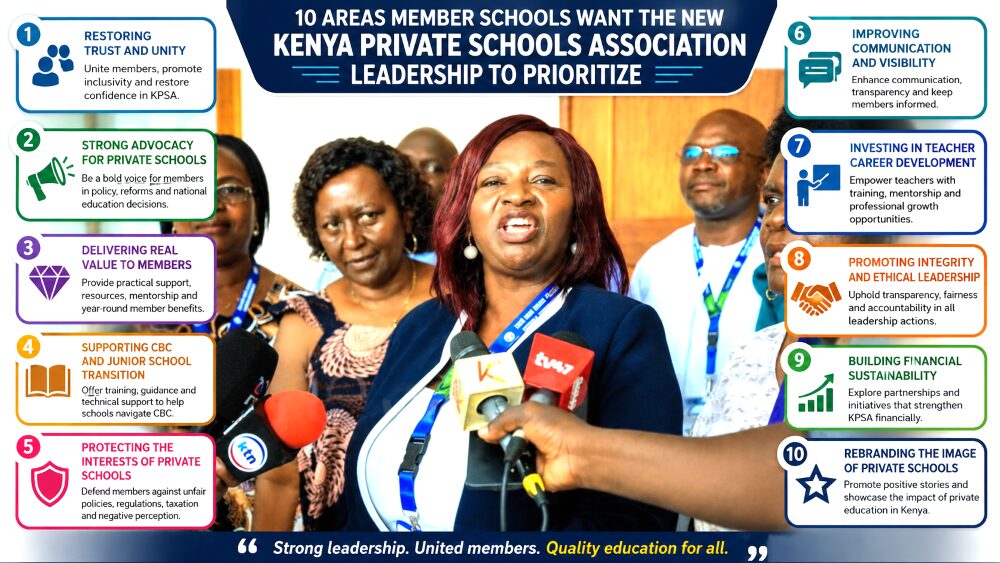
The new leadership of the Kenya Private Schools Association faces enormous expectations from member schools across the country. School directors, proprietors and principals are looking for practical leadership focused on rebuilding trust, strengthening advocacy and restoring confidence in the association.
Below are some of the key priorities many member schools hope the new leadership will address.
- Restoring trust and unity
The new leadership of the Kenya Private Schools Association has inherited an association that urgently needs healing and rebuilding. Across the country, many private school directors, proprietors and principals feel that KPSA gradually drifted away from its original purpose. Internal divisions, political camps, regional caucuses and leadership wrangles weakened the unity that once defined the organisation. Some schools quietly disengaged while others stopped paying subscriptions because they no longer saw value in membership.
Member schools now want one thing above all else: unity. They want a leadership that rises above factions and personal interests. School owners want to feel heard regardless of the size or location of their institutions. The new leadership must therefore prioritise reconciliation and inclusive leadership. Members are tired of politics. They want servant leadership that focuses on restoring confidence in the association.
- Strong advocacy for private schools
Many private schools feel vulnerable and unsupported whenever government policies become complicated or hostile. Issues surrounding licensing, taxation, compliance requirements, CBC implementation and educational reforms continue to place enormous pressure on school owners. During such moments, members expect KPSA to stand firmly with them.
Schools want the association to become a bold and respected voice capable of engaging the Ministry of Education, Kenya National Examinations Council, Kenya Institute of Curriculum Development, Parliament and county governments with authority and professionalism. Members are no longer satisfied with reactive statements issued after decisions have already been made. They want proactive engagement, informed policy discussions and consistent representation at the national level.
- Delivering real value to members
One major concern among member schools is whether KPSA membership genuinely benefits them. Many directors openly question the purpose of paying annual subscriptions if they rarely experience tangible support from the association. The new leadership must urgently address this perception.
Schools expect value in practical terms. They want access to legal guidance, leadership mentorship, educational forums, policy updates, networking opportunities and professional development programs. They want KPSA to become more than just an election-centred organisation. Members expect an association that actively supports schools throughout the year.
If schools continue feeling disconnected from the association, membership retention will remain a major challenge. The leadership must therefore ensure that every school sees visible benefits from belonging to KPSA.
- Supporting CBC and junior school transition
The implementation of competency-based education has become one of the biggest challenges facing private schools in Kenya today. Many institutions are struggling with infrastructure demands, staffing requirements, learner assessment procedures and pathway preparation for junior and senior school transitions.
School owners feel overwhelmed by the speed and complexity of these reforms. They want KPSA to provide practical support instead of generic discussions. Members expect the association to organise meaningful training sessions, curriculum interpretation forums and technical support programs that help schools navigate the CBC system effectively.
The association must position itself as a reliable partner during this transition period. Schools are looking for guidance, clarity and preparedness.
- Protecting the interests of private schools
Private schools continue playing a major role in Kenya’s education sector by creating employment opportunities and absorbing large student populations. However, many proprietors feel the sector is frequently misunderstood and unfairly targeted whenever education challenges arise.
Members want KPSA to firmly defend private schools against excessive regulation, exploitative taxation, policy discrimination and negative public perception. Many directors believe private schools are sometimes treated as commercial enterprises rather than educational institutions contributing to national development.
The new leadership must therefore prioritise protection of the sector’s interests through intelligent advocacy, strategic partnerships and active engagement with policymakers.
- Improving communication and visibility
Poor communication has also frustrated many member schools over the years. Some directors complain that they only hear from KPSA during elections, annual subscription reminders or moments of crisis. This silence creates distance between members and leadership.
Schools want regular updates, professional communication channels and active engagement from the association. They want to know what the leadership is doing on their behalf. They want visibility, responsiveness and transparency.
The new leadership must modernise communication through digital platforms, regional forums, newsletters and official statements that keep members informed and connected. Effective communication will play a major role in rebuilding trust.
- Investing in teacher career development
Many school directors understand that the strength of private education depends heavily on teacher quality. Yet private school teachers often work under difficult conditions with limited professional development opportunities.
Member schools want KPSA to prioritize teacher training, leadership development, digital literacy and CBC instructional skills. Schools are increasingly competing on quality, and teacher capacity remains central to institutional success.
The association should therefore invest heavily in empowering teachers through workshops, conferences, mentorship programs and partnerships with training institutions. Strong teachers strengthen schools, and strong schools strengthen the entire private education sector.
- Promoting integrity and ethical leadership
Another major expectation from members is ethical leadership. Many school owners are exhausted by politics, ego battles, favouritism, and personal interests within association leadership structures. They want professionalism, accountability and humility.
The new leadership is expected to demonstrate financial transparency, fairness and responsible use of member subscriptions. Directors want leaders who serve the association rather than use the association for personal influence or political visibility.
Integrity will determine whether members regain confidence in KPSA leadership.
- Building financial sustainability
Schools also want KPSA itself to become more stable and professionally managed. Overreliance on annual subscriptions limits the association’s ability to deliver meaningful programs and services.
Members expect leadership to explore strategic partnerships, educational sponsorships, professional development programs and revenue-generating educational initiatives. A financially stable association can invest in research, advocacy, technology and member support more effectively.
Financial sustainability is therefore not merely an administrative issue. It is directly connected to the quality of services members receive.
- Rebranding the image of private schools
Finally, many member schools believe private education suffers from unfair public perception. Whenever controversies emerge involving fees, examinations or school management, private institutions are often criticised broadly despite the excellent work many schools are doing.
Members want KPSA to actively promote positive stories about private education. The association should engage the media, publish research, celebrate successful schools and participate meaningfully in national education conversations.
Private schools have contributed significantly to educational access, innovation, employment and academic performance in Kenya. The association must help the public appreciate this contribution.
Conclusion
The expectations facing the new KPSA leadership are enormous. Member schools are no longer interested in ceremonial leadership or endless internal politics. They want action, visibility, support and meaningful representation.
The future of the association will largely depend on whether the new leadership prioritises unity, advocacy, transparency, professionalism and member value. Schools across Kenya are watching closely. They want leaders who listen, leaders who serve and leaders who genuinely understand the realities private schools face daily.
READ ALSO: New Kenya Private Schools Association leadership must redefine purpose and restore trust
If the new leadership focuses on rebuilding trust and delivering practical results, KPSA can regain its influence and once again become a respected and powerful voice in Kenya’s education sector.
By Ashford Kimani
Ashford teaches English and Literature in Gatundu North Sub-county and serves as Dean of Studies.
You can also follow our social media pages on Twitter: Education News KE and Facebook: Education News Newspaper for timely updates.
>>> Click here to stay up-to-date with trending regional stories
>>> Click here to read more informed opinions on the country’s education landscape