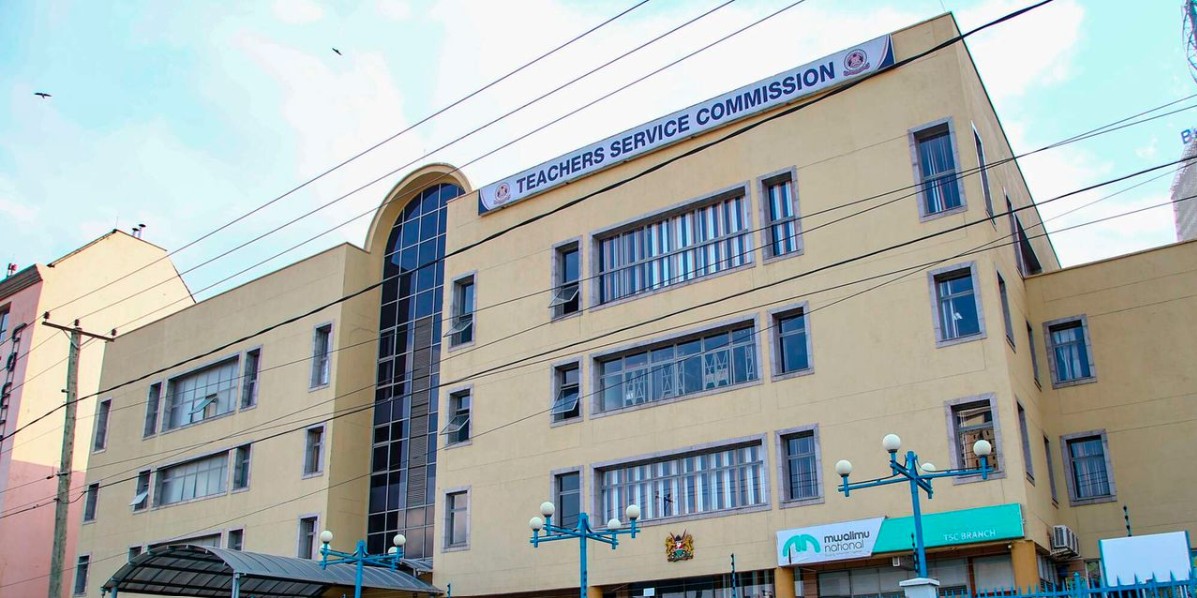
The Teachers Service Commission (TSC) in Kenya stands as a cornerstone of national development, not merely as an administrative body, but as the central nerve system that regulates the country’s teaching profession. It commands stewardship over the largest professional workforce in the public sector and directly shapes the quality, equity, and stability of education delivery across all levels.
When reports of turf wars between the commissioners and the CEO emerge, one wonders why such should arise given the distinct legal functions of the two arms of the government agency.
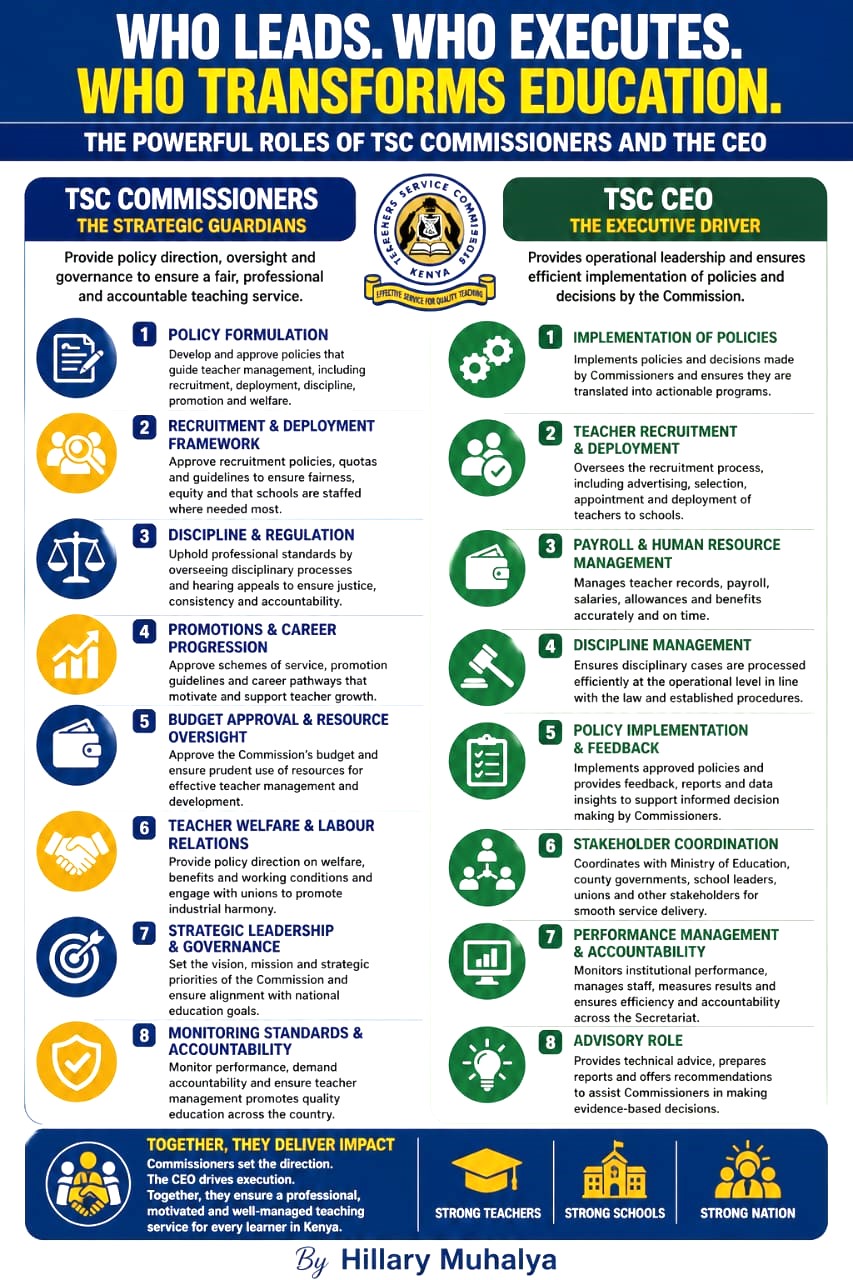
At the core of this institutional architecture is a dual leadership model composed of the TSC Commissioners and the Chief Executive Officer (CEO). Though operating within the same constitutional framework, their roles are deliberately distinct yet structurally interdependent. One provides governance, authority, and strategic direction; the other delivers execution, operational discipline, and administrative continuity. Together, they form a balanced system of control and implementation that sustains the education sector.
The Commissioners: Architects of policy and guardians of oversight
The TSC Commissioners occupy the apex of policy formulation and institutional oversight. Their mandate is not operational, but strategic. They define the direction, standards, and regulatory framework that govern the teaching service in Kenya.
At the heart of their function is policy formulation, a responsibility that shapes the entire education workforce ecosystem. The Commissioners determine recruitment frameworks, staffing policies, deployment strategies, and disciplinary standards. In doing so, they define the architecture of teacher management—deciding not just how many teachers are needed, but where they are needed and under what conditions they should serve.
Education is dynamic, influenced by demographic pressures, curriculum reforms, and shifting national priorities. The Commissioners therefore operate as strategic interpreters of these realities, translating national needs into policy instruments that guide the Commission’s response.
Equally critical is their oversight role. The Commissioners ensure that the Commission operates within constitutional boundaries, adheres to principles of fairness, and maintains accountability in the use of public resources. They review reports from the Secretariat, evaluate institutional performance, and interrogate implementation outcomes.
Another defining responsibility lies in the approval of recruitment and staffing frameworks. While recruitment is operationally executed by the Secretariat, it is the Commissioners who determine the ceilings, priorities, and guiding policies, ensuring equity and balance across regions.
They also shape teacher career progression through schemes of service that define promotion pathways, qualifications, and professional advancement structures—directly influencing motivation and retention.
In addition, they exercise authority over budget oversight and strategic planning, ensuring alignment between financial allocations and institutional priorities.
Finally, they play a stabilising role in labour relations and teacher welfare, guiding engagement with unions and ensuring harmony within the education sector.
The CEO: Executive engine of implementation and administrative control
While the Commissioners define direction, the Chief Executive Officer (CEO) ensures execution. The CEO is the administrative engine of the Commission, responsible for translating policy into action.
The CEO’s foremost responsibility is operational leadership, overseeing daily functions and coordinating departments within the Secretariat.
A critical function is teacher recruitment and deployment management, ensuring transparent execution of recruitment processes and equitable staffing of schools across the country.
The CEO also manages the teacher payroll and human resource system, ensuring accurate registration, payment, and maintenance of teacher records—an essential pillar of institutional trust.
In disciplinary matters, the CEO oversees operational enforcement of procedures, ensuring fairness, timeliness, and compliance with established regulations.
Another key responsibility is policy implementation and feedback reporting, providing Commissioners with insights on performance, challenges, and field realities.
The CEO also serves as the principal technical advisor to the Commissioners, offering data-driven reports that inform high-level decision-making.
Additionally, the CEO leads stakeholder coordination, engaging with the Ministry of Education, school administrators, county governments, and teachers’ unions to ensure policy alignment and institutional harmony.
Finally, the CEO oversees institutional performance management, ensuring efficiency, accountability, and achievement of strategic targets across all departments.
A system built on balanced power and mutual dependence
The relationship between the TSC Commissioners and the CEO is one of structured interdependence. Commissioners provide governance, direction, and accountability, while the CEO provides execution, technical expertise, and administrative continuity.

Without Commissioners, the institution would lack strategic direction. Without the CEO, policy would remain unimplemented. The strength of the TSC lies in this deliberate separation of powers that enhances transparency, efficiency, and institutional balance.
Conclusion: The invisible engine of education stability
The Teachers Service Commission functions as the invisible engine behind Kenya’s education system. Its success depends on the synergy between governance and execution, between strategic oversight and operational delivery.
READ ALSO: Questions as TSC Commissioners reportedly grab teacher transfer roles from staffing personnel
When this dual structure functions effectively, teachers are well managed, schools are adequately staffed, and the education system operates with stability and predictability—ultimately shaping the learning journey of millions of Kenyan learners.
TSC Leadership
| Role | Name | Notes |
|---|---|---|
| Chairperson | Dr. Jamleck Muturi | Head of Commission, policy oversight |
| Vice Chairperson | Leila A. Ali | Assists Chair in governance |
| Commissioner | Mbage Njuguna Ng’ang’a | Policy and oversight |
| Commissioner | Timon Oyucho | Policy and oversight |
| Commissioner | Sharon Kisire | Policy and oversight |
| Commissioner | Annceta Wafukho | Policy and oversight |
| Commissioner | Dr. Nichodemus Anyang | Policy and oversight |
| Commissioner | Christine Kahindi | Policy and oversight |
| Commissioner | Salesa Abudo | Policy and oversight |
| CEO / Secretary | Eveleen Mitei (Acting) | Head of Secretariat, implementation |
By Hillay Muhalya
You can also follow our social media pages on Twitter: Education News KE and Facebook: Education News Newspaper for timely updates.
>>> Click here to stay up-to-date with trending regional stories
>>> Click here to read more informed opinions on the country’s education landscape
>>> Click here to stay ahead with the latest national news.