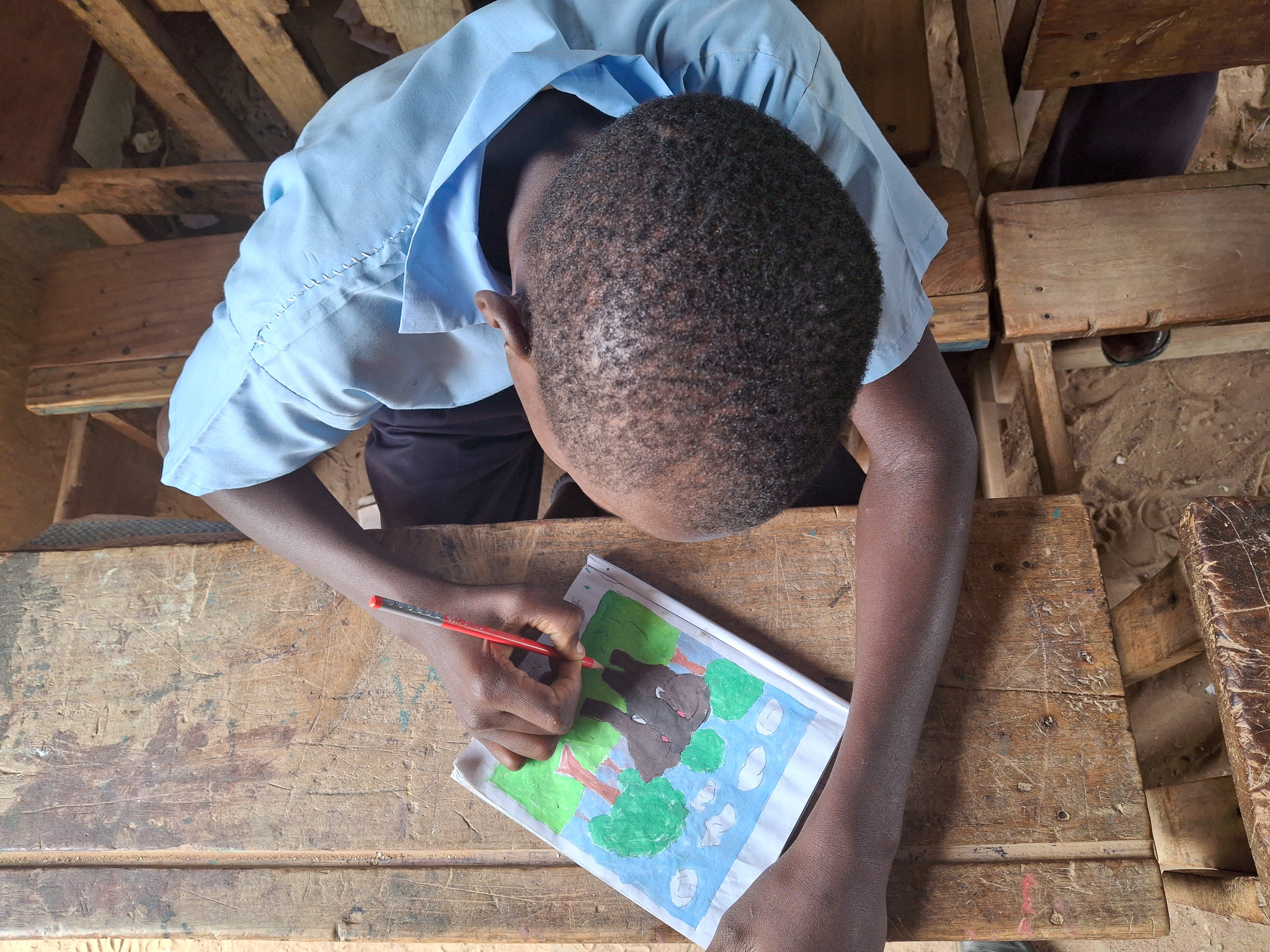
For decades, drawing in schools has been quietly relegated to the margins – treated as a reward, a filler activity or at best, a co-curricular pursuit for the artistically inclined.
Yet emerging scientific evidence is steadily dismantling this assumption. Drawing is not merely an expressive outlet; it is a powerful cognitive tool that strengthens memory, enhances learning and deepens understanding.
Recent research highlighted in science and education discourse shows that children who draw frequently develop stronger memory systems and more effective learning habits. This is not accidental. It is neurological.
When a learner draws, the brain does not engage in a single activity – it orchestrates a complex, multi-layered process. Visual processing is activated as the learner imagines or recalls an image. Motor skills come into play as the hand translates thought into form.
Simultaneously, semantic processing occurs as the learner interprets meaning and organizes ideas. This convergence of systems – visual, kinesthetic, and cognitive – is what scientists refer to as multimodal encoding.
In simple terms, drawing forces the brain to work harder – and smarter.
This explains why learners who draw what they learn often remember it better than those who simply read or copy notes. A child sketching the water cycle is not just reproducing a diagram; they are internalizing processes, sequencing events, and building mental models. The act of drawing becomes an act of thinking.
ALSO READ:
Varsity don urges graduates to embrace job market shift, focus on entrepreneurship and innovation
Equally significant is the connection between drawing and executive function. Executive functions are the brain’s control systems—working memory, cognitive flexibility, and self-regulation. These are the very skills that underpin academic success. Studies indicate that children who engage in drawing tasks demonstrate stronger working memory capacity and better ability to organize and manipulate information.
This has profound implications for classroom practice. It suggests that drawing is not an “extra,” but a foundational learning strategy—particularly for young learners whose cognitive systems are still developing.
There is also a strong link between drawing and language development. When children draw and then describe their drawings, they tend to recall more details and communicate more coherently. The drawing acts as a scaffold—a visual anchor that supports verbal expression. For learners who struggle to articulate ideas, drawing provides an entry point into language.
In the context of Kenya’s Competency-Based Education (CBE), this insight is especially relevant. CBE emphasizes skills such as critical thinking, creativity, communication, and learning to learn. Drawing sits at the intersection of all these competencies.
Consider a Grade 3 English lesson. Instead of asking learners to write a composition from scratch, the teacher could begin with a drawing exercise: “Draw a memorable day.” The drawing becomes a planning tool, helping learners organize thoughts, recall experiences, and structure narratives. Writing then flows more naturally because the cognitive groundwork has already been laid.
In Science, drawing can transform abstract concepts into tangible understanding. Learners who sketch the digestive system or the life cycle of a plant are not passively receiving information; they are constructing knowledge. The diagram becomes a mental map that supports recall long after the lesson ends.
ALSO READ:
Ruto directs TSC to hire 1,800 teachers in Northern Kenya to address staffing gaps
However, it is important to approach this strategy with nuance. Drawing is not a magic bullet. Its effectiveness depends on how it is integrated into learning. Random doodling will not yield the same benefits as structured, purposeful drawing tied to specific learning objectives. Teachers must guide learners on what to draw, why they are drawing it, and how it connects to the content being studied.
Moreover, not all learners will respond to drawing in the same way. Some may initially resist, especially if they believe they are “not good at art.” This is where the teacher’s role becomes critical. The emphasis must shift from artistic quality to cognitive value. The question is not “Is this a good drawing?” but “Does this drawing help you understand and remember?”
Perhaps the most compelling argument for integrating drawing into classroom practice is its accessibility. Unlike many educational interventions that require significant resources, drawing demands very little—paper, a pencil, and intentional pedagogy. In resource-constrained environments, this makes it a highly scalable strategy with substantial impact.
The deeper issue, therefore, is not whether drawing works—it does. The real question is why it remains underutilized in formal education systems. Part of the answer lies in long-standing biases that prioritize text over image, writing over visualization, and conformity over creativity. Yet the modern learner operates in a world saturated with visuals. Education must evolve to reflect this reality.
If schools are serious about improving learning outcomes, they must rethink the role of drawing. It should not be confined to art lessons or used as a time-filler. It should be embedded across subjects as a legitimate and effective learning strategy.
Because when a child draws, they are not wasting time. They are building memory. They are organizing thought. They are learning how to learn as envisioned in one of the CBC core competencies.
And that is the ultimate goal of education.
By Ashford Kimani
Ashford teaches English and Literature in Gatundu North Sub-county and serves as Dean of Studies.
You can also follow our social media pages on Twitter: Education News KE and Facebook: Education News Newspaper for timely updates.
>>> Click here to stay up-to-date with trending regional stories
>>> Click here to read more informed opinions on the country’s education landscape