The Kenya Independent Commissions Workers Union (KICOWU) has formally initiated salary negotiations after submitting a Collective Bargaining Agreement (CBA) proposal to the Salaries and Remuneration Commission (SRC) dated April 16, 2026, seeking significant pay rises for staff in 19 constitutional bodies.
The proposal, dated April 16, 2026 and signed by Secretary General Njeru Kanyamba, gives SRC a 14-day window to respond or initiate negotiations, raising the stakes in an already tense pay dispute.
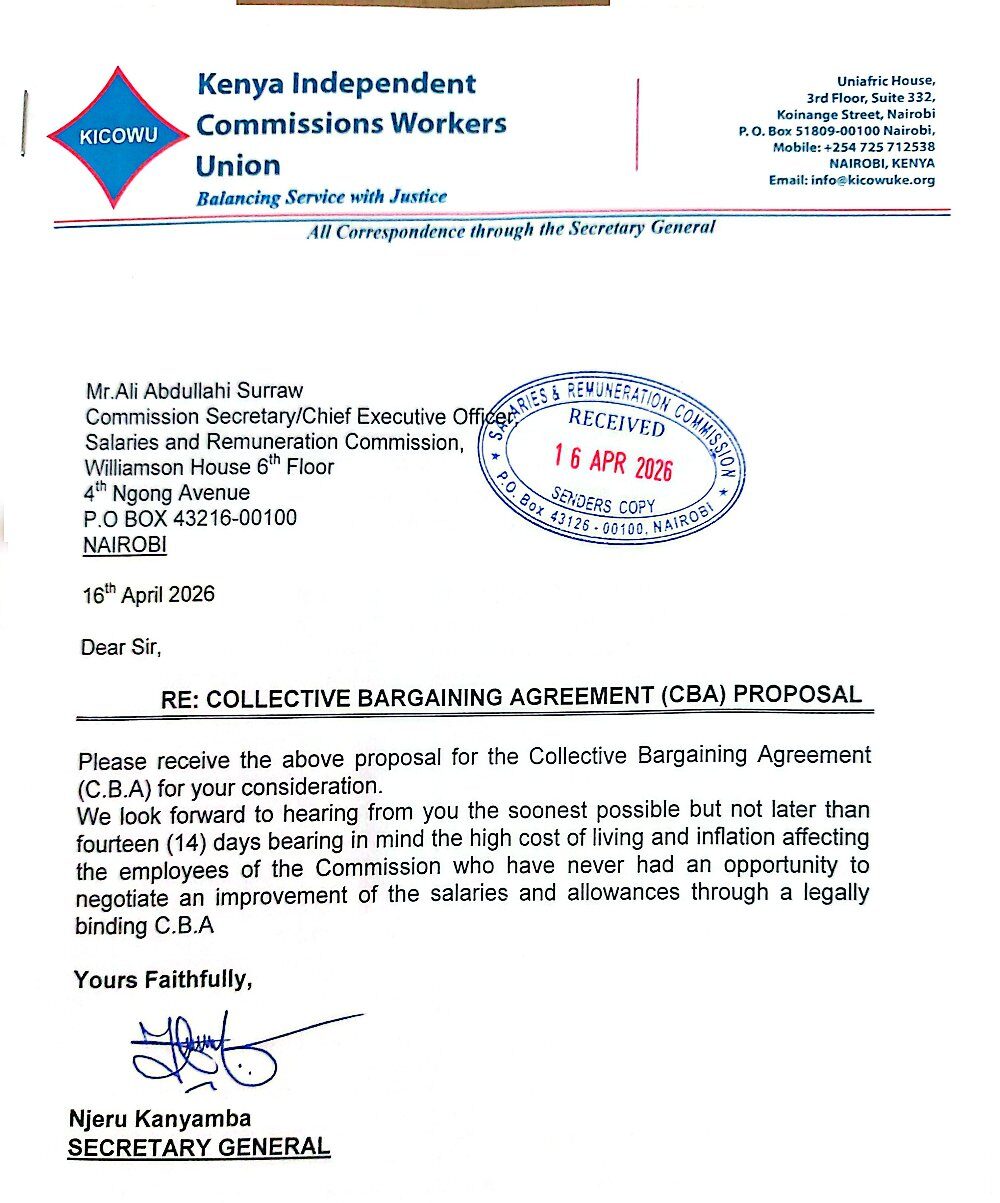
In the document, KICOWU outlines significant salary adjustments, expanded allowances, and improved welfare benefits for secretariat staff who the union says have been excluded from recent public sector pay reviews.
At the core of the demands is a graduated salary increment structure that would see the lowest-paid workers receive up to a 50 per cent pay rise, while the highest earners would get a 20 per cent increase. Mid-level employees would receive increases ranging between 25 per cent and 45 per cent.
According to the document, the union argues that its members have not benefited from recent government-backed salary reviews that favoured other public servants, despite rising inflation and cost of living pressures.
“The objective is to reach a mutually beneficial agreement that recognizes the dedication of our members and ensures fair compensation,” the union states in its preamble, signaling readiness for negotiations but firm expectations on outcomes.
ALSO READ;
Teacher balancing: Inside TSC transfer shake-up ahead of school reopening
Beyond basic salaries, KICOWU is also pushing for sweeping revisions to allowances. House allowances are proposed to increase by between 20 per cent and 50 per cent depending on job group, while commuter allowances could double for lower cadres. Extraneous allowances, paid for additional duties or conditions, are also set for increases of up to 100 per cent for the lowest job groups.
In a notable shift, the union is proposing that leave allowance be standardized to one month’s basic salary across all job groups, replacing the current fixed amounts.
The proposal further introduces structural reforms aimed at protecting workers’ income over time, including the introduction of a Cost of Living Adjustment (COLA) tied to the Consumer Price Index, as well as annual step-based salary increments.
Healthcare benefits have also emerged as a key concern. The union is calling for a major overhaul of the current medical cover, which it says has remained unchanged for over a decade despite rising healthcare costs. Proposed changes include increasing inpatient cover to up to Ksh4 million for some categories and expanding mental health support to include counseling, rehabilitation, and employee assistance programmes.
The CBA proposal also addresses non-financial concerns, including job security, workplace safety, and employee rights.
It calls for retention of a 40-hour work week spread over five days, with eight-hour shifts. It further outlines a provision requiring employers to accommodate employees’ religious practices by granting their designated day of worship.
ALSO READ;
Additionally, the union is pushing for stricter anti-discrimination policies, expanded bereavement leave, and formalized grievance handling procedures culminating in binding arbitration.
KICOWU, which represents secretariat staff in key institutions such as the Independent Electoral and Boundaries Commission (IEBC), Teachers Service Commission (TSC), Judicial Service Commission (JSC), and the Office of the Auditor-General, has increasingly raised concerns over what it describes as systemic pay disparities within the public sector.
The latest proposal intensifies pressure on SRC, which is constitutionally mandated to advise on remuneration for public officers and must approve CBAs before implementation.
The union has proposed a four-year term for the agreement, setting the stage for a potential standoff as pressure mounts on SRC to respond.
By Mercy Kokwon
You can also follow our social media pages on Twitter: Education News KE and Facebook: Education News Newspaper for timely updates.
>>> Click here to stay up-to-date with trending regional stories
>>> Click here to read more informed opinions on the country’s education landscape