The Teachers Service Commission (TSC) has triggered a sweeping nationwide transfer exercise ahead of the reopening of schools for the second term, unleashing a decisive staff balancing operation that is set to redefine how teachers are deployed across the country.
Far from a routine administrative process, this is a calculated, data-driven intervention aimed at correcting long-standing disparities that have left some schools overstaffed and others critically understaffed.
For years, inequitable teacher distribution has quietly undermined the education system, with urban and accessible areas often enjoying a surplus of teachers while remote and hardship regions struggle to attract and retain staff. Now, the Commission appears determined to confront that imbalance head-on. The message is direct and uncompromising: staffing must reflect need, not convenience.
At the center of the exercise are County and Sub-County transfer panels, which have been tasked with implementing a comprehensive balancing matrix built from detailed data submitted by school heads. This matrix captures key indicators including enrolment, number of classes, teacher establishment, gender distribution, and the extent of surplus or shortage. Schools have been clearly categorized as overstaffed, understaffed, or adequately staffed, creating a precise national staffing map that is now guiding transfer decisions with unprecedented clarity.
ALSO READ;
Teachers who have remained in one station for extended periods, particularly in overstaffed institutions, are the primary targets of this exercise. Many are now being earmarked for redeployment ahead of school reopening, with transfers expected both within and across Sub-County and County boundaries. What is emerging is a shift away from the traditional stability that allowed teachers to remain in one posting for years, toward a more dynamic system where movement is dictated by national demand.
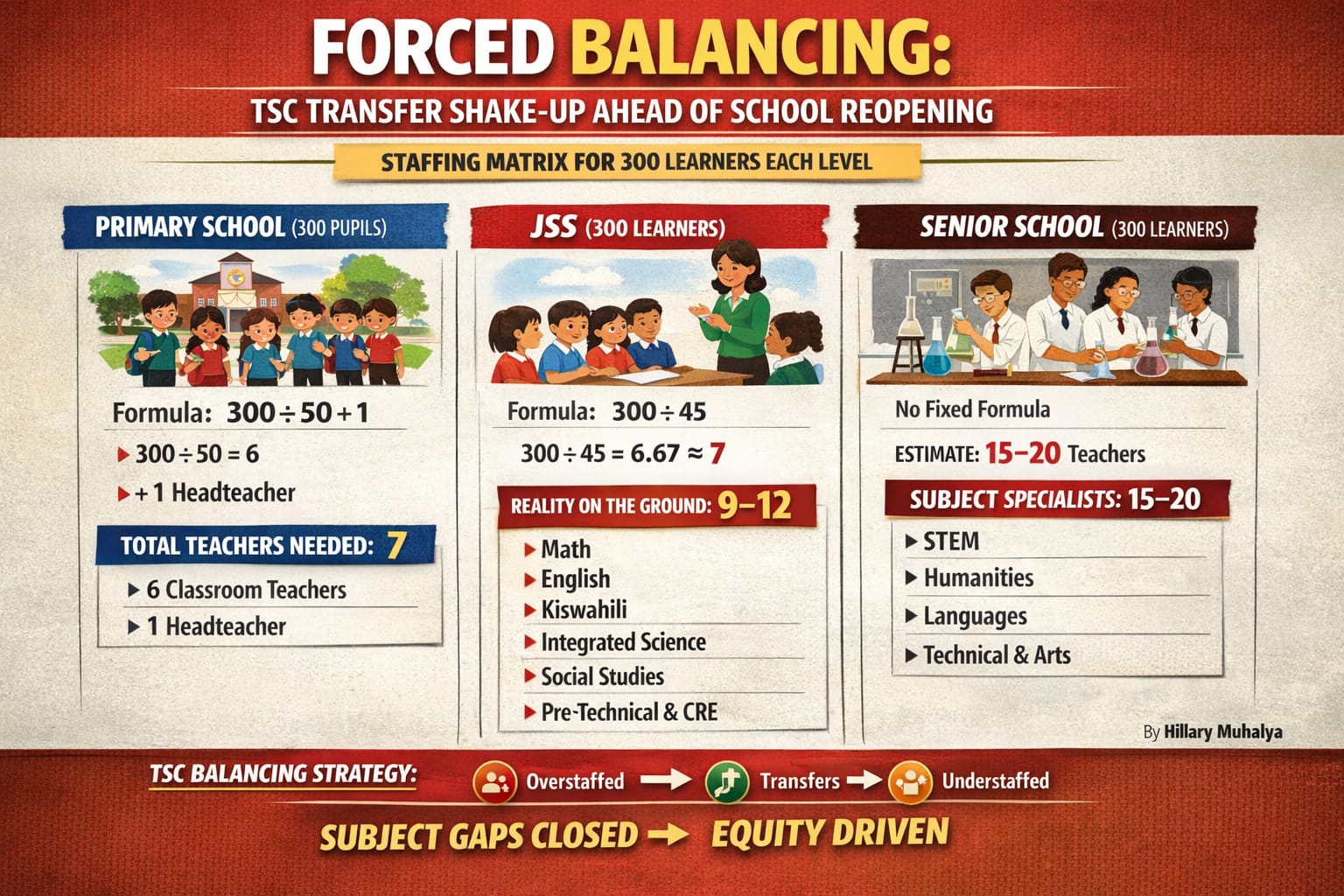
The balancing process itself is anchored on staffing formulas aligned to the Competency-Based Education framework. In primary schools, the number of teachers required is determined by dividing total enrolment by fifty and adding one to cater for the head of institution. In Junior Secondary Schools, covering Grades Seven to Nine, staffing is calculated by dividing enrolment by forty-five. These formulas, while simple in appearance, have exposed significant staffing gaps and surpluses, effectively triggering the current wave of transfers even before learners return to class.
To illustrate, a primary school with 300 learners requires seven teachers—six classroom teachers and one headteacher. A Junior Secondary School with the same enrolment would, by formula, require about seven teachers. However, this is where the simplicity ends and complexity begins.
Unlike primary schools, where teachers handle multiple learning areas, Junior Secondary Schools operate on a subject-specialized model. Each teacher is trained to handle specific disciplines such as Mathematics, Integrated Science, Pre-Technical Studies, Languages, and Humanities. This transforms the balancing process into a far more intricate exercise. A school may appear adequately staffed numerically, yet still lack critical subject teachers. It is entirely possible, for example, to find a school with several Humanities teachers but no Mathematics or Science teacher, rendering it academically imbalanced despite appearing stable on paper.
This reality forces the transfer panels to move beyond simple headcounts and engage in precise, subject-based analysis. Every transfer decision must be carefully calibrated to ensure that the receiving school gains the exact expertise it lacks, without destabilizing the staffing structure of the sending school. In this sense, the process resembles a delicate operation rather than a broad redistribution.
The challenge is further compounded by the limited availability of teachers in specialized areas, particularly in subjects central to the Competency-Based Education framework such as Integrated Science and Pre-Technical Studies. These teachers have effectively become high-demand resources within the system, and their deployment requires careful planning. A single miscalculation could create a ripple effect, leaving multiple schools struggling to deliver key aspects of the curriculum.
Timetabling considerations add yet another layer of complexity. Subject teachers must have sufficient workload to justify their placement, meaning enrolment figures, class streams, and subject demand must align. The panels are therefore balancing not just numbers and subjects, but also workload efficiency and institutional stability.
ALSO READ;
Branch boss moves to Court to halt KUPPET national elections citing constitutional breach
At the senior school level, the challenge expands even further. With pathways such as STEM, Social Sciences, and Arts shaping subject selection, staffing needs become more specialized and less predictable. A school with 300 learners at this level may require between fifteen and twenty teachers, depending on the pathways offered. This stands in stark contrast to primary schools, where the same enrolment would require only seven teachers, highlighting the increasing complexity as learners progress through the system.
With the matrix now fully operational, the implementation phase is imminent. Overstaffed schools will begin releasing excess teachers, while those identified as understaffed will receive reinforcements. Transfer letters are expected to be issued as schools reopen, signaling the start of a period of rapid adjustment across the education sector.
For many teachers, the impact will be deeply personal. Long-standing attachments to stations will be disrupted, family routines may be altered, and some will be required to relocate to unfamiliar or hardship areas. Schools losing experienced teachers may also face temporary instability as they adjust to new staffing arrangements.
Yet, beneath the disruption lies a broader goal of equity. For learners in historically underserved areas, this redistribution could mean access to teachers in critical subjects for the first time. It represents an effort to level the educational playing field and ensure that quality education is not determined by geography.
Ultimately, what the Teachers Service Commission is undertaking is a fundamental shift in teacher management, from a static, comfort-driven system to one defined by responsiveness, accountability, and precision. As schools prepare to reopen, one reality is becoming increasingly clear for thousands of teachers: the next term may not just bring a new timetable, but a new station, a new environment, and an entirely new chapter in their professional journey.
By Hillary Muhalya
You can also follow our social media pages on Twitter: Education News KE and Facebook: Education News Newspaper for timely updates.
>>> Click here to stay up-to-date with trending regional stories
>>> Click here to read more informed opinions on the country’s education landscape