In today’s competitive job market, the value of a university course is no longer measured only by the prestige of the degree, but by how quickly it translates into real employment opportunities.
Across Kenya and the wider global economy, employers are increasingly focused on practical skills, technical competence, and readiness to deliver results immediately after graduation. This has created a clear divide between courses that offer direct entry into the job market and those that require long waiting periods, further training, or additional certifications before employment becomes possible.
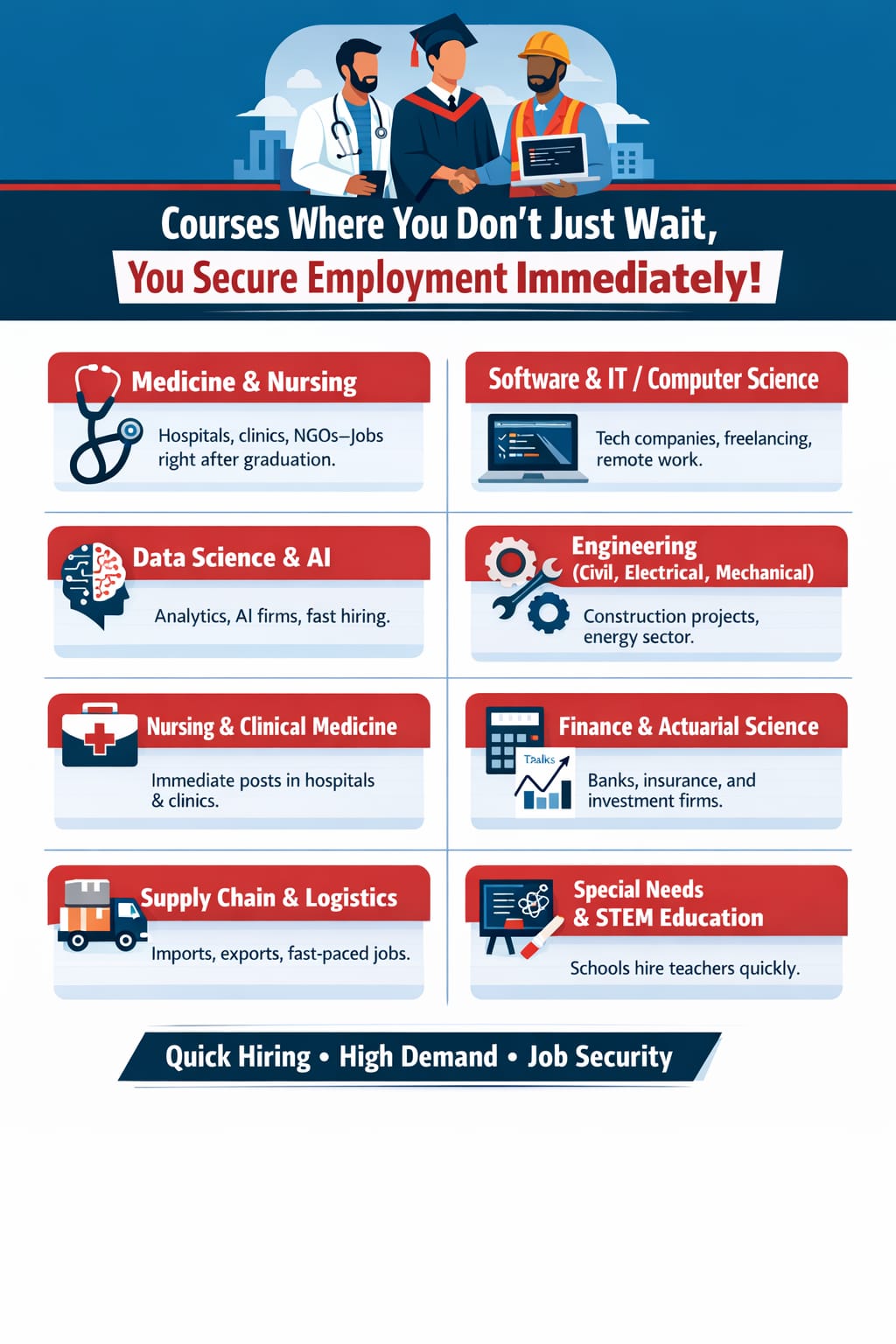
The most marketable university courses today are those that align closely with industry needs, emerging technologies, and essential services that cannot be delayed. These include health sciences, information technology, engineering, data science, education specializations with STEM focus, and logistics and finance-related fields. In these areas, graduates often secure internships, contracts, or full employment soon after completion because demand consistently exceeds supply.
Among the strongest fields is health sciences, which includes medicine and surgery, nursing, pharmacy, laboratory technology, and clinical medicine. These careers remain the backbone of any country’s development. Hospitals, private clinics, research institutions, and international health organizations require continuous staffing regardless of economic conditions. A graduate in nursing or clinical medicine, for instance, often has a direct pathway into employment in public hospitals, private facilities, or NGOs immediately after registration with relevant regulatory bodies. In many cases, job placement begins even before graduation through internships and clinical attachments that transition into employment offers.
ALSO READ;
KUCCPS 2026 application portal is open: Here is what you need to know before you apply
Closely linked to this is the expanding field of information technology and computer science. In an increasingly digital world, every institution relies on software systems, digital communication, and data-driven operations. Courses such as software engineering, computer science, cybersecurity, and information systems are among the fastest routes into employment today. Graduates in these fields can be absorbed into banks, telecommunications companies, government digital services, startups, and global remote work platforms. Unlike traditional careers, IT graduates are not limited to physical workplaces; they can secure contracts online, work remotely, or freelance for international clients, often within months of completing their studies.
Even more recent and highly demanded are data science, artificial intelligence, and machine learning courses. These fields are transforming how businesses operate by enabling predictive analytics, automation, and intelligent decision-making. Companies in finance, agriculture, health, and marketing are now heavily investing in data professionals. A graduate skilled in data analysis or AI development is often absorbed quickly because organizations lack enough qualified experts to meet the growing demand. This shortage makes these courses some of the most “employment-ready” programs available today.
Another highly marketable category is engineering, particularly civil, mechanical, electrical, and mechatronics engineering. These fields are central to infrastructure development, industrial growth, and energy systems. Kenya’s ongoing expansion in housing, roads, energy, and manufacturing ensures a steady demand for engineers. Civil engineers, for example, are frequently employed in construction projects, while electrical engineers find opportunities in power companies and telecommunications. Engineering graduates may also transition into consultancy or project management roles, often starting work soon after graduation due to structured industrial attachments during study.
Closely related is the growing demand for architecture and quantity surveying, which support the construction and real estate industries. As urban development expands, architects and quantity surveyors are needed to design, plan, and manage building projects. These professionals are often employed immediately in construction firms or government projects because of the continuous pipeline of infrastructure development. Many also enter self-employment early by starting design consultancies or joining partnerships in construction firms.
The field of education, though sometimes underestimated, remains highly marketable when properly specialized. Teachers trained in science subjects such as mathematics, physics, chemistry, and biology are consistently in demand due to shortages in secondary schools. Additionally, special needs education has become a priority area as inclusive education policies expand. ICT integration in education has also created demand for teachers who can combine pedagogy with digital skills. In many cases, education graduates secure employment quickly through government recruitment, private schools, or even online tutoring platforms.
Another critical area is supply chain management and logistics. With Kenya serving as a regional trade hub in East Africa, the movement of goods, services, and information has become a key economic driver. Professionals in procurement, logistics, and supply chain management are employed by manufacturing companies, import-export businesses, shipping firms, and large retail chains. These roles are essential in ensuring efficiency in distribution systems, and graduates often find opportunities quickly due to the expansion of e-commerce and cross-border trade.
The financial sector also offers strong opportunities through finance, accounting, and actuarial science. Banks, insurance companies, and investment firms depend heavily on professionals who can manage risk, analyze financial data, and ensure compliance. Actuarial science, in particular, is highly competitive but extremely rewarding, as graduates are often recruited by insurance companies and financial institutions even before completing professional certification exams. Accounting graduates also benefit from universal demand across both private and public sectors.
ALSO READ;
How a Garissa school is beating drought through farming innovation
In recent years, cybersecurity and networking have emerged as essential fields due to the rise in cyber threats and digital fraud. Governments, banks, and private companies are investing heavily in securing their digital infrastructure. As a result, cybersecurity professionals are in short supply, making them highly employable. Graduates in this field often secure contracts quickly because every organization using digital systems requires protection from cyberattacks, data breaches, and system failures.
Beyond technical fields, health informatics, biomedical engineering, and digital health systems are emerging hybrid careers that combine healthcare and technology. These professions are increasingly important as hospitals adopt electronic medical records, telemedicine, and automated diagnostic tools. Graduates with interdisciplinary skills in these areas are often absorbed quickly because they bridge the gap between medicine and technology.
What makes these courses particularly marketable is not just the academic qualification, but the level of practical exposure and industry alignment they provide. Courses that include internships, industrial attachments, practical labs, and real-world projects tend to produce graduates who are job-ready. Employers today are less interested in theoretical knowledge and more focused on whether a graduate can solve problems immediately.
Another key factor influencing employability is digital literacy and adaptability. Even in traditional fields like education or finance, employers now expect graduates to use digital tools, manage online systems, and communicate effectively through technology. This means that even courses that are not purely technical can become highly marketable when combined with ICT skills.
It is also important to recognize that modern employment is no longer limited to formal office jobs. Many graduates today secure employment through freelancing, remote work, consultancy, and entrepreneurship. This is especially true in IT, design, data analysis, and digital marketing. In such fields, employment begins immediately after graduation—or even before graduation, through online platforms and project-based work.
Ultimately, the most successful graduates are those who choose courses aligned with real economic demand, not just personal interest or academic tradition. While passion remains important, it must be balanced with employability and future sustainability. Courses in health sciences, technology, engineering, finance, logistics, and STEM education consistently stand out because they meet essential societal needs.
In conclusion, the modern job market rewards readiness, adaptability, and practical skill. The most marketable university courses are those that place graduates directly into active sectors of the economy without long waiting periods. In a rapidly changing world, success belongs to those who choose wisely, build skills continuously, and position themselves where demand is strongest.
By Hillary Muhalya
You can also follow our social media pages on Twitter: Education News KE and Facebook: Education News Newspaper for timely updates.
>>> Click here to stay up-to-date with trending regional stories
>>> Click here to read more informed opinions on the country’s education landscape