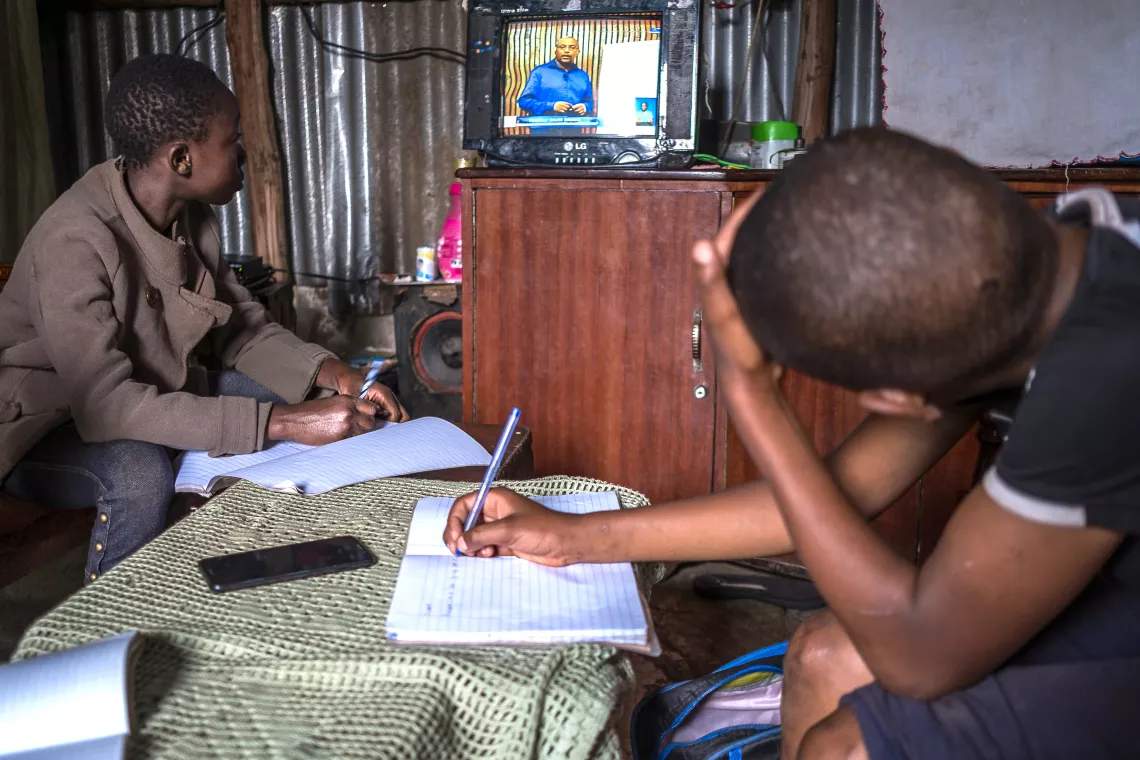
In Nairobi and many other urban areas, a quiet emergency unfolds every evening. From informal settlements to low-income estates, learners walk home from school carrying books, assignments, and dreams—only to step into a single room that must contain everything: sleep, cooking, conversation, conflict, and survival itself. Within those tight walls, education does not just struggle—it is steadily, systematically suffocated.
This is not merely a housing problem. It is an educational crisis hiding in plain sight.
The learning process does not begin and end in the classroom. It is reinforced at home—in silence, in repetition, in reflection. But what happens when silence does not exist? What happens when a learner has nowhere to sit, nowhere to think, nowhere to focus?
Concentration is the first victim.
A child trying to complete homework in a one-room household is not just studying—they are competing. Competing with the clatter of sufurias, the hum of conversations, the cries of younger siblings, the blare of a radio, and the constant movement of people sharing a space too small for their needs. Focus becomes fragmented. Attention slips. Work is rushed, poorly done, or abandoned altogether. Over time, this does not just affect grades—it destroys the very habit of deep thinking.
And without concentration, learning collapses.
Memory follows closely behind. For knowledge to stick, the brain needs calm and repetition. But in a chaotic environment, revision is inconsistent and often impossible. A learner reads today and forgets tomorrow. Concepts never fully settle. The result is a painful cycle: study, forget, repeat—without progress. Confidence begins to erode, not because the learner lacks intelligence, but because the environment denies them the chance to retain what they learn.
Then comes the breakdown of routine.
Effective learning thrives on structure—set times for homework, revision, and rest. But in a single-room home, routine is a luxury. Study time depends on when the room is “free,” which is almost never. A learner may be forced to read late into the night when others are asleep or wake up before dawn to find a moment of quiet. This inconsistency disrupts discipline and weakens mastery. Learning becomes irregular, accidental, and unsustainable.
Sleep, the silent engine of cognition, is brutally compromised.
ALSO READ:
Lessons from Vietnam: Why industry must lead Kenya’s TVET transformation
In overcrowded conditions, rest is shallow and constantly interrupted. People sleep and wake at different times. Movements, noises, and discomfort break the continuity of sleep. A learner arrives at school physically present but mentally exhausted. Their brain struggles to process information, solve problems, or remain attentive. Teachers may see disinterest, but what they are witnessing is fatigue—a mind that has not had the chance to reset.
And then there is the psychological weight—the unseen burden that quietly drains the learner’s mental energy.
In a one-room household, children are exposed to everything. Adult conversations about money, stress, and survival. Conflicts that erupt without warning. Realities they are too young to understand but cannot escape. There are no closed doors, no protected spaces, no gradual introduction to life’s complexities. Everything is immediate. Everything is raw.
This exposure clutters the mind. A learner cannot fully engage with a mathematics problem or a comprehension passage when part of their thoughts are tangled in confusion, anxiety, or emotional distress. Learning requires mental freedom, yet here the mind is occupied long before a book is opened.
The absence of personal space deepens the crisis.
Every learner needs a place—a physical and psychological corner associated with focus. A desk, a chair, a quiet spot that signals: this is where I learn. In a one-room home, that boundary does not exist. A bed becomes a desk. A floor becomes a classroom. Moments after studying, the same space is used for eating, chatting, or sleeping. The brain fails to switch into “study mode.” Discipline weakens. Productivity drops. The learning process becomes disorganized and inefficient.
This disorder spills directly into the classroom.
A learner who has not completed assignments, who has not revised, who is tired and mentally burdened, cannot participate confidently. They shrink from attention. They avoid answering questions. They withdraw from discussions. Slowly, they become invisible—not because they lack potential, but because they are unprepared in ways the system does not see.
Teachers may label them lazy, careless, or disengaged. But behind that label is a child fighting a battle that begins long before the school bell rings.
ALSO READ:
Meru MCA tables motion on street children rehabilitation and reintegration
Independent learning—now a cornerstone of modern education—becomes nearly impossible.
Today’s learners are expected to read ahead, research, explore, and think critically beyond the classroom. But independence requires space, time, and resources. In a one-room household, even when a phone or device is available, it is shared, interrupted, or used in a noisy environment. There is no stability, no continuity. The learner is locked out of deeper engagement, forced to rely only on what is taught in class.
The digital divide widens the gap even further.
While some learners attend virtual lessons, access online resources, and complete assignments in structured environments, others struggle to even charge a device or find a quiet moment to use it. Education, which should be an equalizer, becomes a divider.
Health challenges quietly tighten the grip.
Overcrowding, poor ventilation, and limited sanitation create conditions where illness spreads easily. When one person falls sick, the entire household is exposed. For the learner, this means missed classes, incomplete work, and a constant struggle to catch up. The learning process becomes a cycle of interruption and recovery, never allowing steady progress.
And then comes the most dangerous shift—the transformation of mindset.
Children are observant. They see the difference between their lives and those of their peers. They notice who has space, who has resources, who has stability. Slowly, quietly, a belief begins to form: maybe I am not meant to succeed. Confidence fades. Participation drops. Dreams shrink to fit reality.
This is how potential dies—not in one dramatic moment, but in small, repeated limitations.
With no space to breathe at home, the outside world begins to pull.
Streets offer what the room cannot—freedom, movement, and escape. Peer groups become substitutes for family space. But without guidance, this shift exposes learners to risky behaviors, negative influences, and choices that can derail their education entirely. What begins as a search for space can end in the loss of direction.
And yet, in the middle of this storm, some learners rise.
They wake before dawn to study. They revise under dim light. They memorize amid noise. They build discipline where none exists. Their resilience is extraordinary. But let us be clear—resilience should not be the entry requirement for success. It should not take suffering for a child to prove their capability.
ALSO READ:
How constituencies can enhance operational efficiency in the management of bursary funds
The uncomfortable truth is this: a one-room home is not just a living condition—it is an invisible barrier embedded within the education system. It fragments concentration, disrupts memory, destroys routine, weakens participation, and burdens the mind. It does not just affect how a child lives; it determines how a child learns.
If we are serious about education, then we must confront this reality head-on.
Schools must go beyond instruction and provide safe, structured spaces where learners can study in peace. Extended study hours, remedial programs, and counseling are no longer optional—they are necessary.
Teachers must look beyond performance and ask deeper questions. Why is this learner struggling? What environment are they coming from? Understanding context is the first step toward meaningful support.
Communities must rise to the challenge by creating shared learning spaces—libraries, study halls, and safe centers where children can read, revise, and think without interruption.
And policymakers must treat housing as an educational issue. Because when living conditions undermine learning, no curriculum reform, no exam, no policy can fully compensate.
The walls of a single room may seem small, but their impact is enormous. They shape attention, memory, behavior, confidence, and ambition. They determine whether a learner thrives or merely survives.
Because when everything in a child’s life is squeezed into one room, learning does not just compete for space—it loses.
By Hillary Muhalya
You can also follow our social media pages on Twitter: Education News KE and Facebook: Education News Newspaper for timely updates.
>>> Click here to stay up-to-date with trending regional stories
>>> Click here to read more informed opinions on the country’s education landscape