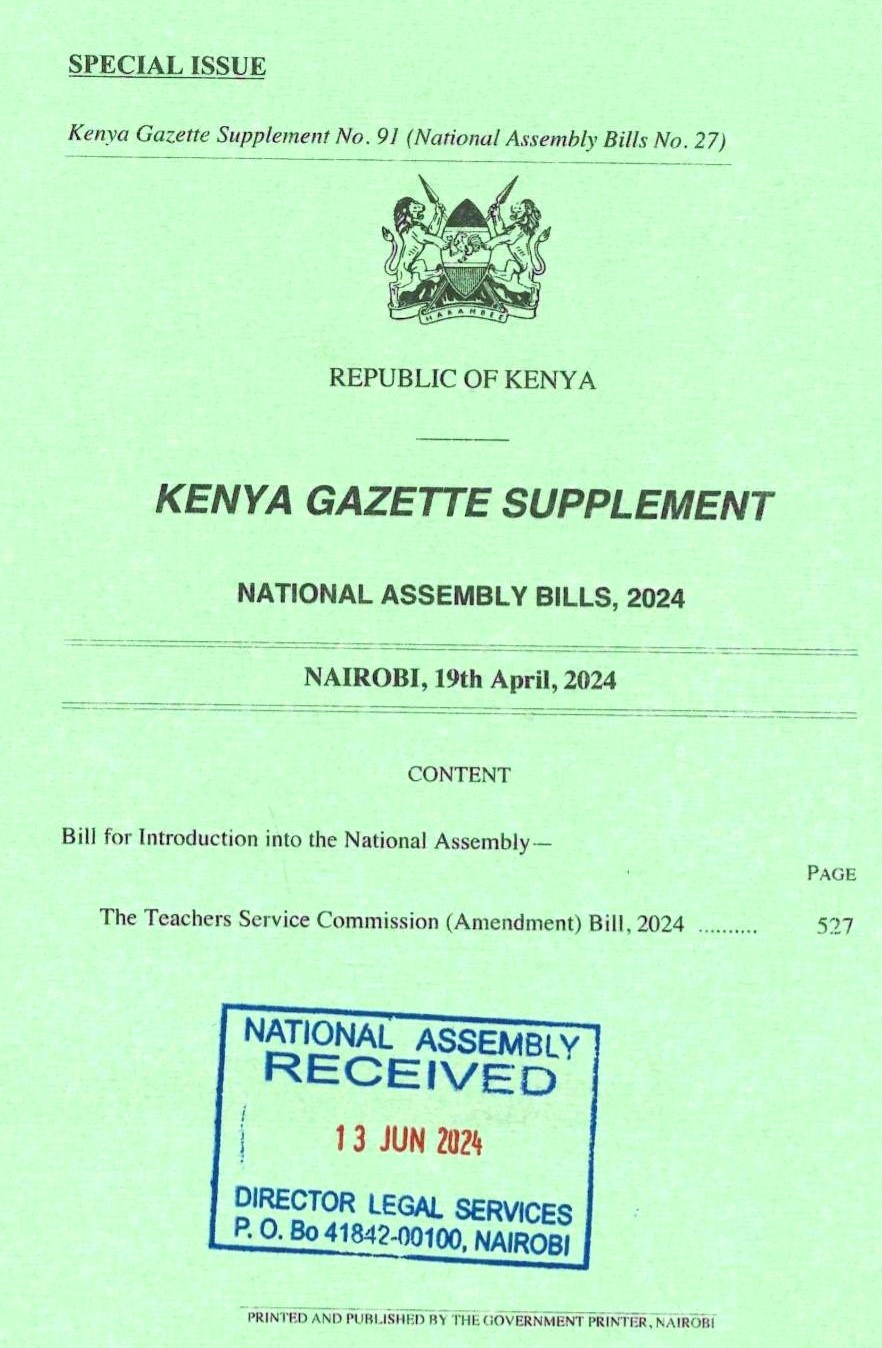
The proposed amendments to the Teachers Service Commission law under the TSC Amendment Bill 2024 signal one of the most far-reaching attempts in recent years to redefine discipline, accountability, and professional standards in Kenya’s teaching service.
If enacted, the Teachers Service Commission (Amendment) Bill, 2024 will significantly expand the powers of the Teachers Service Commission (TSC), particularly in dealing with sexual exploitation, professional misconduct, and administrative breaches by teachers.
At the heart of the TSC Amendment Bill 2024 is a strong stance against sexual misconduct involving learners. The draft law introduces a clear and expansive definition of sexual exploitation, describing it as sexual abuse of a learner through exchange of sex or sexual acts for academic grades, school fees, pocket money, protection, or other benefits. In a system where teachers wield enormous influence over young people’s futures, such conduct represents not only moral decay but also a grave abuse of authority.
The Bill categorises misconduct into three broad groups: immoral behaviour with a learner, professional misconduct, and infamous conduct. Immoral behaviour goes beyond physical acts. It includes sexual harassment, flirtation, romantic relationships with learners, exposure to pornography, and even the giving of gifts intended to lure learners into immoral conduct. In an era where digital interaction is commonplace, the inclusion of cyber-related elements in the TSC Amendment Bill 2024 is particularly timely.
Professional misconduct, as outlined in the Bill, targets behaviours that undermine institutional effectiveness. Chronic lateness, absenteeism, desertion of duty, incitement, insubordination, and persistent poor performance fall under this category. While these may appear less sensational than sexual offences, they directly affect learning outcomes. A teacher who is habitually absent or negligent can quietly sabotage the academic progress of hundreds of learners over time.
The third category, infamous conduct, is sweeping in scope. It covers drunkenness, fighting, abusive language, cyberbullying, falsification of official documents, mismanagement, and embezzlement of public funds. Importantly, it also criminalises exposing learners to drugs and psychotropic substances, or engaging in other gainful employment while under TSC employment without authorisation. The breadth of this category under the TSC Amendment Bill 2024 signals the Commission’s intention to protect not only learners’ safety but also the integrity of public resources and institutional reputation.
Beyond defining offences, the TSC Amendment Bill 2024 seeks to strengthen the enforcement architecture. It proposes the establishment of an internal review committee within the TSC to handle appeals before matters proceed to court. This move could expedite disciplinary processes and reduce prolonged litigation that often leaves schools in uncertainty. However, it will also require strict adherence to due process to avoid perceptions of bias or administrative overreach.
Another significant proposal is the TSC’s bid to take administrative action against teachers who conduct or facilitate holiday tuition, charge unauthorised levies, or withhold national examination certificates. These practices have long generated public outrage. Withholding certificates, in particular, punishes learners for systemic financial challenges beyond their control. By outlawing such acts within its disciplinary framework, the Commission seeks to reaffirm that learners’ rights must come first.
Implications of the TSC Amendment Bill 2024
Institutionally, the Bill also clarifies the relationship between the TSC and the Ministry of Education. Following negotiations mediated by Deputy President Kithure Kindiki and involving key actors such as Cabinet Secretary Julius Ogamba and TSC Chairperson Jamleck Muturi, an agreement was reached to delineate responsibilities. The TSC will oversee performance standards and discipline of teachers, while the Ministry retains quality assurance and funding oversight of schools. This dual structure recognises the constitutional independence of the Commission while preserving policy coherence.
KUPPET speaks tough to TSC on SHA failures, CBA and teacher promotions
School heads are expected to operate under a dual mandate, effectively serving both the TSC and the Ministry. The Bill further proposes redefining “institutional administrator” to include principals, deputy principals, registrars, deans, and senior teachers. This broader definition ensures that accountability is not confined to classroom teachers alone but extends to those in leadership and supervisory roles.
Of particular interest is the proposal to establish an Institute of Teacher Support and Professional Development. If properly funded and professionally managed, such an institute could shift the disciplinary conversation from mere punishment to proactive support. Continuous professional development, mentorship, and ethical training may prevent many cases of misconduct before they arise.
Reform, Oversight, and the TSC Amendment Bill 2024
Critics may argue that expanding TSC powers risks centralisation and bureaucratic excess. Others may fear that vague terms such as acts that “grossly offend public interest” could be misapplied. These concerns underscore the need for precise regulations and transparent procedures once the law is enacted.
Nonetheless, the direction of reform under the TSC Amendment Bill 2024 reflects a broader societal demand for higher ethical standards in schools. Teachers occupy a position of trust unmatched by many professions. They shape values, character, and intellect. When that trust is violated, the damage extends far beyond individual victims to the moral fabric of society.
TSC tables plan to separate JSS from primary school administration
Ultimately, the proposed amendments represent an attempt to recalibrate the balance between authority and accountability within Kenya’s teaching service. If implemented with fairness, clarity, and professionalism, they could restore public confidence, safeguard learners, and elevate the status of teaching as a noble calling rather than merely a public sector job.
The TSC Amendment Bill 2024 represents a decisive shift in strengthening professional accountability.
By Ashford Kimani
You can also follow our social media pages on Twitter: Education News KE and Facebook: Education News Newspaper for timely updates.
>>> Click here to stay up-to-date with trending regional stories
>>> Click here to read more informed opinions on the country’s education landscape
>>> Click here to stay ahead with the latest national news.