








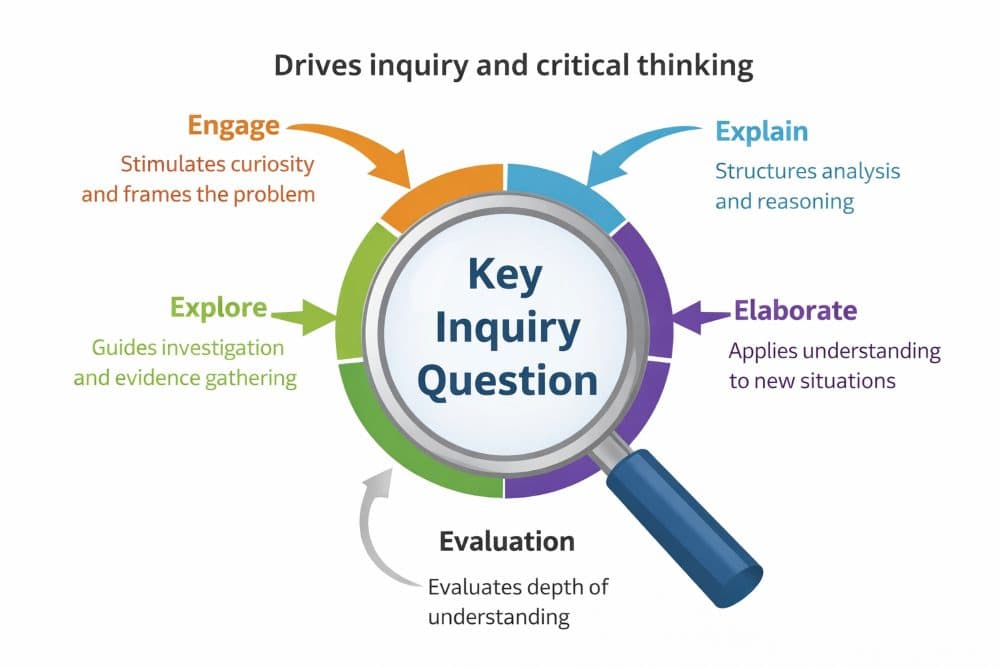
A Key Inquiry Question (KIQ) is a carefully structured, open-ended question that anchors learning around investigation rather than information transmission. It is designed to stimulate curiosity, guide exploration, and sustain intellectual engagement across a lesson or unit of study. Unlike traditional classroom questions that test recall, a Key Inquiry Question frames learning as a problem to be explored. It encourages learners to think deeply, gather evidence, construct explanations, and apply understanding in meaningful ways. In inquiry-based instructional frameworks such as the 5E model developed by the Biological Sciences Curriculum Study under the leadership of Rodger W. Bybee, the KIQ is typically introduced during the engagement phase and revisited throughout the learning cycle to maintain coherence and purpose.
At its core, a Key Inquiry Question shifts the focus of teaching from “What content must be covered?” to “What understanding must be uncovered?” It reframes learning as a journey of discovery. For instance, instead of asking learners to define democracy, a teacher might pose the question, “How does citizen participation influence governance?” This form of questioning cannot be answered solely through memorisation. It requires learners to investigate examples, analyse relationships, debate perspectives, and support their conclusions with evidence. The KIQ, therefore, transforms passive reception into active inquiry.
An effective Key Inquiry Question possesses several defining characteristics. It is open-ended, meaning it allows for multiple responses grounded in reasoning. It is concept-driven rather than topic-driven, focusing on big ideas that extend beyond a single lesson. It encourages sustained investigation over time rather than quick answers. It connects learning to real-world contexts, making education relevant and meaningful. It also promotes higher-order thinking skills such as analysis, synthesis, and evaluation. Importantly, a strong KIQ cannot be answered with a simple “yes” or “no,” nor can it be resolved by copying a definition from a textbook.
Within competency-based educational systems such as Kenya’s CBC, the Key Inquiry Question plays a vital role in aligning classroom practice with the development of core competencies. CBC emphasises critical thinking, creativity, collaboration, communication, citizenship, and problem-solving. A well-crafted KIQ naturally activates these competencies. When learners investigate a central question, they must work together, share perspectives, gather and analyse evidence, articulate reasoning, and apply knowledge to authentic situations. The classroom becomes a space of dialogue and exploration rather than mere note-taking.
The KIQ also promotes coherence in instructional planning. It acts as a compass guiding the teacher’s decisions. During the initial stage of a lesson, the question captures curiosity and activates prior knowledge. In the exploration stage, it frames investigations and experiments. During explanation, learners connect their findings back to the question, refining their understanding. In elaboration, they apply insights to new but related contexts. Finally, during evaluation, both the teacher and the learners assess how effectively the question has been addressed. This cyclical return to the inquiry question ensures that learning remains purposeful rather than fragmented.
READ ALSO:
https://educationnews.co.ke/kyuso-girls-renamed-after-mama-pauline-kalonzo/
In practical terms, designing a strong Key Inquiry Question requires intentional thought. Teachers must first identify the central concept or enduring understanding they want learners to grasp. From this conceptual core, they frame a question that invites investigation. For example, in Science, a teacher might ask, “What factors determine the survival of living organisms in different environments?” In Social Studies, “How do economic decisions impact community well-being?” In English and Literature, “How does conflict shape character development?” Each of these questions opens a pathway to sustained analysis and application. They are broad enough to encourage discussion yet focused enough to guide inquiry.
The use of KIQs also supports differentiated learning. Because the questions are open-ended, learners at varying levels can engage meaningfully. Some may provide basic explanations, while others offer complex, nuanced arguments supported by diverse evidence. The teacher scaffolds learning through probing questions, structured tasks, and collaborative activities, ensuring that all learners operate within their zone of growth. Over time, students become more confident in posing their own inquiry questions, fostering intellectual independence.
Furthermore, Key Inquiry Questions cultivate metacognition. As learners revisit the question throughout a unit, they reflect on how their understanding evolves. They recognise misconceptions, refine ideas, and strengthen arguments. This reflective process deepens learning and builds self-regulation. Students learn not merely to answer questions but to think about how they arrive at answers.
The power of a Key Inquiry Question lies in its ability to transform classroom culture. It replaces teacher talk with dialogue. It prioritises evidence over opinion. It encourages curiosity over compliance. When learners are driven by a compelling question, they become investigators rather than recipients of information. Knowledge becomes something they construct and defend, not something they copy and repeat.
Ultimately, a Key Inquiry Question is more than a pedagogical tool; it is a philosophy of learning. It affirms that education is not about accumulating isolated facts but about exploring significant ideas that shape understanding. In inquiry-oriented classrooms, the KIQ serves as the intellectual heartbeat of instruction, sustaining curiosity, guiding exploration, and ensuring that learning is deep, connected, and meaningful.
By Ashford Kimani
Ashford teaches English and Literature in Gatundu North Sub-county and serves as Dean of Studies.
You can also follow our social media pages on Twitter: Education News KE and Facebook: Education News Newspaper for timely updates.
>>> Click here to stay up-to-date with trending regional stories
>>> Click here to read more informed opinions on the country’s education landscape



Reader Discussion (0)
Sign in to comment