







Kenya’s struggle to balance rapid technological advancement with governance challenges and economic realities has taken centre stage at the ongoing 64th Kenya National Drama and Film Festival in Nyeri, where students are using theatre to reflect the opportunities and risks shaping the country’s future.
From automation-driven job losses and political mismanagement to the growing need for financial literacy and digital inclusion, learners are presenting bold narratives that mirror a society in transition—while offering solutions rooted in innovation, responsible leadership, and informed financial decision-making.
Performances staged at Kagumo Teachers Training College, Nyeri National Polytechnic and Dedan Kimathi University of Technology are not only entertaining but deeply reflective of national concerns. Many pieces emphasize the need to embrace technology responsibly, strengthen governance systems, and promote better financial management through accessible digital platforms.
The festival, themed Digital Stages: Driving Kenya’s Development through Theatre and Film, has seen students creatively interrogate the intersection of technology, politics, and everyday life. Through drama, dance, and spoken word, they explore how digital transformation is reshaping livelihoods while exposing gaps in leadership and social systems.
One of the standout performances, The Cyclone by Eregi TTC, delivers a powerful political allegory on leadership and accountability.
The play follows two brothers, Tembo and Mushimuli, locked in a struggle for leadership symbolized by Lady Shiombo. While Tembo embodies selfish ambition and destructive politics, Mushimuli champions people-centred development, advocating access to healthcare, water, insurance, and financial support systems. The play culminates in Tembo’s downfall.

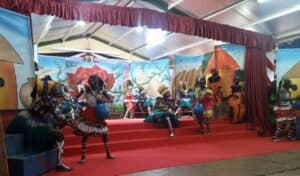
Shamberere National Polytechnic students perform a modern dance depicting the struggles of herders searching for pasture, where a herder is attacked by a monstrous threat but is rescued by officers who capture the creature. The performance took place at Nyeri National Polytechnic during the 64th Kenya National Drama and Film Festival.
“The play reflects the cost of unchecked leadership and the possibilities of competent governance,” the scriptwriter said.
Beyond politics, the realities of a changing economy are also explored. Tumutumu Primary School’s Fire Me Feed Me tells the story of a family disrupted by automation after a father loses his job. Hope emerges when a child leverages digital tools to create new opportunities, illustrating how technology, while disruptive, can also drive resilience and innovation.
Agriculture, a key pillar of Kenya’s economy, also features prominently. Kwale High School’s dance Blessed Machinery portrays farmers grappling with water scarcity and pests while envisioning a future shaped by agri-tech solutions such as automated irrigation and modern farming innovations.
Students are equally addressing the influence of digital culture. Sigalagala National Polytechnic’s Suzana examines the dangers of social media misuse, while St. John’s Tala High School’s Power Edition shows how platforms like podcasts and live streaming can nurture talent, promote inclusivity, and instill national values among the youth.
Financial literacy and digital banking have emerged as key themes at the festival, reflecting a growing national conversation around economic empowerment in the digital age. Through creative expression, learners used the stage not only to entertain but also to educate communities on the importance of managing finances in an increasingly cashless society.
A standout performance by Rae-Kanyaika, titled Anjela, seamlessly blends tradition with modern financial education. The cultural dance uses rhythmic song and captivating choreography to urge communities to embrace a culture of saving, particularly through accessible digital platforms. It illustrated how tools such as mobile banking can empower individuals to manage their finances more effectively, plan for the future, and build long-term economic resilience.
ALSO READ;
https://educationnews.co.ke/government-rolls-out-intensive-stem-training-for-kitui-jss-teachers-to-strengthen-cbc-implementation/
The contemporary dance piece Childlock offered a striking commentary on the rising effects of excessive phone use among children. Using powerful choreography and visual storytelling, the performance drew attention to how unchecked screen time is increasingly disrupting learning, contributing to declining academic performance and, in some cases, dependency on mobile devices.
Through carefully crafted scenes, the dancers depicted learners caught in a cycle of distraction, where constant engagement with phones erodes focus, discipline, and overall academic progress. The portrayal struck a chord with parents and educators alike, echoing concerns that are becoming more prevalent across many communities.
Beyond highlighting the problem, Childlock advanced a clear call to action. It urged parents and guardians to take a more active role in regulating children’s digital habits by introducing measures such as passwords and screen-time limits. In doing so, the piece underscored the importance of guiding responsible technology use, ensuring that digital tools enhance rather than hinder children’s development and education.
Rae-Kanyaika patron Steve Opiyo said the performance aimed to bridge culture and modern financial practices.
“We used our cultural dance to promote saving through digital platforms, while modern dance highlighted the need for responsible phone use, showing that although technology is empowering, it must be balanced with learning,” he said.
Inclusivity in education has also taken centre stage, with DePaul Austin Academy presenting the national play Aisai, which explores the integration of learners with special needs into the education system through digital innovation.
The play tells the story of a young girl unable to attend school or participate in learning like other children due to her disability. Concerned about her sister’s situation, one learner sparks a conversation at school, leading to an innovative solution driven by internet integration within the new curriculum. Through this intervention, the girl is finally able to access learning and engage alongside her peers.
The performance delivers a powerful message that disability should not be seen as inability, but rather as a challenge that can be addressed through inclusive and technology-driven solutions.
Director Ann Njau said the production reflects real-life experiences faced by many children with disabilities and highlights the need for practical interventions in education.
Students of Rae-Kanyaika perform a cultural dance, Anjela, at Kagumo TTC during the 64th Kenya National Drama and Film Festival, showcasing the importance of embracing digital banking in a lively presentation sponsored by Equity Bank.
“Through Aisai, we want to show that a child who cannot learn or interact like others can still be supported through internet-based innovations. With the right interventions, they can fully participate in learning alongside other children,” she said.
Kenya National Drama and Film Festival (KNDFF) Prof. Christopher Joseph (C.J.) Odhiambo said integrating technology and social themes into theatre is key to preparing learners for the future.
“By engaging with these realities on stage, students are better prepared to navigate the tensions between tradition and a rapidly evolving technological landscape,” he said.
He called for urgent attention to inequalities in Kenya’s education system, noting that learners in urban informal settlements face challenges comparable to those in marginalized rural regions.
“As Kenya advances education reforms, policymakers must adopt a more inclusive lens that recognises deprivation across both rural and urban settings,” he said.
Odhiambo also revealed plans to push for the digitalization of the National Drama Festival as part of a broader effort to align co-curricular activities with Kenya’s digital learning agenda.
“The digitalization of the festival should not be seen as an isolated initiative, but as part of a wider journey to ensure all learners benefit from a coordinated national transformation,” he said.
By special correspondent
You can also follow our social media pages on Twitter: Education News KE and Facebook: Education News Newspaper for timely updates.
>>> Click here to stay up-to-date with trending regional stories
>>> Click here to read more informed opinions on the country’s education landscape




Reader Discussion (0)
Sign in to comment