







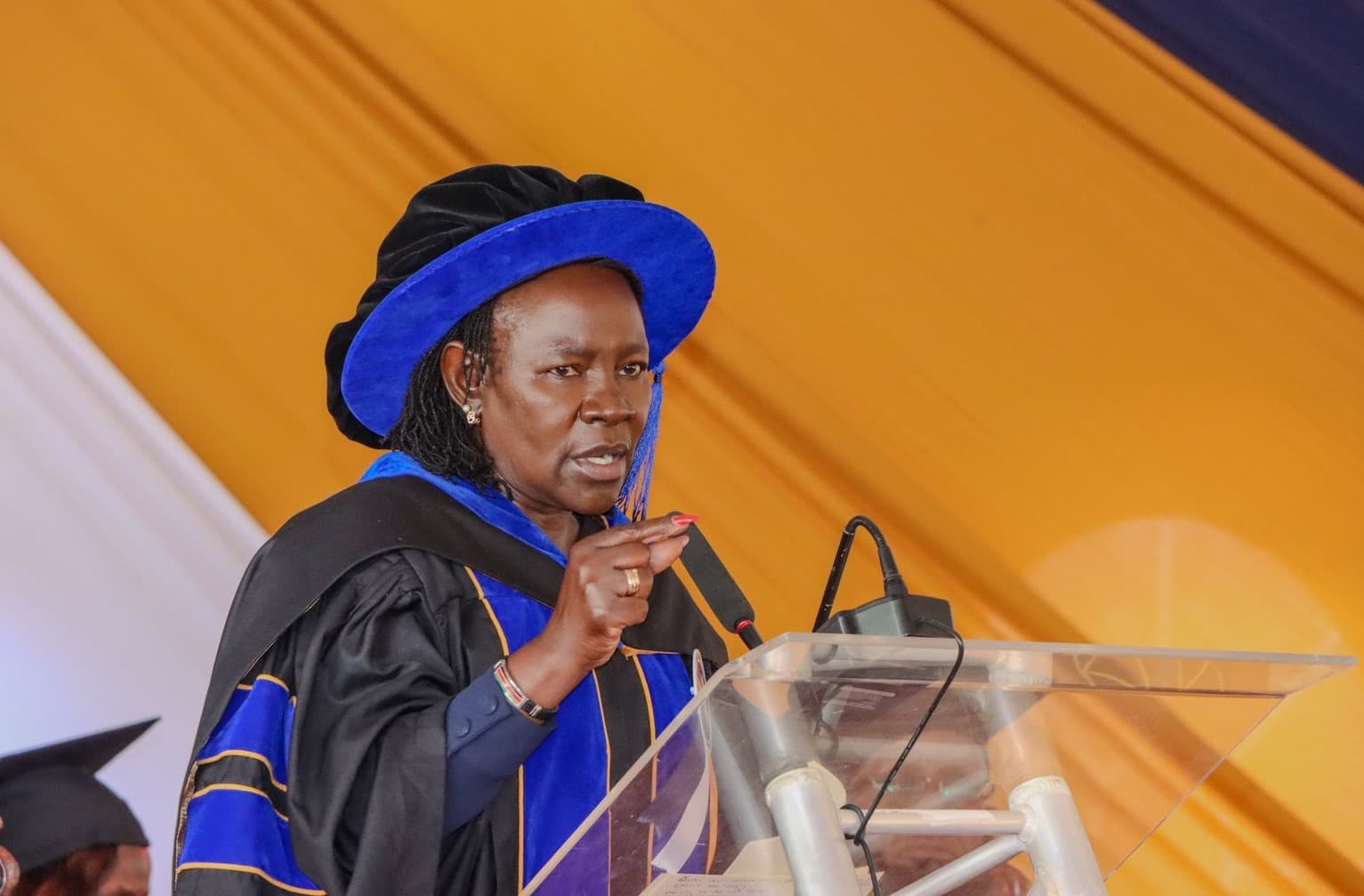
The Principal Secretary, State Department for Technical and Vocational Education and Training, Dr. Esther Muoria has advised all institutions of higher learning countrywide to establish alternative income generating projects in order to be able to sustain themselves financially.
PS Murioa said that the institutions should consider converting workshops, laboratories and training facilities into viable production units that can generate income from real markets while simultaneously enhancing training delivery.
Speaking at Mukiria Technical Training Institute in Imenti Central Constituency, Meru County during the 3rd graduation ceremony, the PS reiterated the government commitment in making such institutions self-reliant through prudent management.
“Equally imperative is the financial sustainability and productive transformation of TVET institutions. Institutions should deliberately convert workshops, laboratories and training facilities into viable production units that generate income from real markets while simultaneously enhancing training delivery. Income-Generating Units (IGUs) must be mainstreamed as integral academic and operational components, embedded within institutional planning, budgeting and performance management systems, rather than operating as peripheral commercial ventures,” said PS Muoria.
Muoria said the government remains firmly committed in strengthening TVET as the backbone of industrialization, economic growth and inclusive development.
She noted that over the past three years, they have undertaken far-reaching reforms aimed at ensuring that TVET institutions deliver training that is practical, industry-responsive and aligned with labour market needs.
ALSO READ:
https://educationnews.co.ke/tvets-asked-to-submit-enrolment-dropout-data-amid-curriculum-concerns/
“A major milestone in these reforms was the full transition to Competency-Based Education and Training (CBET) in September 2023. This marked a decisive shift from content-based instruction to a system that emphasizes demonstrable competence, practical skills and workplace readiness. Under CBET, graduates are assessed on what they can do, not merely on what they know—thereby enhancing employability, productivity and relevance to industry,” Muoria said.
She said in a bid to build such foundation, the government rolled out the modularized curriculum in May 2025 to further strengthen CBET delivery.
The PS said the modular approach provides a flexible and structured training framework, with increased emphasis on hands-on learning, realistic workplace simulation and clearly defined progression pathways.
“It allows trainees to acquire skills in manageable modules, exit and re-enter training as needed and progressively advance their qualifications in line with industry demand and career aspirations.”
The PS further alluded that to support effective implementation of CBET and modularized training, the Ministry of Education, through the Kenya School of TVET (KSTVET), has continued to undertake nationwide capacity-building programmes for trainers, assessors and institutional leaders.
“These initiatives focus on curriculum delivery, assessment methodologies, quality assurance and learner-centred pedagogy to ensure consistency, credibility and quality across all TVET institutions,” said Dr. Muoria.
She said the government is also strongly committed to greening TVET and advancing climate-smart skills development by implementing a national programme to solarize TVET institutions to ensure access to clean, reliable and cost-efficient energy.
ALSO READ:
https://educationnews.co.ke/nairobi-county-approves-school-feeding-policy-to-make-dishi-na-county-permanent/
“Beyond reducing operational costs, solarization supports sustainability while creating practical learning platforms for renewable energy and green technology skills—competencies that are increasingly in demand in the modern economy,” said the PS.
She emphasized that Recognition of Prior Learning (RPL) remains one of the most transformative reforms within the TVET sector noting that through the State Department for TVET and the RPL Delivery Unit, structured national capacity-building programmes have been undertaken to train RPL practitioners and operationalize RPL centres.
“This initiative is opening formal certification pathways for skilled individuals in the informal sector, recognizing experience-based competencies, promoting dignity of work and supporting inclusive economic participation,” she noted.
Dr. Muoria said the government continues to promote innovation, digital transformation and youth empowerment within the TVET sector.
The PS called on institutions to establish formal, structured and performance-based industry partnerships that clearly define trainee intake capacities, training responsibilities, supervision arrangements and expected competency outcomes.
“The role of the Industry Liaison Officer must be fully operationalized as a strategic institutional function, with clear mandates, measurable performance indicators and mandatory reporting to management,” she emphasized.
Dr. Muoria urged the graduands to apply the competencies they have acquired with integrity, creativity and commitment in order to contribute meaningfully to national development.
“This occasion marks the successful completion of a significant training journey and reflects the continued transformation of Technical and Vocational Education and Training (TVET) as a critical driver of skills development, employment creation and national development,” said Dr. Muoria.
By John Majau
You can also follow our social media pages on Twitter: Education News KE and Facebook: Education News Newspaper for timely updates.
>>> Click here to stay up-to-date with trending regional stories
>>> Click here to read more informed opinions on the country’s education landscape



Reader Discussion (0)
Sign in to comment