



The Ministry of Education (MoE) has made a bold and strategic move to reshape teacher training in Kenya by merging the Diploma in Early Childhood Teacher Education (DECTE) and the Diploma in Primary Teacher Education (DPTE) earlier offered distinctively at Teacher Training Colleges (TTCs).
The new unified programme will be known as the Diploma in Teacher Education – Pre-Primary and Primary (DTE PP & P). This reform, communicated through a circular dated January 19,2026, is already beginning to alter the landscape of teacher education across the country and is expected to bring long-term benefits to the education sector.
A Ministry official, speaking on condition of anonymity, explained that the merger is intended to strengthen the transition between early childhood and primary education. “The decision to merge DECTE and DPTE is driven by the need to strengthen the transition from pre-primary to primary schooling,” the official said. “This integration ensures teachers are trained to support learners throughout the foundational years.”
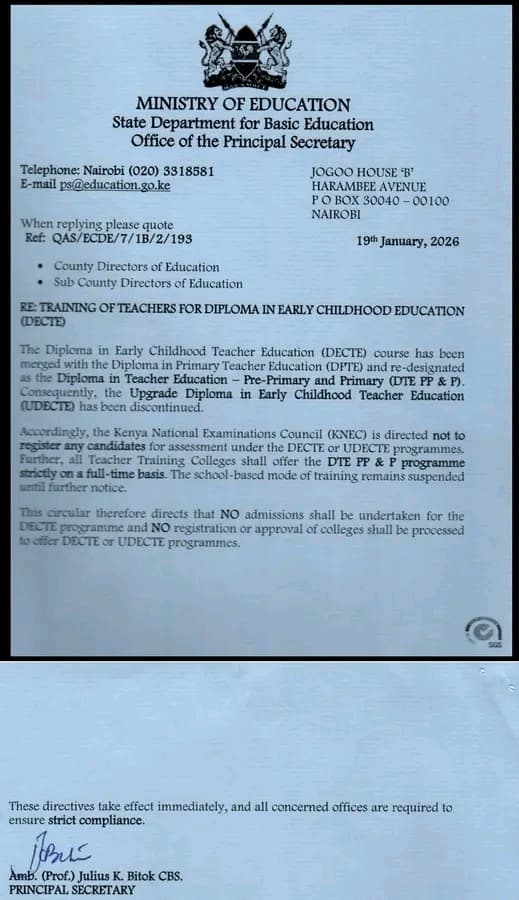
The MoE circular on the merger of TTCs diplomas/Photo Courtesy
He added that the reform addresses a long-standing challenge in teacher training, adding that in the past, DECTE graduates focused mainly on early childhood education methods, while DPTE trainees were trained in primary teaching techniques. “The separation often resulted in gaps in teaching quality, particularly during the transition between pre-primary and primary school.” He said.
Education experts argue that this fragmentation has contributed to inconsistent learning outcomes, especially in early literacy and numeracy. When children move to primary school, they are sometimes confronted with a sudden change in teaching methods and expectations, which can lead to confusion and learning setbacks.
A teacher trainer observed that children do not experience education in isolated phases. “When a learner moves from pre-primary to primary, the teaching approach should not change dramatically,” the trainer said. “This merger will help align teaching methods across both levels.”
ALSO READ:
https://educationnews.co.ke/kitale-man-abandons-120-hour-tree-hugging-bid-for-daughters-fees-after-confrontation/
The new DTE PP & P programme is expected to produce teachers who are more versatile and capable of handling the full foundation phase. Teachers will be trained to understand the unique needs of young learners at the pre-primary stage, while also being equipped with the skills required for primary school teaching. This holistic training is important because early childhood education lays the foundation for a child’s future learning. A strong foundation in literacy and numeracy is crucial for success in later stages of education, and teachers who understand the continuum are better positioned to support learners effectively.
The merger also reflects broader global education trends that emphasize the importance of continuity between early childhood and primary education. Countries that have adopted integrated training models have reported improved learner performance and reduced dropout rates. Kenya’s decision to merge DECTE and DPTE is therefore seen as a forward-looking move that strengthens the education system from the ground up.
One immediate effect of the merger is the instruction given to the Kenya National Examinations Council (KNEC) not to register candidates for DECTE or UDECTE. This means that all teacher training colleges must now focus on offering the new DTE PP & P programme only. In practical terms, this simplifies training structures and reduces duplication of resources, allowing colleges to concentrate on quality delivery rather than managing multiple programmes.
The circular also states that the school-based mode of training has been suspended until further notice. This shift will require colleges to realign their training strategies and ensure that teacher trainees are adequately supported through institutional training. While the suspension of school-based training may present challenges for some institutions, it also offers an opportunity to standardize teaching practices and ensure that all graduates meet a consistent national standard. Colleges will need to strengthen their mentorship systems, improve classroom-based teaching practice, and ensure that trainees receive sufficient support and supervision.
ALSO READ:
https://educationnews.co.ke/kuppet-raises-concern-over-grade-10-transition-crisis-in-bungoma/
A teacher training college principal commented that the merger will simplify training structures and improve the quality of training. “Colleges can now channel their resources towards delivering one quality programme rather than managing multiple diploma tracks,” the principal said.
For students, the merger means a clearer pathway into the teaching profession. They will no longer need to choose between two separate diploma tracks. Instead, they will be trained under a unified programme that recognizes the importance of both pre-primary and primary education. This is likely to enhance their employability and expand opportunities for career growth, as graduates will be qualified to teach across a wider range of levels.
A teacher trainee expressed optimism about the new programme, noting that it will open more job opportunities. “With the new diploma, we will be qualified to teach both levels, which expands our career options,” the trainee said.
Education analysts believe the long-term impact of the merger could be transformative for the education system. Teachers trained under the DTE PP & P programme will be better positioned to deliver consistent teaching methods and ensure smoother learning transitions for young learners. This is crucial for improving national learning outcomes, particularly in early literacy and numeracy. When teachers have a clear understanding of the continuum, they can design lessons that build on the skills acquired at the pre-primary level, ensuring that learners are well-prepared for the demands of primary school.
In addition, the merger could reduce the number of learners who struggle during the transition phase. When children enter primary school with strong foundational skills, they are more likely to succeed academically and remain in school. Improved learning outcomes at the early stages also contribute to long-term educational success, as learners are better equipped to cope with the increasing demands of higher grades.
An education policy analyst described the reform as progressive and aligned with global trends. “Countries that have integrated teacher training models report improved learner performance and reduced dropout rates,” the analyst said.
ALSO READ:
https://educationnews.co.ke/knut-transmara-lifts-curfew-parents-resume-schooling/
The decision to merge the two diplomas reflects the government’s recognition that early childhood and primary education are not separate islands but rather part of a continuous learning journey. Children transition from pre-primary to primary school with minimal breaks, yet the teaching approach they encounter often changes dramatically. This discontinuity has, over time, created challenges in the learning process, especially during the critical foundational years when children are developing literacy, numeracy, and essential life skills. By integrating the training programmes, the Ministry aims to ensure that teachers are prepared to support learners throughout the entire foundation phase, strengthening the link between pre-primary and primary education.
It is also more than an administrative adjustment. It represents a strategic reform aimed at building a stronger, more integrated teacher workforce capable of supporting learners through their most critical years. The success of the merger will depend on how effectively teacher training colleges implement the new programme and how well the Ministry and stakeholders coordinate the transition.
As the Ministry implements the new programme, education stakeholders will need to work together to ensure that the transition is smooth and that the benefits of the merger are fully realized. This will require close collaboration between the Ministry, teacher training institutions, county education offices, and education partners. It will also require ongoing monitoring and evaluation to ensure that the new programme meets its objectives and delivers the intended improvements in teaching quality and learner outcomes.
Ultimately, the merger is a step toward strengthening Kenya’s education system from the foundation up. By ensuring that teachers are trained to support learners across the early learning continuum, the Ministry is investing in the future of the nation. The new Diploma in Teacher Education – Pre-Primary and Primary is a significant reform that has the potential to improve the quality of education and enhance the learning experience for young learners across the country.
By Hillary Muhalya
You can also follow our social media pages on Twitter: Education News KE and Facebook: Education News Newspaper for timely updates.
>>> Click here to stay up-to-date with trending regional stories
>>> Click here to read more informed opinions on the country’s education landscape


Reader Discussion (0)
Sign in to comment