









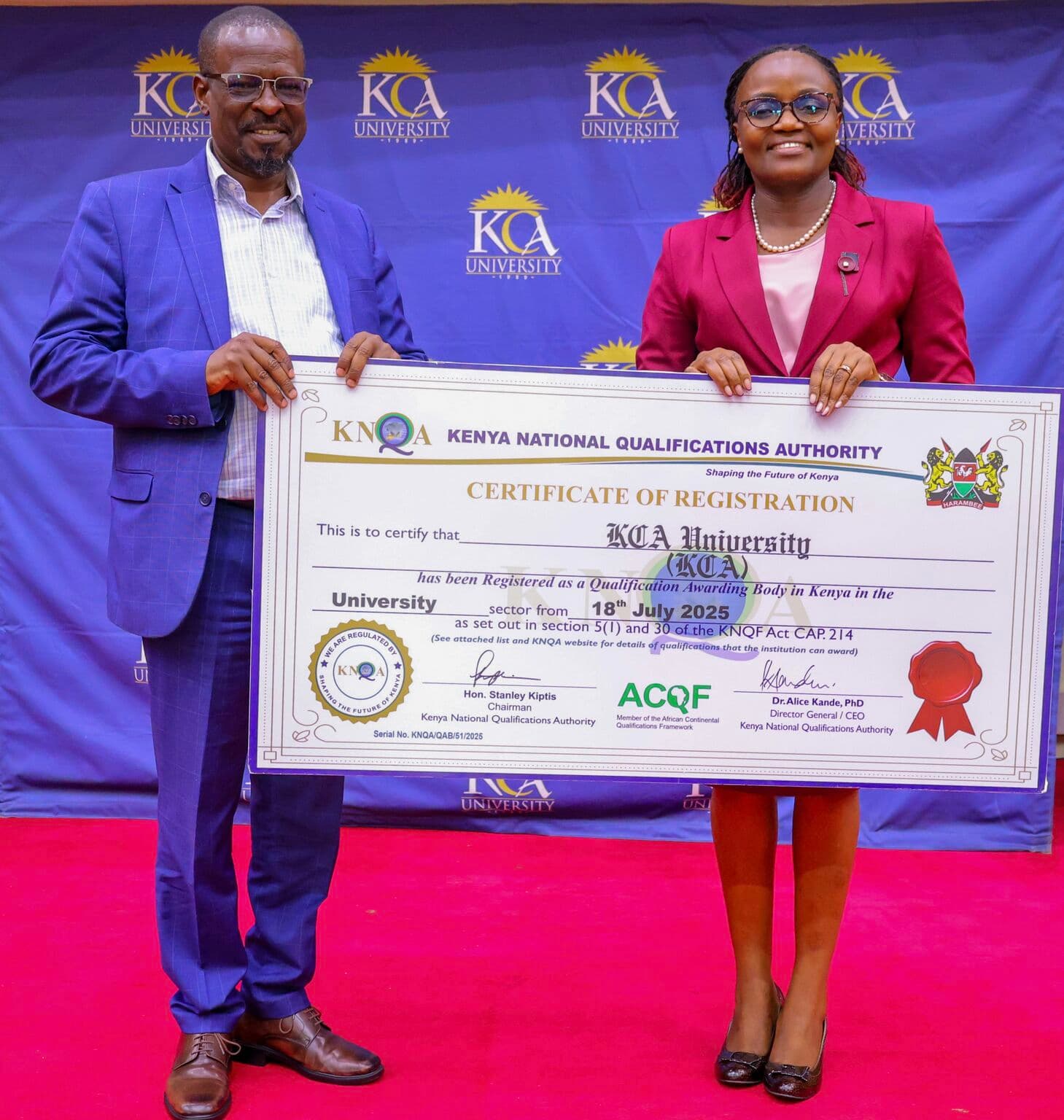
The Kenya National Qualifications Authority (KNQA) has registered KCA University as a Qualification Awarding Body (QAB) on the National Qualifications Database even as the authority acknowledged that the country’s drive to bring institutions under the Kenya National Qualifications Framework (KNQF) remains far from complete.
KNQA Council Chairperson Stanley Kiptis and Director-General Dr. Alice Kande presented the QAB Certificate to Vice Chancellor Prof. Isaiah Wakindiki at the university’s main campus.
Out of 122 institutions that KNQA has mapped for registration, only 31 have been formally registered as QABs. Kiptis called on unregistered institutions to accelerate their compliance, noting that statistics on awarding body registrations, qualification records and graduate data on the NQD reveal considerable ground yet to be covered.
Registration as a QAB requires an institution to demonstrate a legal mandate, sound governance structure and functional quality enhancement mechanisms. Once registered, the institution’s qualifications are evaluated for their appropriate level, credit value and alignment with the KNQF level descriptors.
All accreditation, qualification registration and learner registration processes are conducted through the National Qualification Management Information System (NQMIS), an online platform whose data feeds automatically into the NQD. KCA University is now required to upload its learner records onto the database as part of its obligations as a registered body.
ALSO READ:
https://educationnews.co.ke/ecde-centres-lower-primary-schools-s/
Dr. Kande said the registration formally anchors the university within the national qualifications system and urged institutions to revise their curricula using notional learning hours to accurately reflect the total learner workload, a requirement under the KNQF. She added that KNQA is working with the Commission for University Education (CUE) to ensure alignment in this area.
A total of 100,532 learners have so far been registered in the National Learners Records Database (NLRD) since the authority began on boarding institutions, a figure that reflects both the scale of the exercise and how much remains unregistered.
The CEO also invited KCA University to participate in the 1st National Qualifications Conference scheduled for May 12 to 14, 2026, describing it as a platform for advancing the national qualifications agenda.
By Benedict Aoya
You can also follow our social media pages on Twitter: Education News KE and Facebook: Education News Newspaper for timely updates.
>>> Click here to stay up-to-date with trending regional stories
>>> Click here to read more informed opinions on the country’s education landscape




Reader Discussion (0)
Sign in to comment