










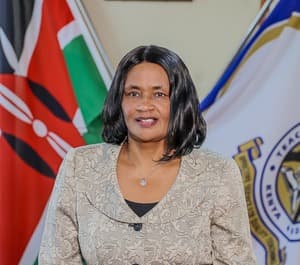
When Eveleen Mitei stepped into the role of Acting Chief Executive Officer of the Teachers Service Commission (TSC), she did so at a moment defined less by opportunity and more by constraint. The exit of Nancy Macharia had created a leadership vacuum, but what followed was not a smooth transition.
Court battles over the recruitment of a substantive CEO meant that Mitei assumed office without the full authority, security, or policy latitude that typically accompanies such a position. In many ways, her tenure has been a study in leadership under limitation, where the measure of success is not dramatic reform, but the quiet, often overlooked ability to hold a complex institution together.
The Teachers Service Commission is not a minor agency that can afford drift or indecision. It sits at the heart of Kenya’s education system, managing recruitment, discipline, deployment, and welfare for hundreds of thousands of teachers. Any instability at its helm reverberates quickly across schools, staffrooms, and classrooms nationwide.
Mitei’s first and perhaps most significant achievement has been to ensure that such instability did not occur. In a period when uncertainty could easily have translated into administrative paralysis, the commission continued to function. Salaries were processed, teacher management systems remained operational, and institutional routines were preserved. This kind of continuity rarely attracts headlines, yet it is the backbone of effective governance.
Equally notable has been her approach to stakeholder engagement, particularly with teacher unions. The relationship between the commission and unions has historically oscillated between cautious cooperation and open confrontation. Upon assuming office, Mitei signaled a different tone. Rather than retreating into bureaucratic defensiveness, she initiated dialogue, opening channels of communication around issues such as the Collective Bargaining Agreement.
ALSO READ:
https://educationnews.co.ke/nita-proposes-return-to-one-month/
While it would be inaccurate to claim that all tensions were resolved, the shift in posture mattered. It suggested a leadership philosophy that recognizes negotiation not as a sign of weakness, but as a necessary instrument of stability in a sector where morale and motivation directly affect learning outcomes.
This emphasis on engagement has been complemented by a leadership style that appears more consultative than prescriptive. Reports from within the education sector point to a more accessible office, one willing to listen before acting. In an institution often criticized for its perceived distance from the classroom realities of teachers, such accessibility is not trivial. It begins to rebuild trust, and trust, in turn, becomes a form of administrative capital.
When teachers feel heard, even difficult decisions become easier to implement. In this regard, Mitei’s tenure has subtly shifted the internal culture of the commission, nudging it toward responsiveness without compromising its regulatory mandate.
Her background in teacher discipline has also shaped her approach. Before rising to the acting CEO position, Mitei was deeply involved in enforcing professional standards, a role that required both firmness and procedural clarity. That experience has carried into her current position, where the commission has maintained a steady stance on issues of teacher conduct.
While discipline is often viewed negatively, in a system as large as Kenya’s, it is essential for safeguarding the integrity of the profession. By sustaining these standards, she has reinforced the idea that teaching is not merely a job, but a regulated profession with clear expectations and consequences.
What makes these achievements more significant is the context in which they have occurred. Acting appointments, by their nature, are transitional. They discourage long-term planning, limit bold decision-making, and often place leaders in a defensive posture as they await either confirmation or replacement.
ALSO READ:
https://educationnews.co.ke/teen-mothers-among-youth/
Mitei has had to operate within these constraints while also navigating financial pressures and policy uncertainties affecting the education sector. The delayed conclusion of key processes, such as negotiations tied to the next cycle of the Collective Bargaining Agreement, has further complicated her mandate. Yet, rather than allowing these limitations to stall the commission, she has focused on what is controllable: maintaining order, sustaining dialogue, and preventing regression.
There is also a symbolic dimension to her tenure that should not be overlooked. Leadership transitions in public institutions often expose underlying weaknesses, whether in governance structures or institutional culture. By steering the commission through this uncertain period without visible crisis, Mitei has demonstrated that stability is not always dependent on permanence.
Sometimes, it is the product of disciplined administration and measured decision-making. Her tenure challenges the assumption that acting leaders are merely placeholders. Instead, it suggests that even within temporary authority, meaningful impact is possible.
However, a balanced assessment must acknowledge the limits of her achievements. The absence of sweeping reforms is not necessarily a reflection of personal capacity, but of structural reality. Major policy shifts, systemic overhauls, and transformative initiatives typically require the legitimacy and time horizon that come with a substantive appointment.
ALSO READ:
https://educationnews.co.ke/kilifi-delegates-endorse-incumbent-knut-national-leadership-for-2026-2031-term/
Without these, any attempt at large-scale change risks being reversed or undermined. Mitei’s legacy, therefore, is unlikely to be defined by bold reforms, but by the steadiness of her stewardship.
In many ways, her tenure invites a rethinking of how leadership success is defined in public service. It is easy to celebrate visible change, to equate effectiveness with dramatic transformation. Yet, in complex systems like education, the absence of disruption can be just as valuable.
Keeping the system running, maintaining trust among stakeholders, and preserving institutional integrity are achievements that demand both competence and restraint. They require a leader who understands when to act decisively and when to prioritize continuity over change.
As the process of appointing a substantive CEO continues, the period of Mitei’s acting leadership will likely be remembered not for grand gestures, but for its quiet effectiveness. She has managed to stabilize a critical institution at a time when instability was a real possibility, set a tone of engagement in a historically tense environment, and uphold professional standards without escalating conflict. These may not be the achievements that dominate public discourse, but they are the ones that sustain systems and, ultimately, serve the broader goal of education.
By Ashford Kimani
Ashford teaches English and Literature in Gatundu North Sub-county and serves as Dean of Studies.
You can also follow our social media pages on Twitter: Education News KE and Facebook: Education News Newspaper for timely updates.
>>> Click here to stay up-to-date with trending regional stories
>>> Click here to read more informed opinions on the country’s education landscape



Reader Discussion (0)
Sign in to comment