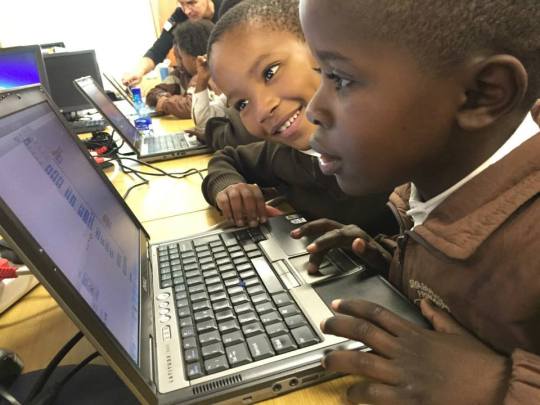
If a Kenyan child can memorise all the Premier League fixtures, unlock a smartphone faster than their grandmother can answer a call and navigate YouTube like a seasoned media analyst, then one thing is clear: our children are not digitally confused; they are digitally ready.
The real question is this: Are we teaching them to consume technology or are we preparing them to create it? That is where coding comes in. To say we must ‘hack their potential’ is not to suggest mischief. It is to recognise that every child carries raw brilliance waiting to be unlocked. And in today’s world, one of the smartest keys we can place in a child’s hand is the ability to code.
Let us be honest: the future is not arriving politely. It is already here; in our phones, our schools, our banks, our farms, our businesses and even our matatu routes. From mobile money to artificial intelligence, from digital classrooms to online jobs, technology is no longer a side issue. It is the road itself. And if Kenyan children are going to thrive on that road, they cannot remain mere passengers. They must learn how to drive.
One of the biggest lies we have told ourselves is that coding is for a special tribe of hoodie wearing, caffeine fuelled tech wizards somewhere in Silicon Valley. That myth needs to be buried; respectfully, but permanently. Coding is not first about computers. It is first about thinking. It teaches children how to approach problems without panicking.
It trains them to break down confusion into smaller, manageable parts. It helps them identify patterns, test ideas, make corrections and keep going when things fail. And that, frankly, is not just a digital skill. That is a life survival skill in Kenya.
A child who learns to fix a broken line of code is also learning how to face frustration without giving up. They are learning patience, resilience, precision and persistence; qualities that will serve them whether they become software developers, teachers, doctors, pilots, entrepreneurs or presidents.
ALSO READ:
Kisumu ready to host KSSSA Term One school games as St Mary’s Yala flexes for victory
Now let us not make the classic Kenyan mistake of turning every useful thing into a stressful exam topic. Coding for children should not begin with fear, jargon or thick notes that look like they were photocopied in 2003 and survived three governments. It should begin with play.
Young learners do not need to start by memorising complex programming languages. They need visual tools, digital stories, puzzles, games, animations and creative activities that make coding feel like exploration rather than punishment. When a child builds a talking cartoon, designs a simple game or creates an animated story, they are not ‘just playing.’
They are learning sequencing, logic, problem solving and digital creativity; without even realising how much heavy lifting their brain is doing. That is good teaching. Children learn best not when they are intimidated, but when they are intrigued.
One of the greatest tragedies of modern childhood is this: many children are surrounded by technology, yet remain strangers to how it works. They can swipe, tap, scroll, skip ads and find cartoons with frightening speed; but they are still mostly consumers. Coding changes that.
It shifts a child from being a passive user of technology to an active creator of it. Suddenly, the child is no longer just playing a game. They are asking: How was this game made? Can I build one? Can I make this better? That shift is powerful. It gives children agency.
It tells them they do not have to wait for someone in California, China or Bangalore to build the future for them. They, too, can create something useful, beautiful and world changing; right from a classroom in Nakuru, Kisii, Eldoret, Kibra or Kajiado. That is not a small thing. That is how nations are built.
Some people hear the word ‘coding’ and imagine a dry, joyless world of symbols, screens and mathematical suffering. But coding, when taught well, is astonishingly creative. A child building a game must imagine characters, settings, movement, rules, colour, timing and challenge.
A child designing an animation is telling a story. A child creating an app is solving a human problem. So no; coding is not the enemy of creativity. It is creativity wearing spectacles and carrying a laptop.
And in a world that increasingly rewards both imagination and innovation, this blend matters deeply. The future will not only belong to those who can think hard. It will belong to those who can think hard and build boldly.
ALSO READ:
There is also another myth worth retiring: the image of coding as a lonely child hunched over a machine in total silence like a digital monk. In reality, some of the best coding happens through collaboration. Children learn by sharing ideas, asking questions, comparing approaches and solving problems together. One child may understand the logic.
Another may have the design sense. Another may spot the error. Together, they create something stronger than any one of them could alone. That is real-world learning. And if there is one thing Kenyan children need, it is not just individual brilliance, but collaborative intelligence; the ability to think with others, create with others and solve with others. In coding, as in life, genius is often a group project.
Now here is the warning bell. Kenya has a dangerous habit of taking beautiful educational ideas and dragging them into the dark basement of over testing, over noting and over seriousness. Let us not do that with coding.
If we reduce coding to definitions, schemes of work, rigid lesson notes and exam panic, we will kill the very spirit that makes it valuable. We will turn innovation into another classroom funeral. Coding should not feel like punishment for being born in the 21st century. It should feel like discovery.
Teachers must therefore create environments where children are free to try, fail, laugh, fix, test and try again. In coding, mistakes are not proof of stupidity. They are part of the process. In fact, debugging is one of the most educationally rich things a child can do. Failure, in coding, is often just success wearing overalls.
This is where the conversation must become honest. Not every school in Kenya has a computer lab that works. Not every child has access to a tablet. Not every teacher has been trained to teach digital skills confidently. In some schools, the phrase ‘ICT lesson’ still means one dusty CPU and a printer that retired emotionally in 2016. So yes, access is a serious issue.
But lack of perfect infrastructure should not become an excuse for total paralysis. Coding can still begin with low cost and even offline methods. Children can learn computational thinking through games, logic activities, sequencing tasks, role play, paper based coding and teacher led simulations. Schools do not need to wait for a million shilling digital lab before they begin planting the right mindset.
What we need is not just equipment. We need intentionality. Government, school leaders, education stakeholders and private partners must invest in teacher training, affordable digital tools, child friendly coding platforms, and equitable access for both urban and rural learners. Because if coding only reaches children in elite schools with glossy brochures and suspiciously happy websites, then we will not be closing the opportunity gap. We will be decorating it.
ALSO READ:
Parents, too, must stop thinking coding is for ‘those very clever watoto’ who wear spectacles and speak fluent keyboard. Your child does not need to be a mathematical prophet to begin learning how to code. What they need is encouragement.
Let them explore. Let them ask questions. Let them tinker. Let them fail without being mocked. Let them build nonsense before they build brilliance. Because that is how learning works. A child who is free to experiment becomes a child who is free to imagine. And a child who is free to imagine becomes a child who can one day innovate.
In a country where unemployment, economic uncertainty and rapid technological change are real, we cannot afford to raise children who are only trained to wait for instructions. We must raise children who can create solutions.
Yes, coding may open doors to careers in software, robotics, data science, cybersecurity, game design and digital entrepreneurship. But this conversation is bigger than employment. Teaching children to code is ultimately about giving them a way of thinking that helps them survive and thrive in a world that keeps changing without warning.
The jobs of tomorrow are still being invented. The tools of tomorrow are still being built. The challenges of tomorrow are already warming up. So the greatest gift we can give children is not just information. It is adaptability. It is curiosity. It is confidence. It is the courage to face a new world and say, I may not know everything yet, but I know how to learn, think and build. And that is priceless.
To ‘hack their potential’ is not to force Kenyan children into becoming miniature software engineers with eye bags and startup dreams. It is to open their minds. It is to show them that the devices in their hands are not just for scrolling, dancing, gossip and disappearing bundles. They are also tools for invention, expression and transformation.
Coding is not the whole future. But it is certainly one of the languages of the future. And if we want Kenyan children not just to survive tomorrow, but to shape it, then we must teach them that language today.
Because the child who learns to code may one day do more than build an App. They may build a solution. They may build a company. They may build a country.
By Virginia Bwana
Virginia Bwana is an early childhood educator and a champion of homeschooling.
You can also follow our social media pages on Twitter: Education News KE and Facebook: Education News Newspaper for timely updates.
>>> Click here to stay up-to-date with trending regional stories
>>> Click here to read more informed opinions on the country’s education landscape