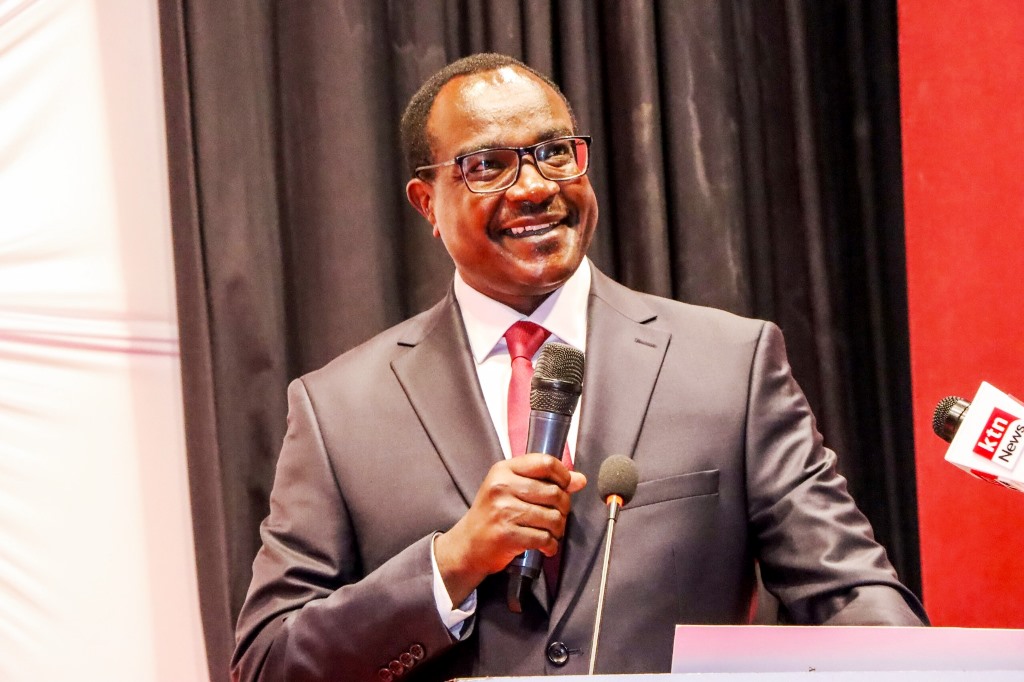
Education Cabinet Secretary Julius Migos Ogamba has appointed Professor Clara Samiji Momanyi as the new Non-Executive Chairperson of the Council of Kenyatta University.
The appointment takes effect on December 19, 2025, and will run for a three-year term, in accordance with Section 36 (1) of the Universities Act.
“In exercise of the powers conferred by section 36 (1) of the Universities Act, the Cabinet Secretary for Education appoints– Under paragraph (a)– Clara Samiji Momanyi (Prof.) to be the Non-Executive Chairperson of the Council of the Kenyatta University, for a period of three (3) years, with effect from the 19th December, 2025,” a gazette notice by Ogamba reads.
“The appointment of Ben Chumo (Dr.) is revoked.”
Professor Momanyi replaces Dr Ben Chumo, who resigned from the position in November 2025 following controversy surrounding governance issues and delays in the recruitment of a substantive vice-chancellor.
Chumo stepped down on November 17 this year submitting his resignation letter to CS Ogamba shortly before a scheduled full council meeting that was to deliberate on the criteria for appointing a new vice-chancellor.
In a statement issued after his resignation, Chumo maintained that his decision was guided by principle. He dismissed claims that pressure from the Kenya Universities Staff Union (KUSU) influenced his departure.
“Contrary to claims, I did not resign because of union pressure—nothing could be further from the truth. I have faced far greater pressures leading large organisations.
My resignation is a matter of principle: if the ministry has no faith in me, then they should find someone else to run the process,” Chumo told one of the dailies.
He further suggested that specific individuals may have been using the union to advance a misleading narrative.
“The union’s statement appears to be an attempt to trivialise an important process and make themselves appear to be a mouthpiece. Someone is using the union to assign blame, perhaps even to make it look like they pushed me out,” he said.
Chumo also pointed to what he described as interference by senior officials, arguing that it signalled diminished confidence in the council’s leadership.
According to him, the ministry’s involvement in internal council matters—particularly the vice-chancellor recruitment—undermined the credibility of the process.
READ ALSO:
How parents can appeal Senior School placement after results release
“The biggest issue here is the process. When you interfere with the process, the outcome becomes compromised. Things do not go wrong—they start wrong,” he said.
“When the ministry stepped into our Council room, that signalled the wrong start. That is why I chose to step aside.”
The leadership transition comes at a crucial moment for Kenyatta University as it prepares for the retirement of Vice-Chancellor Professor Paul Wainaina in January 2026. Professor Momanyi is expected to steer the council through this transition period.
Her appointment was published in a Gazette Notice on December 19, 2025.
The notice did not indicate reasons for the leadership change sparking public debate and internal concerns over governance and transparency at the university.
Professor Momanyi’s tenure will therefore be closely observed as the university enters a new phase of academic and administrative planning.
A distinguished scholar, Momanyi has taught Kiswahili literature in several Kenyan universities. She is also a prolific creative writer, translator, and researcher, with notable contributions to the development of the Kiswahili language and literature.
Her creative works include Tumaini, Nakuruto, and Nguu za Jadi. She has also authored several children’s books, among them Ushindi wa Nakate—winner of the 2015 Text Book Centre Jomo Kenyatta Prize for Literature—as well as Siku ya Wajinga and Pendo Katika Shari.
By Joseph Mambili
You can also follow our social media pages on Twitter: Education News KE and Facebook: Education News Newspaper for timely updates.
>>> Click here to stay up-to-date with trending regional stories
>>> Click here to read more informed opinions on the country’s education landscape