








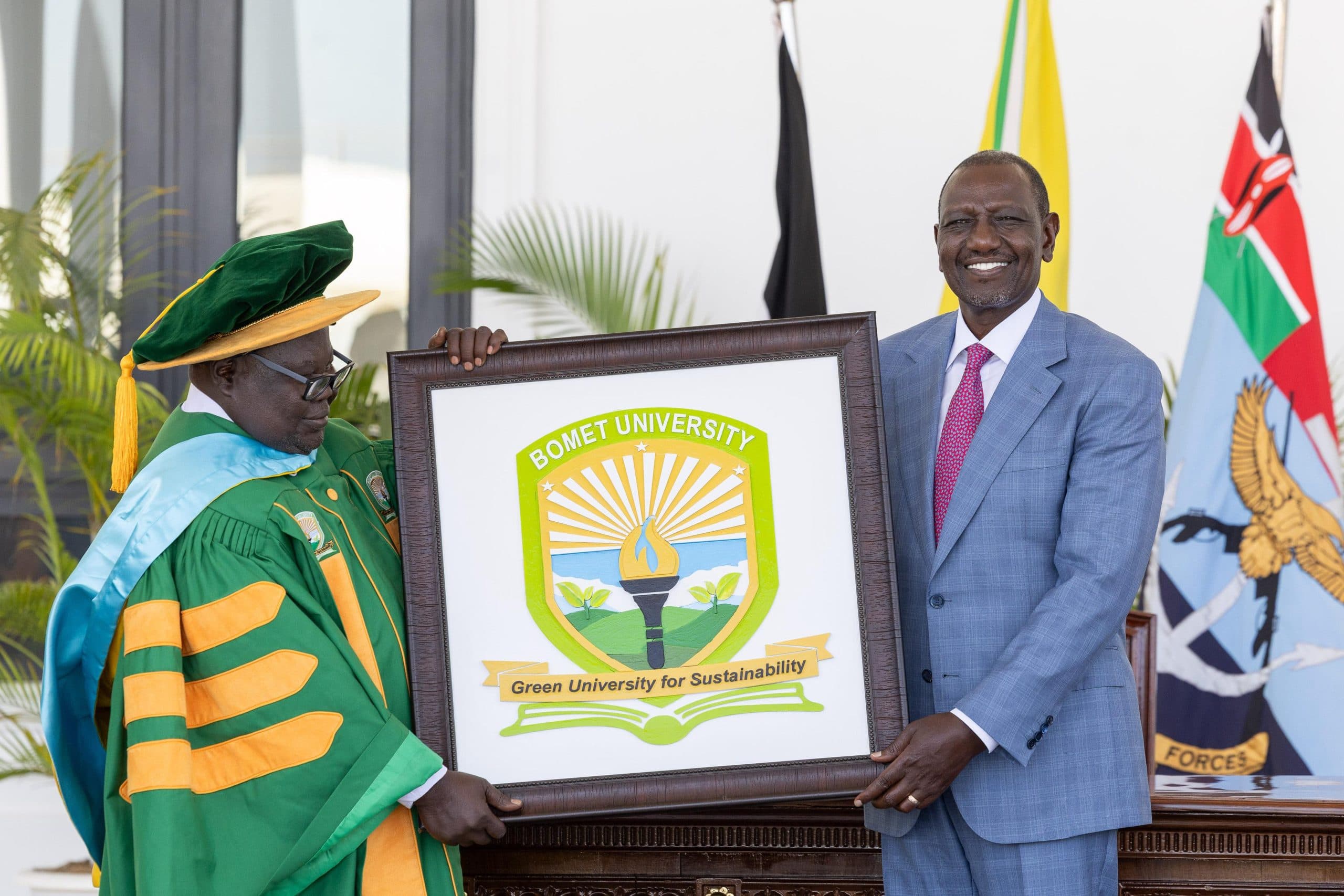
Bomet University has officially joined Kenya’s league of fully-fledged public universities after awarded it a charter at State House, Nairobi, a move that strengthens the government’s aggressive expansion of higher education and reshapes access to university training in the South Rift region.
With the charter, Bomet University becomes the 36th public chartered university, raising the total number of universities in the country to 83 and serving a combined student population of nearly 630,000 learners.
The milestone places Bomet at the centre of Kenya’s rapidly evolving higher education landscape, driven by funding reforms, rising enrolments and a renewed emphasis on science, research, and innovation.
Speaking during the ceremony on Wednesday, President Ruto framed the chartering of Bomet University as part of a broader national strategy to use education as an engine of economic transformation, equity, and shared prosperity.
“Education remains the surest path to transformation,” the President said, underscoring the government’s determination to ensure that every qualified Kenyan has a fair chance to access university education regardless of background.
ALSO READ:
https://educationnews.co.ke/tsc-suffers-another-blow-as-fresh-court-order-halts-ceo-recruitment/
The charter comes at a time when the government is rolling out sweeping reforms in higher education financing. Central to these changes is the student-centred funding model, which channels resources directly to learners based on need and ability, replacing blanket subsidies that critics say favoured a few institutions at the expense of equity.
The reforms are backed by increased public spending, whereby the education budget has risen from Ksh490 billion in 2021 to over Ksh700 billion in the current financial year, funds the government says are already improving infrastructure, stabilising universities and expanding teaching capacity.
Beyond access, the President placed heavy emphasis on research and innovation, announcing renewed momentum to position universities as engines of problem-solving and enterprise creation.
The establishment of a state department for science, research, and Innovation is intended to anchor STEM training and accelerate the commercialisation of academic research.
ALSO READ:
https://educationnews.co.ke/tvet-cdacc-releases-november-december-2025-assessment-results/
The government also reaffirmed its commitment to scale up the National Research Fund, targeting an increase in research investment from 0.8 per cent to 2 per cent of GDP, with a long-term goal of building a Ksh1 trillion research and innovation base within the next decade.
For Bomet University, the charter marks the culmination of years of institutional growth and academic consolidation, transforming it from a regional institution into a national and international player.
While rooted in the South Rift, the university is now positioned to attract students, researchers and partnerships from across Kenya, the East African region and beyond.
As the government pushes to decentralise higher education and bring universities closer to communities, Bomet University’s elevation signals both opportunity and expectation — to deliver quality teaching, impactful research and tangible community development in line with Kenya’s broader economic ambitions.
By Philip Koech
You can also follow our social media pages on Twitter: Education News KE and Facebook: Education News Newspaper for timely updates.
>>> Click here to stay up-to-date with trending regional stories
>>> Click here to read more informed opinions on the country’s education landscape



Reader Discussion (0)
Sign in to comment