








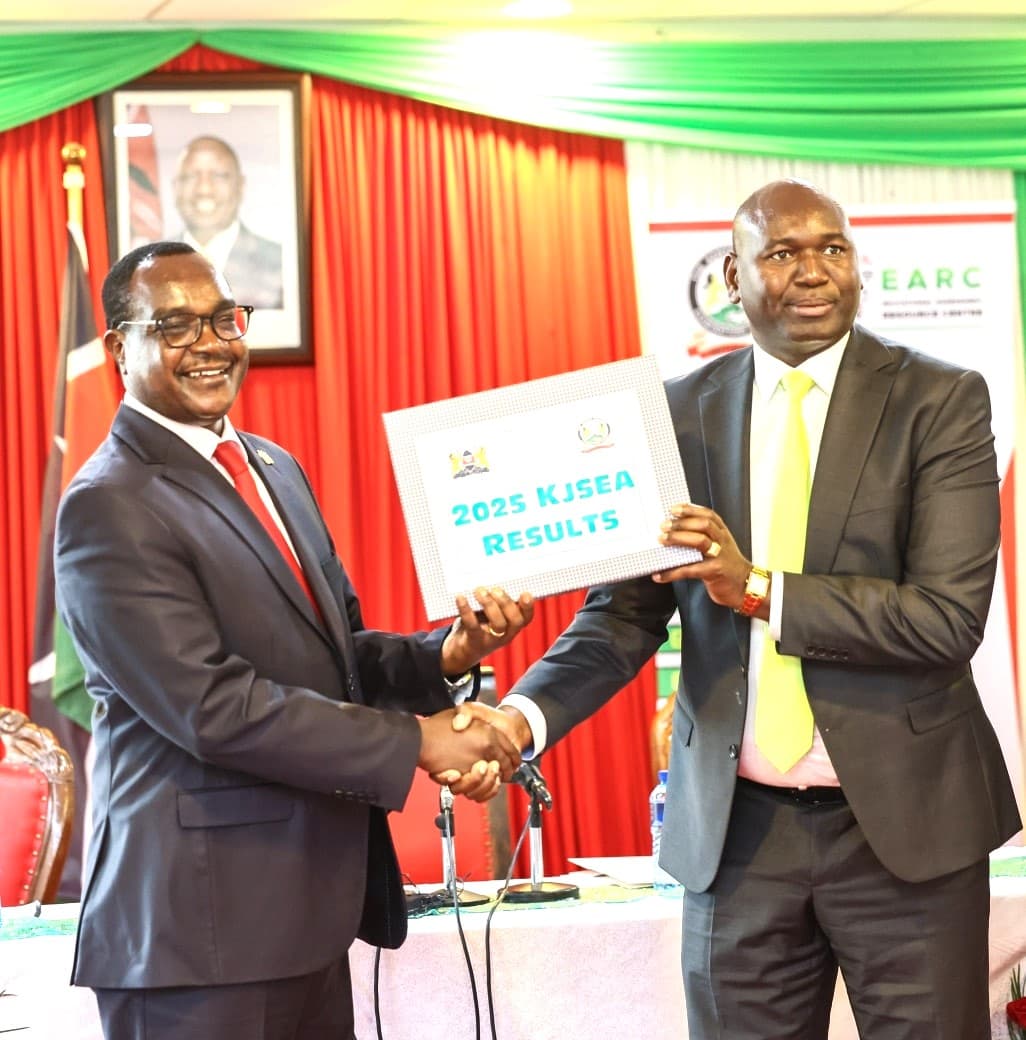
Kenya’s education landscape entered a new chapter this week as the Ministry of Education released the results of the first-ever Kenya Junior School Education Assessment (KJSEA), marking a major shift in how the country evaluates learner progress under the Competency-Based Curriculum (CBC).
Unlike previous national examinations—which were synonymous with tense countdowns, ranking races, and public pressure—a calmer, more learner-centred tone marked the release of KJSEA results.
Education Cabinet Secretary Dr Julius Ogamba, while announcing the results in Nairobi, emphasised that the new assessment framework is designed to guide learner progression—not to punish, rank, or label children.
“This assessment is meant to show a learner’s strengths, competencies, and areas that need support. It is not a verdict on a child’s future,” Ogamba said, urging parents to embrace the new system with openness and patience.
Ogamba noted that more than 1.13 million learners sat for the KJSEA, which evaluates nine learning areas using achievement levels rather than raw marks. He highlighted that the structure promotes fairness, reduces exam anxiety, and encourages teachers to focus on continuous learning instead of drilling.
As results continue to appear on the national portal, many parents and guardians have been seeking clarity on how to interpret the KJSEA scores, especially since the system differs fundamentally from KCPE’s traditional approach.
READ ALSO:
https://educationnews.co.ke/acting-tsc-ceo-awarded-moran-of-order-of-the-burning-spear-in-jamhuri-day-honours/
Below is a simple guide to understanding the meanings of the numbers and abbreviations.
How the KJSEA Achievement Levels Work
KJSEA performance is measured through four broad categories: Exceeding Expectations, Meeting Expectations, Approaching Expectations, and Below Expectations. Each level has two sub-bands, with corresponding points.
1. Exceeding Expectations (EE)
Junior School in this band have exhibited skills and comprehension above the expected level.
- EE1 (90–100%) – 8 points
- EE2 (75–89%) → 7 points
2. Meeting Expectations (ME)
Stands for solid, grade-appropriate mastery.
- ME1 (58–74%) → 6 points
- ME2 (41–57%) → 5 points
3. Approaching Expectations (AE)
Learners show partial mastery but need support.
- AE1 (31–40%) → 4 points
- AE2 (21–30%) → 3 points
4. Below Expectations (BE)
Signals areas requiring targeted interventions.
- BE1 (11–20%) → 2 points
- BE2 (1–10%) → 1 point
With nine learning areas, the highest possible score is 72 points (8 points × 9 subjects).
A score of 36 points represents the average national achievement level.
Putting the Results in Context
CS Ogamba said that the assessment is formative rather than summative, and that placement to Senior School in 6 will not be solely dependent on one test.
He emphasised that: Learner strengths and competencies will guide Senior School pathways (STEM, Social Sciences, Arts & Sports Science), Parents should not compare children based on points, Teachers are expected to use results to offer support where needed and Every learner has a place and a pathway in the CBC system.
His remarks came in the wake of Kenya shifting from a KCPE-style ranking culture to a more meaningful understanding of learner development.
This aligns with the ministry’s broader focus on competency, values, and life skills rather than memorisation.
By Joseph Mambili
You can also follow our social media pages on Twitter: Education News KE and Facebook: Education News Newspaper for timely updates.
>>> Click here to stay up-to-date with trending regional stories
>>> Click here to read more informed opinions on the country’s education landscape
>>> Click here to stay ahead with the latest national news.



Reader Discussion (0)
Sign in to comment