- Gender and Social Services CS Anna Cheptumo says FGM remains a major threat to girls’ education.
- She says improved security in Baringo has helped families return home and learners resume schooling.
- The Government is also expanding digital access and supporting literacy efforts in areas such as Tiaty.
Gender and Social Services Cabinet Secretary Anna Cheptumo has reiterated the Government’s commitment to ending female genital mutilation (FGM), describing the practice as a major threat to girls’ education and their future.
Cheptumo said retrogressive cultural practices continued to expose girls to FGM and early marriage, while pushing boys into banditry in pursuit of wealth.
“Retrogressive practices have encouraged our girls to undergo FGM and get married at an early age, while our boys indulge in banditry to get wealth,” she said.
Speaking in Eldama Ravine, Baringo County, she urged communities to abandon harmful practices and instead embrace education, saying it remained a powerful tool for transforming lives and opening opportunities for young people.
Cheptumo said literacy levels in the region had risen to 75 per cent, attributing the improvement partly to increased security in volatile parts of Baringo County.
She commended President William Ruto’s administration for what she described as a robust programme to address FGM and promote girls’ education, including the implementation of anti-FGM laws and policies aimed at achieving zero tolerance to the practice and ensuring girls remain in school.
“We have a policy of zero tolerance to FGM and mandatory education of girls,” she said.
The Cabinet Secretary said her ministry was working closely with security agencies to achieve the government’s objectives, noting that communities that had fled their homes due to insecurity were gradually returning.
“When there is disruption, learners move away from schools and people run to safe places. We are happy that security has now been regularised and things have returned to normal,” she said.
Cheptumo also highlighted the role of technology in accelerating development and improving access to education. She said internet connectivity was being expanded across the country to boost digital literacy.
“Technology is one of the pillars of development, and we are using it to tackle the challenges facing our people,” she said.
She further called for positive parenting, urging parents to invest in the education of their children.
“Education is an equaliser. It can change your future and enable you to dine with kings,” she said.
Government pushes digital literacy
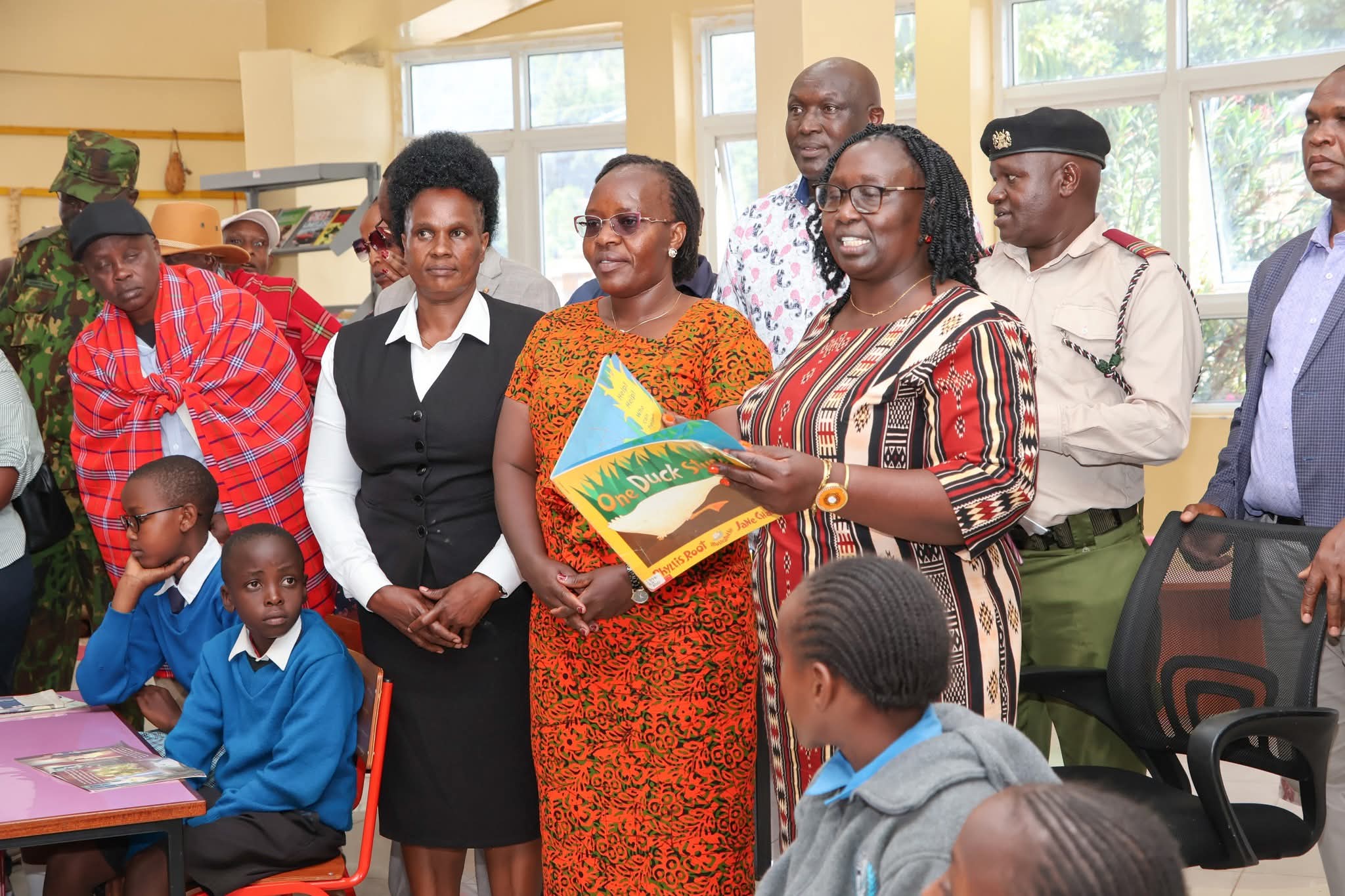
Cheptumo also allayed fears that digitisation could undermine traditional library services, saying the Government was instead seeking to modernise libraries and expose Kenyans to emerging technologies, including artificial intelligence.
“Digitisation will not paralyse library services. We are leveraging what is happening across the country to bring AI equipment to libraries so that Kenyans can get exposure,” she said.
On efforts to improve literacy in Tiaty, Cheptumo said the Government’s interventions were beginning to bear fruit, pointing to an increase in the number of children enrolling in early childhood development education (ECDE).
She said Tiaty had now recorded the highest number of ECDE learners in Baringo County, a development she described as a positive sign in the fight against illiteracy.
READ ALSO: At 90, John Khaminwa’s life offers Kenya a lesson in law, courage and service
“Efforts to combat illiteracy in Tiaty are bearing fruit. The influx of ECDE learners shows that communities are increasingly embracing education,” she said.
By Kimutai Langat
Get more stories from our website: Education News
To write to us or offer feedback, you can reach us at: editor@educationnews.co.ke
You can also follow our social media pages on Twitter: Education News KE and Facebook: Education News Newspaper for timely updates.
>> Click here to stay up-to-date with trending regional stories