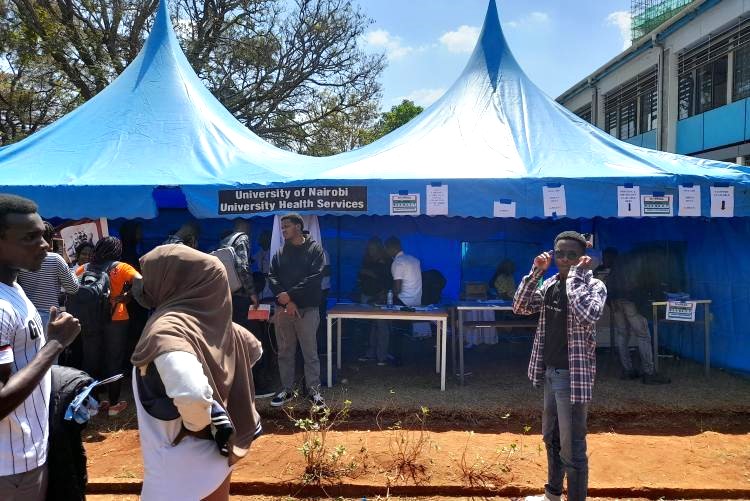
- Hillary Muhalya examines how Kenya’s transition to the Social Health Authority is changing healthcare arrangements for university students.
- He argues that students need to understand their registration status, dependant eligibility, referrals and benefit entitlements before illness strikes.
- Hillary maintains that universities should make SHA orientation part of student induction so learners can navigate healthcare without unnecessary delays or costs.
The medical card is changing — and university students must learn how to navigate Kenya’s new healthcare system.
For a university student who wakes up sick thousands of kilometres from home, the most important question is no longer simply whether there is a campus clinic.
It is: Who will pay for my treatment?
That question is becoming increasingly important as Kenya moves deeper into the Social Health Authority (SHA) era and universities bring the new health financing system into student registration and medical arrangements.
Thousands of students entering universities and colleges in 2026 are already encountering SHA-related medical requirements as part of their admission and campus clearance processes.
But behind the paperwork is a much bigger transformation.
The old assumption that a student could simply present a university medical card and expect the institution to handle the bill is giving way to a system in which students must understand their SHA status, eligibility, healthcare providers, referrals and the benefits attached to their cover.
For a generation already struggling with tuition, accommodation, food, transport and other living expenses, that knowledge could prove as valuable as the student ID card itself.
One of the biggest areas of confusion concerns students who reach adulthood while still in university.
Under the Social Health Insurance Act, a beneficiary can include a person below 21 who has no income and lives with the contributor. Crucially for university students, the law also provides dependant eligibility for a person below 25 who is undertaking a full-time course at a university, college, school or other educational institution and has no income other than a scholarship, bursary or similar award.
That means a student who turns 18 while studying should not automatically assume that their parents’ or guardians’ health cover has disappeared.
The Social Health Insurance Regulations require an individual who turns 18 to update their registration details within 90 days. However, the regulations expressly provide that eligible students below 25 can continue accessing healthcare as beneficiaries under a contributor’s cover while undertaking full-time education and meeting the applicable conditions.
For parents, therefore, the message is clear: do not leave a student’s SHA status to assumption.
For students, the message is equally important: know exactly how you are registered.
For many learners, the campus medical centre will be the first place they go when they develop a fever, suffer an injury, require a consultation or need basic medical attention.
But the university clinic should increasingly be viewed as part of a wider healthcare network rather than an isolated facility.
Where the campus facility can manage the condition, treatment can begin there.
Where a student needs diagnostic investigations, specialised treatment or hospital admission beyond the facility’s capacity, the learner may have to move to an appropriate healthcare provider within the SHA system.
That makes referrals crucial.
A student should not simply leave campus and assume that the nearest private hospital will automatically provide the required service under SHA.
Registration does not mean every bill is automatically covered
The biggest mistake would be to believe that SHA registration means every medical bill is automatically paid in full.
It does not work that simply.
SHA administers three major financing arrangements: the Primary Healthcare Fund, the Social Health Insurance Fund and the Emergency, Chronic and Critical Illness Fund. The Social Health Insurance Act establishes these three funds, while SHA identifies their administration as part of its mandate.
The applicable benefits include a range of healthcare services, but the particular service, healthcare facility, referral pathway, benefit package and any applicable limits still matter.
This means students must stop thinking about healthcare simply in terms of “I have SHA” and start thinking in terms of: “What does my entitlement allow me to access, where and under what conditions?”
That is a major cultural change.
A student should develop a simple habit before seeking non-emergency treatment outside campus:
Is my SHA status active?
Does this facility participate in the SHA system?
Is the service I need covered under my applicable benefit package?
If referral is required, there is another question:
Do I need to be referred by my campus or primary healthcare facility before accessing specialised care?
These questions could prevent students from discovering a financial liability only after receiving treatment.
Consider a student injured in a road accident during a weekend trip home.
The first priority is emergency treatment.
The student should not be left waiting for administrative clarification when immediate medical attention is required.
But once the emergency is stabilised, the healthcare provider and student need to navigate the applicable SHA procedures.
This is why universities need clearly communicated emergency arrangements.
Students should know which campus number to call, where the nearest appropriate hospital is located and how the university medical department interacts with SHA-participating facilities.
Mental health cannot be ignored either.
University life brings academic pressure, financial stress, relationship problems, homesickness and uncertainty about the future.
Consequently, healthcare for students cannot be reduced to malaria, accidents, infections and broken bones.
Healthcare services under the SHA legal framework encompass both physical and mental impairments, reinforcing the need for universities to treat mental-health support as part of mainstream student healthcare.
A student who is struggling psychologically should know where to seek help just as clearly as a student suffering from a physical illness.
There is another group that requires particular attention: students living with chronic conditions.
A university student may require regular medication, laboratory monitoring, specialist consultations or continuing treatment.
For such learners, interruption of treatment can have serious academic and personal consequences.
The Emergency, Chronic and Critical Illness Fund is therefore particularly significant, although the exact entitlement depends on the applicable rules and benefit package.
Universities should identify appropriate confidential support mechanisms so that students with continuing medical needs can navigate the system without unnecessary disruption to their studies.
Universities must strengthen SHA orientation
University students are mobile.
A learner may be studying in Nairobi but spend the weekend in Nakuru.
Another may be enrolled in Eldoret but travel to Kisumu during the holidays.
Another may return to a rural home in West Pokot, Turkana or Bungoma.
Healthcare must therefore follow the student.
The new system makes it increasingly important for students to understand how to identify appropriate SHA-participating facilities beyond their university campus.
The campus clinic is a starting point — not necessarily the student’s only healthcare destination.
Universities should treat SHA orientation as seriously as academic registration.
A new student should not leave orientation knowing only how to access the library, register for courses and find lecture rooms.
They should also know how to confirm SHA registration, establish whether their cover is active, understand dependant status, locate the campus medical centre, identify facilities they can access outside campus and know when referrals are required.
They should understand how emergency treatment is handled, how to seek mental-health support, what to do if treatment is denied or delayed and where to obtain assistance when a SHA-related problem arises.
This is not bureaucracy.
It is health literacy.
The SHA transition is not solely a university problem.
Parents and guardians supporting students should also verify the student’s status before sending them to campus.
A parent who assumes that a child automatically remains covered without confirming registration could discover the problem only after a medical emergency.
The same applies to students who have reached 18.
The family should establish whether the student has been properly registered under the applicable SHA arrangement rather than relying on assumptions.
The transition from NHIF to SHA is more than changing the name on a medical card.
SHA represents a different architecture of healthcare financing, with the Authority administering the Primary Healthcare Fund, Social Health Insurance Fund and Emergency, Chronic and Critical Illness Fund.
For university students, the practical lesson is simple.
The health system is no longer something that happens around them.
They have to learn how to navigate it.
A student who understands the system can seek treatment faster, ask the right questions and avoid unnecessary financial surprises.
A student who does not understand it may discover the rules only when already sitting in a hospital.
Ultimately, the success of SHA among university students will not be measured by how many learners fill out registration forms.
It will be measured by what happens when a student actually becomes ill.
Can the student access treatment quickly?
Can the campus clinic coordinate appropriate care?
Can the learner obtain a referral without unnecessary delays?
Can a student with a chronic condition continue treatment?
Can a young person experiencing a mental-health crisis obtain professional assistance?
And can students and their families understand what SHA pays for before a hospital bill arrives?
Those are the questions that will determine whether the new system becomes a genuine safety net or another complicated government programme that students struggle to understand.
For universities, the prescription is clear: SHA education must become part of student orientation.
For parents, it is equally straightforward: verify your student’s status before an emergency occurs.
And for students, the message is perhaps the simplest of all:
Know your cover before you need it.
READ ALSO: Grade 9 learners given five days to complete Grade 10 school, pathway selections
Because when illness strikes in the middle of a semester, knowing where to go may matter almost as much as knowing who will pay.
By Hillary Muhalya
Get more stories from our website: Education News
To write to us or offer feedback, you can reach us at: editor@educationnews.co.ke
You can also follow our social media pages on Twitter: Education News KE and Facebook: Education News Newspaper for timely updates.
>> Click here to stay up-to-date with trending regional stories