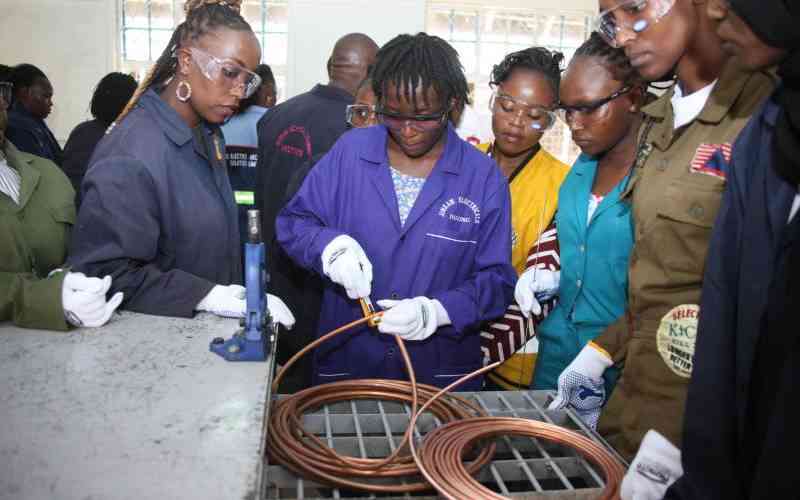
- Kenya has continued to treat TVET as a second-choice pathway, despite growing calls for it to become a central driver of jobs and industrialisation.
- Experts have called for stronger alignment between TVET training and labour market needs, alongside modern workshops, better-trained instructors and stronger private sector partnerships.
- Analysts have urged Kenya to reform public perception of technical education and prepare TVET institutions for emerging industries such as renewable energy, robotics and automation.
Kenya cannot achieve meaningful industrialisation, create enough decent jobs for its youthful population or compete effectively in a rapidly changing global economy without a strong Technical and Vocational Education and Training (TVET) system. For years, however, TVET has often been treated as a second-choice pathway, an option for learners perceived not to have excelled in conventional academic education. That perception is outdated and increasingly dangerous.
The country needs to fundamentally change the way it looks at technical education. TVET should not be the destination after academic failure. It should be one of the most powerful engines of skills, employment, entrepreneurship and economic transformation. Kenya’s economy needs competent electricians, plumbers, welders, mechanics, builders, machine operators, ICT specialists, agricultural technicians, renewable-energy experts, chefs, automotive technicians and thousands of other skilled professionals. These are the people who keep industries running, construct infrastructure, maintain machinery, provide essential services and turn ideas into tangible products.
ALSO READ:
Prof. Olive Mugenda: The woman who broke Kenya’s university leadership glass ceiling
Aligning training with the realities of the labour market
The first step towards rebuilding TVET must therefore be to align training with the realities of the labour market. Institutions should regularly review their programmes to establish whether the skills being taught correspond with what employers and industries require. Kenya should avoid a situation where institutions continue producing graduates in areas with limited opportunities while companies struggle to find appropriately skilled technicians.
The world of work is changing rapidly. Electric vehicles are gaining ground, renewable energy is expanding, agriculture is becoming increasingly technology-driven, manufacturing is embracing automation and digital technologies are transforming businesses. TVET must move at the same pace. The workshop must become as important as the classroom, since a learner cannot become a competent technician simply by memorising notes and passing examinations. Technical competence requires practical experience, meaning TVET institutions need modern workshops, laboratories, machinery, tools, simulators and digital equipment.
Investment should therefore not stop at constructing classrooms and administrative buildings. Institutions must be equipped with the technology students will encounter after graduation. Outdated equipment risks producing graduates trained for yesterday’s economy when employers are looking for skills for tomorrow’s workplace.
The private sector should also become a much stronger partner in TVET development. Industries can participate in curriculum development, provide equipment, offer apprenticeships and expose trainees to real working environments. Industrial attachment should not be treated as a short formality that students complete simply because it is required. Kenya needs a stronger workplace-based training and apprenticeship culture in which students spend meaningful time learning from experienced professionals. Such partnerships would benefit both sides: students would gain practical experience while employers would have an opportunity to identify and nurture future employees.
But equipment and facilities alone cannot transform TVET. The quality of instructors is equally critical. TVET trainers must continuously upgrade their knowledge because technology and industrial practices are constantly evolving. Instructors should have opportunities for professional development, industry exposure and practical refresher training, since a trainer who has not interacted with modern industrial technology for years may find it difficult to prepare students for a modern workplace.
KUSNET petitions Ruto to push Treasury on stalled promises to SNE teachers
Kenya must also address the affordability of technical education. Fees, accommodation, transport, tools and other costs can prevent talented young people from completing training. Government financing, scholarships and student-support programmes should therefore be strengthened, while institutions should receive funding in a predictable and timely manner. Supporting a young person through technical training should be regarded as an investment in Kenya’s productive capacity.
Changing public perception and preparing TVET for the future
There is also a battle that must be fought beyond classrooms and workshops: the battle over public perception. Parents and society must stop telling young people that TVET is where they go when they have failed academically. A highly skilled technician can establish a successful business, employ other people and build a prosperous career. The electrician who understands modern electrical systems, the mechanic trained in electric vehicles, the welder working with advanced fabrication equipment and the technician maintaining industrial machinery are not failures. They are critical players in the economy.
Kenya should therefore deliberately promote technical careers and expose learners to them early enough to make informed choices. TVET should be presented as a prestigious and practical career pathway capable of leading to employment, entrepreneurship and further education.
Another important reform concerns assessment. The ultimate question in technical education should be simple: can the trainee actually do the job? Assessment should therefore give sufficient weight to practical competence, troubleshooting, creativity, precision, safety and workplace discipline alongside theoretical knowledge. A certificate should represent genuine competence rather than merely successful completion of examinations.
TVET can also become a powerful vehicle for youth entrepreneurship. Not every graduate will immediately find formal employment. Training should therefore equip students with business skills that allow them to establish and manage enterprises, covering financial management, pricing, taxation, digital marketing, customer service, business planning, procurement and access to financing. A graduate who knows both how to repair a machine and how to run a business has a significantly greater chance of becoming a job creator.
Kenya must equally prepare TVET for the industries of the future. Training programmes should increasingly embrace renewable energy, electric mobility, automation, robotics, artificial intelligence, cybersecurity, advanced manufacturing, digital fabrication and modern agricultural technologies. The country’s training institutions cannot continue preparing young people for an economy that is disappearing.
TVET must also become a ladder rather than a dead end. Learners should have clear opportunities to progress from artisan training to certificate, diploma and higher qualifications where appropriate. Recognition of prior learning should also be strengthened so that experienced workers can have their skills formally recognised and gain opportunities to upgrade their qualifications.
Universities Fund receives over 159,000 funding applications from first-year students
At the institutional level, governance and accountability must be strengthened. Money allocated to TVET should translate into functioning workshops, modern equipment, competent trainers, learning materials and meaningful practical training. The success of the sector should ultimately not be measured merely by the number of institutions constructed or students enrolled. The more important questions are: How many graduates secure decent jobs? How many establish businesses? How many industries recruit them? How many innovations emerge from TVET institutions? And how many graduates go on to create employment for others? Those are the indicators that should define Kenya’s TVET success story.
Kenya has a youthful population, ambitious development goals and enormous demand for skilled labour. The opportunity is therefore enormous. What is required is a decisive change in attitude, investment and policy. TVET must stop being Kenya’s Plan B. It should become one of the country’s strongest Plan A strategies for employment, industrialisation, innovation and economic transformation.
A country cannot build modern infrastructure without technicians. It cannot operate factories without skilled workers. It cannot expand renewable energy without trained specialists. It cannot maintain sophisticated machinery without competent artisans. And it cannot build a modern digital economy without technical talent. The future of Kenya’s economy will therefore depend not only on how many young people enter institutions of learning, but on how effectively those institutions equip them with skills that the real world needs.
Rebuilding TVET into a powerhouse is not simply an education reform. It is an investment in Kenya’s workforce, industries, enterprises and economic future.
By Hillary Muhalya
You can also follow our social media pages on Twitter: Education News KE and Facebook: Education News Newspaper for timely updates.
>>> Click here to stay up-to-date with trending regional stories
>>> Click here to read more informed opinions on the country’s education landscape
>>> Click here to stay ahead with the latest national news.