- Lucy Achieng says social-emotional skills training helped her rebuild relationships and take control of her life.
- The 27-year-old used financial literacy lessons to save money and purchase a second-hand sewing machine.
- She now hopes to join a TVET institution and develop her skills as a professional fashion designer.
A social-emotional skills programme has helped a young mother in Oyugis, Homa Bay County, overcome alcohol abuse, rebuild her family and launch a tailoring business.
Lucy Achieng, 27, says her life was once characterised by alcohol abuse, conflict and neglect before she enrolled in a training programme targeting young people and vulnerable residents of informal settlements.
“I was not the person I am today,” Lucy says. “There was a time my children feared me. I could not take care of them, and I did not care about my home.”
Living in A Thousand Streets informal settlement, Lucy says she had reached a point where she was simply trying to get through each day.
“I was completely lost,” she says. “I had no direction. I was not a mother, not a wife. I was just surviving each day without thinking about tomorrow.”
Her circumstances began to change after she joined Social Emotional Skills Training (SEST), where she learnt how to manage her emotions, communicate effectively and make better decisions.
“The training opened my eyes,” Lucy says. “I learned how to manage my emotions, how to communicate with people, and how to make better choices for my life.”
From saving to tailoring
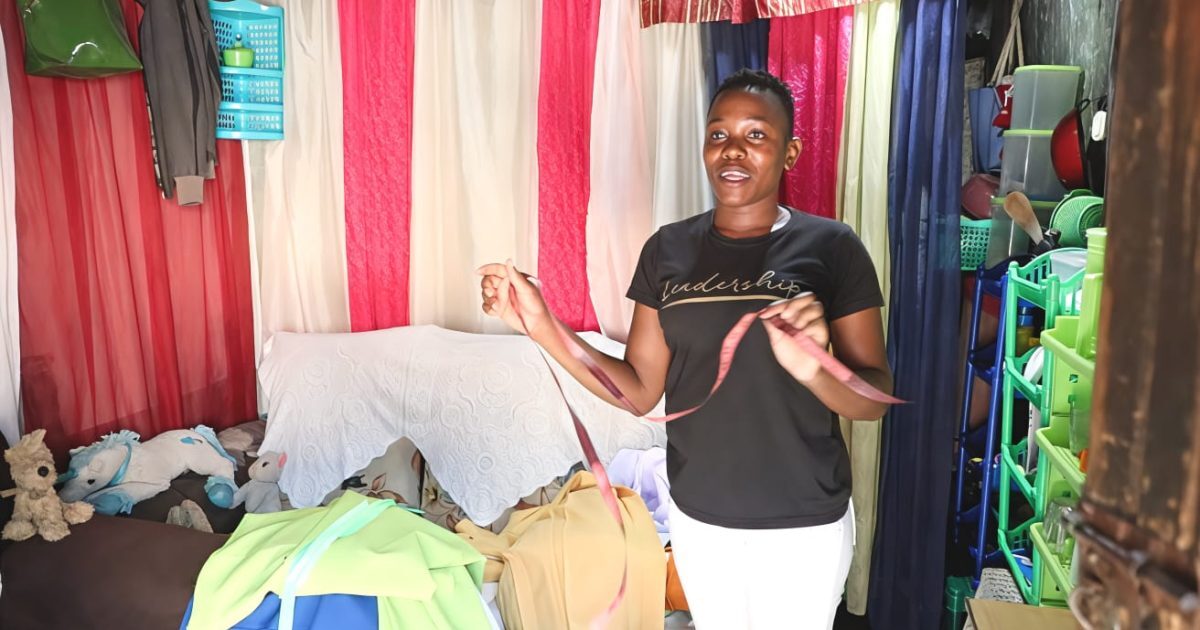
The training also introduced her to financial literacy and entrepreneurship. Lucy started saving money and eventually bought a second-hand sewing machine.
“I started saving little by little,” she says. “It was not easy, but I stayed consistent. And one day, I realised I had enough to invest in myself.”
She has since established a tailoring business, making church garments for members of the Legio Maria faith.
“I feel proud when I see people wearing clothes I have made,” she says. “It gives me confidence and hope that I can go even further.”
Her growing enterprise has brought changes to her household. She says she can now budget her income, provide for her children and maintain better relationships with her family and customers.
“I can now sit with my children, guide them, and show them love,” she says. “I speak well with my husband, and I treat my customers with respect. People trust me again.”
Lucy is now looking beyond her current business. She wants to undertake further training and become a professional fashion designer.
“If I get the opportunity, I would like to join a TVET institution,” she says. “I want to improve my tailoring skills and become a professional fashion designer.”
She also hopes to acquire a modern sewing machine to increase her productivity.
Skills programme transforms lives
Lucy’s story is among the outcomes of the Social Emotional Skills Training programme implemented under the Second Kenya Informal Settlements Improvement Project (KISIP II) through the National Youth Opportunities Towards Advancement (NYOTA).
The programme is part of KISIP II’s Socio-Economic Inclusion component and focuses on life skills, financial literacy, entrepreneurship and emotional resilience.
The interventions are taking place alongside major infrastructure improvements in informal settlements across Homa Bay County.
KISIP II is upgrading roads and drainage systems, constructing vending platforms, ablution blocks and children’s playgrounds, and installing street lighting and solar high-mast lights in A Thousand Streets in Oyugis, Nyandiwa, Rusinga Old Town, Sofia, Shauri Yako and Makongeni.
The project has also supported land tenure regularisation in Kendu Bay, Kijijini and Ndhiwa informal settlements, where residents have received lease titles.
The titles provide residents with greater security of tenure and can help them access credit by using their properties as collateral.
KISIP II is being implemented by the County Government of Homa Bay in partnership with the national government and development partners, including the World Bank, the European Union and the Agence Française de Développement (AFD).
For Lucy, the impact of the programme is personal and profound.
READ ALSO: Over 300 Samburu girls embrace alternative rite of passage in Wamba
“I am still growing,” she says. “But I am no longer the woman I used to be. I have hope now. I have a purpose.”
You can also follow our social media pages on Twitter: Education News KE and Facebook: Education News Newspaper for timely updates.
>>> Click here to stay up-to-date with trending regional stories
>>> Click here to read more informed opinions on the country’s education landscape
>> Click here to stay ahead with the latest national news.