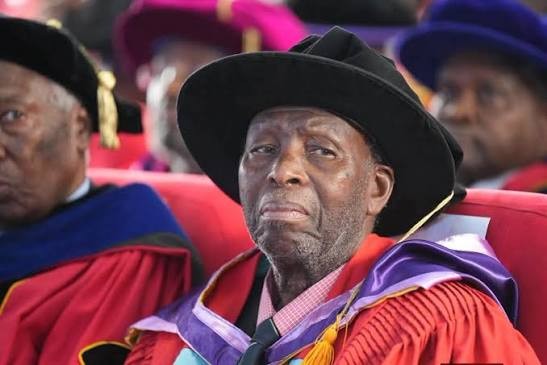
- Prof. Francis Gichaga led the University of Nairobi through one of Kenya’s most politically turbulent periods, from 1991 to 2002.
- Gichaga pioneered the expansion of self-sponsored education (Module II), a funding model later adopted across Kenya’s public university system.
There are moments in the history of a university when leadership is tested far beyond examination results, academic rankings, or infrastructure development; tested instead by politics entering lecture halls, constrained finances, students challenging authority, and staff demanding reform. Prof. Francis John Gichaga led the University of Nairobi during precisely such a period.
His tenure as Vice-Chancellor, from 1991 to 2002, coincided with one of the most politically turbulent eras in Kenya’s history, as the country transitioned from one-party rule to multiparty democracy. Universities were becoming centres of political discourse, student activism was intensifying, and public institutions faced significant financial pressures.
At the centre of this environment was Gichaga — a civil engineer, scholar, professor, and administrator tasked with ensuring the stability and continuity of Kenya’s premier university amid rapid national change. His story therefore extends beyond biography, offering a practical leadership reference for future Vice-Chancellors and university administrators.
TSC extends Term Two TPAD deadline to August 24 following system glitches
An Engineer Who Rose Through Academia
Long before assuming the Vice-Chancellor’s office, Gichaga had established himself as a respected civil engineer and academic, with professional expertise spanning highway and transport engineering, pavement engineering, and engineering design. He earned a PhD in Highway Engineering in 1980, and at the University of Nairobi progressed from lecturer and researcher to professor and senior administrator, teaching and mentoring generations of engineers. His influence extended into the professional engineering community as a Fellow of the Institution of Engineers of Kenya and a Fellow of the Institution of Civil Engineers in the United Kingdom. His appointment to the university’s top office capped a steady academic and administrative progression: in 1991, he served as Deputy Vice-Chancellor in charge of Academic Affairs before being appointed Vice-Chancellor later that year.
Taking Charge at a Difficult Moment
Gichaga assumed leadership of an institution that was far more than a centre of learning. The University of Nairobi occupied a central place in Kenya’s intellectual and political landscape — student demonstrations often attracted national attention, academic staff increasingly advocated for institutional autonomy, government focused on stability and control, and the university itself grappled with rising enrolment and limited resources. The Vice-Chancellor therefore had to function as administrator, diplomat, negotiator, and crisis manager, with a leadership style largely associated with restraint, consultation, and persistence. One of the key lessons for contemporary university leaders is that calmness under pressure is a strength, not a weakness — in environments where disagreements can escalate quickly, emotional discipline helps prevent temporary disputes from becoming long-term institutional crises.

The Funding Challenge That Reshaped Kenyan Universities
One of the most consequential developments associated with the Gichaga era was the expansion of self-sponsored education, commonly known as Module II or parallel programmes. Public universities faced constrained government funding at a time when demand for higher education was rapidly increasing, and in response, the University of Nairobi expanded access for students who could finance their own studies. The policy was widely debated, with critics raising concerns about the commercialisation of higher education and the potential for financial capacity to influence access. However, the additional revenue enabled the university to expand academic programmes, improve facilities, and respond to growing demand — a model subsequently adopted across Kenya’s public university system. For future Vice-Chancellors, the lesson remains highly relevant: financial sustainability is an essential component of academic leadership, since a university cannot maintain quality laboratories, libraries, research capacity, infrastructure, and competitive staffing without stable and diversified funding sources. At the same time, financial innovation must be balanced with academic integrity, since expanding enrolment without safeguarding quality ultimately undermines institutional reputation.
Balancing Government Relations and Institutional Autonomy
Gichaga’s tenure also highlights the delicate balance between universities and the State. Public universities rely heavily on government policy and funding, yet must preserve the intellectual independence necessary to fulfil their academic mandate. The key lesson for contemporary Vice-Chancellors is not to isolate universities from government, but to cultivate constructive, professional engagement while safeguarding institutional autonomy — university leadership requires political awareness without allowing the institution to become a political instrument, demanding diplomacy, credibility, and the courage to defend academic principles when necessary.
Listening to Students Before Crises Escalate
Student activism was a defining feature of university life during Gichaga’s tenure, and the lesson remains highly relevant today. Students are not merely recipients of education; they are integral members of the academic community and key stakeholders in university governance. Effective administration requires credible mechanisms through which students can express concerns, engage leadership, and seek resolution. Listening does not imply surrendering authority — rather, it enables early identification of issues before they escalate into institutional crises. For future Vice-Chancellors, the guiding principle is clear: addressed grievances are easier to resolve than ignored concerns that have escalated over time.
Staff as the Foundation of the University
No university can function effectively without committed academic and non-academic staff. Gichaga’s experience underscores a fundamental truth: a Vice-Chancellor does not manage infrastructure alone; they lead people. Transparent promotion systems, continuous professional development, clear communication, recognition of performance, and attention to staff welfare are central to institutional stability — where staff feel undervalued or excluded, institutional performance inevitably declines.
Gichaga maintained his engineering identity throughout his administrative career, associated with initiatives aimed at strengthening indigenous engineering capacity, including university-linked efforts related to prototype vehicle development under Kenya’s car project. This reflected a broader vision that universities should not only produce graduates but also contribute directly to national problem-solving — a lesson that remains critical today, as Kenyan universities must strengthen research that addresses local challenges, fosters innovation, supports industry, and contributes to employment creation and improved public services.
ALSO READ:
Kenya moves to strengthen oversight of foreign-curriculum schools: and why it matters
Recognition at Home and Abroad
Gichaga’s career earned significant professional, academic, and national recognition. He received Kenyan state honours, including EBS and MBS, alongside professional distinctions within the engineering fraternity. He was also awarded an honorary Doctor of Science degree by Jomo Kenyatta University of Agriculture and Technology and received an international honour from Soka University in Tokyo, Japan, in 1992. Ultimately, however, his legacy is defined less by accolades and more by the institutions and professionals he helped develop.
After leaving the University of Nairobi in 2002, Gichaga continued contributing to higher education leadership. In January 2010, he was appointed Chancellor of Jomo Kenyatta University of Agriculture and Technology, remaining engaged in national discussions on science, technology, research, and higher education. His career illustrates an important principle: leadership experience should be channelled into institutional mentorship and continued public service rather than personal withdrawal from intellectual engagement.
One of the most critical tests of a Vice-Chancellor is succession planning. A university should never become dependent on a single individual — future leaders must intentionally develop capable deputies, deans, directors, and departmental heads who can sustain institutional performance beyond leadership transitions. The strongest legacy is not indispensability; it is leaving behind an institution that continues to function effectively without reliance on one individual.
A university’s reputation takes decades to build but can be damaged quickly. Vice-Chancellors must therefore treat academic integrity, research ethics, procurement processes, governance systems, financial accountability, and professional conduct as strategic priorities, since every decision at leadership level affects students, staff, alumni, and the broader public. Leadership must therefore be grounded in transparency and accountability.
Gichaga’s memoir, Surviving the Academic Arena: My Complex Journey to the Apex, offers insight into the pressures of academic leadership, with its title reflecting the demands of the role. The Vice-Chancellor’s office is often isolating, with decisions subject to scrutiny from students, staff, government, governing councils, alumni, and the public. Future leaders therefore require emotional resilience, trusted advisory networks, personal discipline, and a strong ethical foundation — leadership should not overwhelm the individual entrusted with it.
Perhaps the most important lesson from Gichaga’s career is that a Vice-Chancellor serves as a temporary custodian of a permanent institution. The true measure of leadership is not speeches delivered, ceremonies attended, or titles held, but whether the institution is stronger at the end of the tenure — whether academic programmes have improved, infrastructure has been enhanced, finances are more stable, staff morale is stronger, governance is more effective, research capacity has grown, and institutional credibility has increased.
JKF urges Elimu Scholars to embrace education, leadership and purpose
The Gichaga Standard
Gichaga’s tenure at the University of Nairobi demonstrates what institutional leadership looks like under sustained pressure. He led during political transition, financial constraints, student activism, and rapidly increasing demand for higher education. His engineering background offers a fitting metaphor: an engineer understands that structures are tested not under calm conditions but under load. During Gichaga’s tenure, the institutional load increased significantly — political pressures intensified, financial constraints deepened, students and staff demanded reform, government required stability, and society demanded expanded access. Yet the institution remained functional and stable.
This remains a powerful lesson for future university leaders: do not merely occupy office, but strengthen the institution; do not build systems around individuals, but build systems that outlast them; do not fear pressure, but learn to manage it effectively. Above all, leadership is temporary, but the university serves generations. Prof. Francis John Gichaga’s legacy is therefore best understood not only through his years as Vice-Chancellor, but through the enduring principle of institutional stewardship: a great university leader is not defined by personal prominence, but by the strength and continuity of the institution they leave behind.
By Hillary Muhalya
You can also follow our social media pages on Twitter: Education News KE and Facebook: Education News Newspaper for timely updates.
>>> Click here to stay up-to-date with trending regional stories
>>> Click here to read more informed opinions on the country’s education landscape