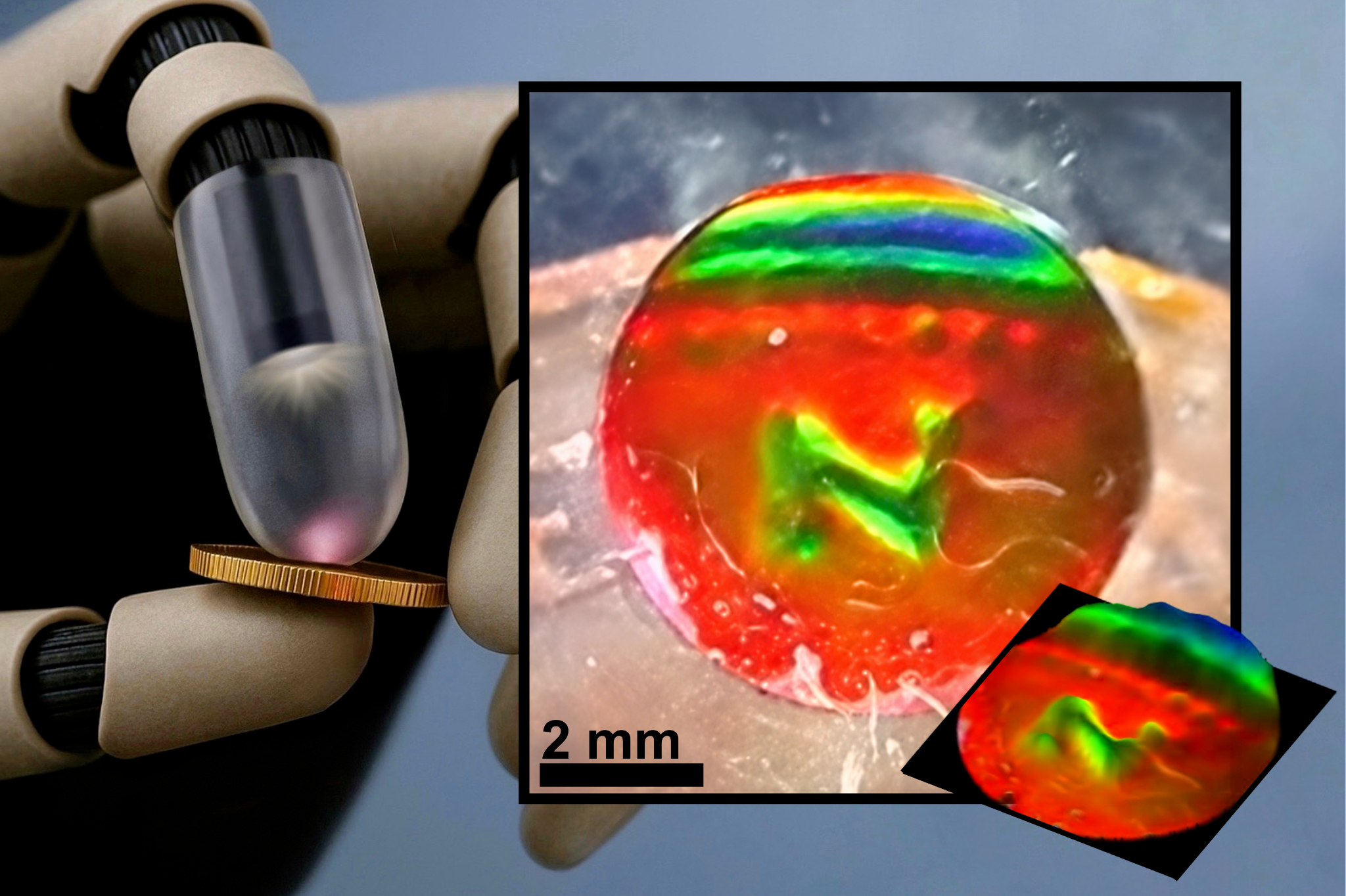
- Engineers at Queen Mary University of London have developed a colour-changing tactile sensor that allows robots to detect touch instantly.
- The breakthrough could transform robotics, healthcare, prosthetics and precision manufacturing.
- Researchers say the technology delivers detailed pressure maps without complex computing systems.
Researchers at Queen Mary University of London have developed a groundbreaking colour-changing tactile sensor that enables robots to “see” and feel touch in real time, a technological breakthrough expected to revolutionise robotics, healthcare and advanced manufacturing.
The innovation, developed by Dr Giacomo Sasso, a postdoctoral researcher at the university’s School of Engineering and Materials Science, converts invisible mechanical forces into dynamic colour patterns that reveal detailed maps of pressure, strain and contact instantly.
Unlike conventional tactile sensors, which depend on complex electronic sensor arrays and sophisticated reconstruction algorithms, the new technology embeds the sensing capability directly into the material itself.
When pressure is applied to the soft sensing surface, the material generates structural colours that vary according to the amount of force exerted. These colour patterns are then captured instantly using an ordinary low-cost USB camera, allowing robots to interpret touch almost immediately.
A breakthrough in robotic touch
Researchers say the innovation overcomes one of robotics’ greatest challenges—replicating the extraordinary sensitivity of the human hand.
According to Dr Sasso, a single human hand contains more than 10,000 mechanoreceptors responsible for detecting touch, making artificial tactile sensing extremely difficult to reproduce.
“You won’t guess how much information is generated when your finger presses a light switch. A human hand contains more than 10,000 mechanoreceptors to do the job, yet touch sensing remains one of the major challenges in robotics,” he said.
He explained that the team’s approach differs fundamentally from existing technologies.
Instead of embedding dense arrays of electronic sensors, the material itself becomes the sensing medium, transforming mechanical interaction directly into visible colour patterns that are captured by a simple camera.
The approach produces detailed pressure maps while significantly simplifying the overall sensing system.
The technology has significant implications for advanced manufacturing, where robotic grippers could assemble delicate micro-scale components with far greater precision.
By allowing every subtle variation in force to become visible in real time, manufacturers could improve both speed and accuracy during highly sensitive production processes.
The innovation could also transform healthcare.
Artificial limbs fitted with the sensor may provide users with a richer sense of touch during everyday activities, while surgeons using robotic systems could distinguish between healthy and diseased tissue by analysing subtle pressure differences detected through the colour-changing material.
A simpler and faster approach
Professor James Busfield, one of the project’s co-authors, said one of the greatest advantages of the technology is that the information is already contained within the light signal itself.
“What is particularly powerful is that the information is already in the light signal. You are no longer reconstructing touch—you are observing it directly,” he said.
The research emerged from efforts to overcome the long-standing trade-off between sensing speed and image resolution in vision-based tactile technologies.
Existing high-resolution tactile systems often require intensive computation that slows performance, while faster systems generally sacrifice accuracy.
By embedding sensing directly into the material, the researchers have demonstrated the first real-time solution capable of delivering both speed and high-resolution tactile information simultaneously.
The project was developed through collaboration between Queen Mary University of London, the University of Florence and the University of Trieste in Italy.
The researchers combined expertise in soft robotics, polymer science and material engineering to create a sensing platform that could reshape the future of intelligent machines.
READ ALSO: Eight Utumishi Girls students deny murder charges over deadly dormitory fire
Scientists believe the breakthrough opens new possibilities for next-generation robots capable of interacting with people and their environments more safely, accurately and naturally than ever before.
By Our Reporter
You can also follow our social media pages on Twitter: Education News KE and Facebook: Education News Newspaper for timely updates.
>>> Click here to stay up-to-date with trending regional stories
>>> Click here to read more informed opinions on the country’s education landscape
>>> Click here to stay ahead with the latest national news.