
Hillary Muhalya examines the opportunities and challenges of introducing the Chinese language in Kenyan schools amid a shortage of trained teachers.
The decision by the Ministry of Education (MoE) to introduce Chinese language learning in schools marks a defining moment in the evolution of Kenya’s education system. It is a move loaded with promise—one that speaks to global relevance, economic foresight, and the desire to prepare learners for a rapidly changing world. Yet, like many ambitious reforms, it stands at the intersection of opportunity and challenge, where vision must confront reality.
At its core, the introduction of Mandarin is about positioning Kenya within the global conversation. The country’s deepening ties with the People’s Republic of China have made it increasingly clear that language is not just a cultural asset but an economic tool. From infrastructure development to trade partnerships, China’s footprint in Kenya is expansive. In such a landscape, the ability to communicate in Mandarin offers a distinct advantage. It empowers learners to engage directly, negotiate effectively, and participate meaningfully in sectors that are shaping the country’s economic future.
This is where the importance of the initiative becomes most evident. For learners, Mandarin represents more than an additional subject—it is a gateway. A gateway to careers in diplomacy, international business, tourism, and translation. A gateway to scholarships and academic exchanges. A gateway, ultimately, to global competitiveness. In a job market where differentiation is increasingly critical, language proficiency can be the thin line between seizing opportunity and losing it.
The efforts of the Commission’s acting Chief Executive Officer, Evaleen Mitei, reflect an understanding that such transformation cannot happen by chance. Through high-level engagements and stakeholder coordination, she has sought to lay the groundwork for implementation, signalling that this is not merely an announcement, but a process. Complementing this is the strategic involvement of Beatrice Muganda Inyangala, whose role in higher education policy has consistently emphasised internationalisation and skills development. Their combined influence reinforces the idea that Mandarin is not just for basic education but part of a broader continuum connecting schools to universities and, ultimately, to the global economy.
Yet even as the importance of the initiative is clear, the challenges it faces are equally profound.
Foremost among these is the issue of teachers. A curriculum is only as strong as those who deliver it, and in this case, the shortage is glaring. Kenya does not currently have enough trained Mandarin teachers to support a nationwide rollout. Training new teachers will take time, resources, and institutional commitment. In the interim, reliance on foreign instructors may fill the gap, but it raises questions about sustainability and localisation. Without building a strong base of Kenyan educators, the programme risks becoming externally dependent and unevenly distributed.
Then there is the question of curriculum development. The integration of Mandarin must pass through the Kenya Institute of Curriculum Development, a process that demands careful planning. Content must be age-appropriate, culturally sensitive, and aligned with existing educational goals. Assessment methods must be designed, teaching materials produced, and schools equipped. These are not minor undertakings—they require both time and funding, two resources that are often constrained within the education sector.
Equity also emerges as a critical concern. Will Mandarin be accessible to all learners, or will it remain the preserve of a few well-resourced schools? Kenya’s education system already grapples with disparities between urban and rural institutions. Introducing a new subject without addressing these disparities risks widening the gap rather than bridging it. What begins as an opportunity could, if poorly managed, deepen educational inequality.

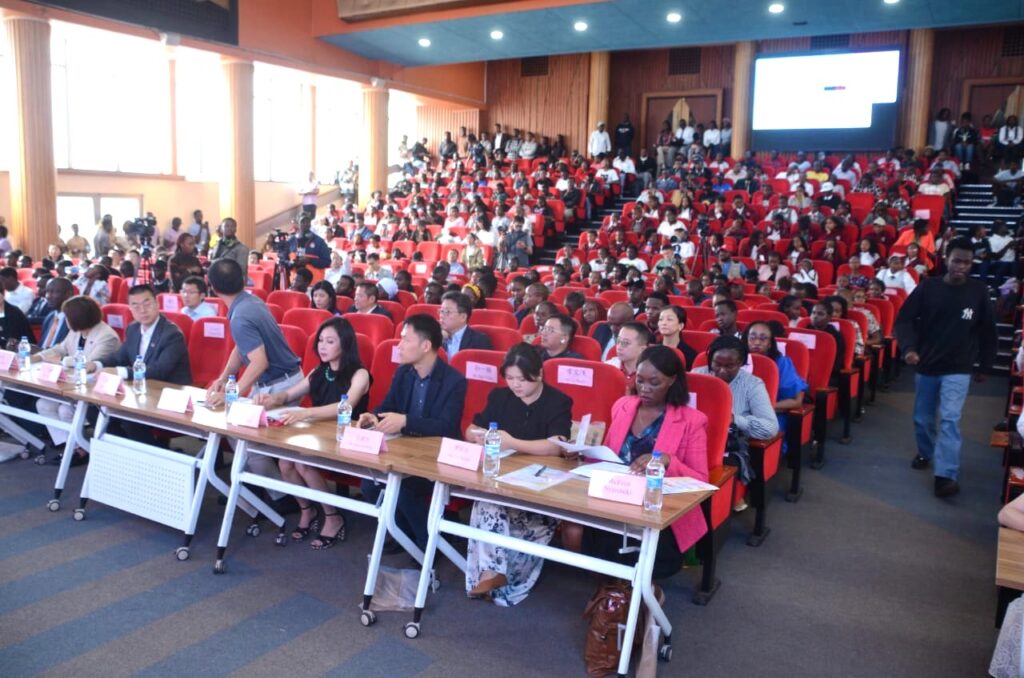
Prof. Wang Shangxue, Chinese Director of the Confucius Institute at the University of Nairobi, with TSC Chairman Dr Jamleck Muturi John during the launch of the Chinese language programme in Kenyan schools.Beyond logistics, there is a deeper, more philosophical challenge. Education is not only about preparing learners for the global stage; it is also about preserving identity and strengthening local foundations. Kenya is rich in indigenous languages and cultural heritage, yet many of these are already under pressure. The introduction of Mandarin must therefore be balanced carefully, ensuring that it complements rather than competes with Kiswahili and other local languages that form the backbone of national identity.
Financial constraints cannot be ignored either. Implementing a new subject at scale demands investment—in teacher training, instructional materials, and school readiness. At a time when schools face funding challenges and teachers grapple with delayed payments and resource shortages, the question arises: is the system financially ready for this expansion? Ambition without adequate resourcing risks turning vision into strain.
And yet, despite these hurdles, the initiative should not be dismissed. Every transformative idea encounters resistance, not necessarily because it is flawed, but because it disrupts the status quo. The key lies in execution. If the rollout is gradual, well-funded, and inclusive, Mandarin could become a powerful addition to Kenya’s education landscape. If rushed or under-resourced, it risks joining the long list of well-intentioned reforms that fail to achieve their full potential.
The way forward demands clarity of purpose. It calls for investment in teacher training institutions, partnerships with universities, and deliberate efforts to localise expertise. It requires the government to address systemic challenges within the education sector, ensuring that the introduction of Mandarin does not overshadow existing priorities. Above all, it demands a learner-centred approach—one that focuses not on policy headlines, but on tangible outcomes in the classroom.
READ ALSO: Kaimosi Varsity eyes global expansion with Chinese-Swahili programme
The Teachers Service Commission’s decision is bold, and its importance cannot be overstated. It reflects a recognition that education must evolve alongside the world it serves. But boldness alone is not enough. Success will depend on the ability to navigate the challenges with precision, patience, and purpose.
In the end, the question is not whether Mandarin should be taught in Kenyan schools. The question is whether Kenya is ready to teach it well.
By Hillary Muhalya
You can also follow our social media pages on Twitter: Education News KE and Facebook: Education News Newspaper for timely updates.
>>> Click here to stay up-to-date with trending regional stories
>>> Click here to read more informed opinions on the country’s education landscape
>>> Click here to stay ahead with the latest national news.