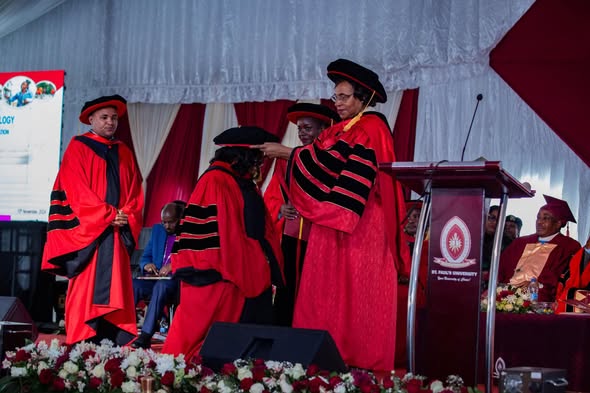
Kenya is facing a critical shortage of PhD holders, a gap that experts warn is undermining the country’s ability to build the human capital needed to drive development through science, research, and innovation.
Despite having strong talent and institutional presence, systemic weaknesses in PhD training continue to slow progress in establishing a competitive research ecosystem.
According to data from the African Population and Health Research Centre (APHRC), Kenya produces fewer than 1,000 PhDs annually, far below the threshold required to support industrial transformation.
APHRC Executive Director Dr. Catherine Kyobutungi noted that the country is currently at only 23 percent of the target of 1,000 PhDs per one million people. She added that in some universities, nearly a third of faculty members who are expected to hold doctoral qualifications do not meet that standard.
ALSO READ:
KUCCPS to introduce new university placement criteria starting 2026/27 cycle
Speaking during the launch of the Kenya Science, Research and Innovation (SRI) Synergy Blueprint at Safari Park Hotel in Nairobi, Dr. Kyobutungi emphasized that the deficit is particularly pronounced among women. While gender parity has been achieved at undergraduate level, female representation declines sharply at doctoral and professorial ranks. “At Master’s level, we have a 50-50 balance. By associate professorship, women are down to 19 percent. The pipeline is leaking at a very high rate,” she observed, pointing to mentorship gaps and systemic barriers.
Beyond low doctoral output, APHRC highlighted four other structural weaknesses affecting Kenya’s SRI ecosystem. These include the absence of strong postdoctoral pathways, which leaves early-career researchers vulnerable to instability and brain drain; unsustainable student-to-staff ratios in public universities that overload faculty with teaching duties at the expense of research; fragmented promotion and retention systems across institutions; and the lack of a unified national framework to coordinate research careers.
“These are not failures of individual institutions,” APHRC stressed. “They reflect the absence of a coordinated national research workforce architecture.” The organization argued that Kenya’s research system requires both a stronger workforce and equitable access to modern infrastructure to meet national development goals.
The newly launched SRI Synergy Blueprint seeks to address these bottlenecks by proposing a coordinated national architecture that integrates data systems, aligns financing, strengthens accountability, and enhances collaboration across ministries, universities, and research institutes. Rather than creating new institutions, the plan focuses on improving coherence and reducing fragmentation.
ALSO READ:
School Holidays: Why parents, guardians should limit excessive freedom for children
Dr. Kyobutungi acknowledged that Kenya has made notable strides compared to other African countries, citing the existence of more than 200 innovation hubs nationwide. The country also spends 0.78 percent of its GDP on research, which is slightly below the African Union’s 1 percent target and far short of Kenya’s own 2 percent statutory goal. However, she warned that overlapping mandates, siloed infrastructure, and fragmented funding streams continue to weaken efficiency and slow the translation of research into industry.
The SRI Synergy Blueprint aligns with Kenya Vision 2030, the Bottom-Up Economic Transformation Agenda (BETA), the African Union’s Science, Technology and Innovation Strategy for Africa (STISA) 2034, the Accra Reset Declaration on research sovereignty, and the Sustainable Development Goals. It positions science and innovation as instruments of economic sovereignty, reducing dependency on fragmented donor-driven systems and strengthening nationally coordinated development pathways.
By Masaki Enock
You can also follow our social media pages on Twitter: Education News KE and Facebook: Education News Newspaper for timely updates.
>>> Click here to stay up-to-date with trending regional stories
>>> Click here to read more informed opinions on the country’s education landscape