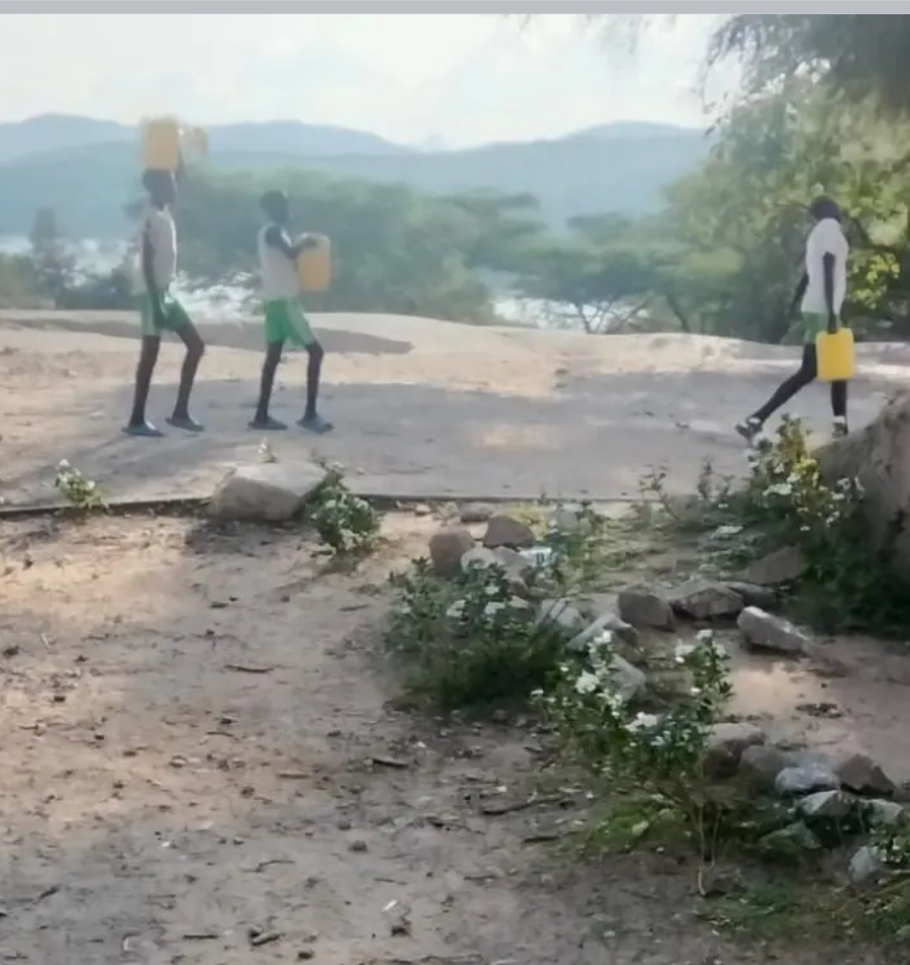
Residents and school communities in the Kerio Valley are living a daily nightmare that should never be part of a child’s school life. For over three weeks, pupils at Riting Primary School and Riting Girls High School have been forced to fetch water directly from a nearby dam after the water motor that supplies their schools broke down, exposing children to life-threatening risks, including crocodile attacks and possible drowning.
The institutions entrusted with ensuring basic services, Kerio Valley Development Authority (KVDA) and Kenya Electricity Generating Company (KenGen), have reportedly failed to act, leaving the community frustrated, fearful, and angry.
For years, the water motor had served as a lifeline, providing water for drinking, cooking, and sanitation. Its failure revealed a glaring vulnerability: the absence of timely maintenance, effective communication, and a responsive system from the authorities. Parents and school leaders first reported the breakdown to KVDA and KenGen, expecting urgent action. But three weeks have passed, and there has been no repair, no timeline, and no explanation. The silence from the responsible authorities has transformed what could have been a minor disruption into a full-blown public safety emergency.
With the motor still out of service, pupils are forced to walk to the dam to fetch water, a perilous journey for children as young as ten. The dam is known to host crocodiles, posing a very real threat. Beyond wild animal attacks, the risk of drowning is constant. Parents report children coming home drenched, scared, and traumatized, yet the authorities remain unmoved. “This is unacceptable. Our children should not be endangered just to get water for school,” said one parent, echoing the frustration of many. Teachers and school leaders are equally alarmed. The headteacher of Riting Girls High School emphasized that while staff have tried to organize protective measures, they cannot supervise every child at the dam. “Our duty is to educate, not to place students in mortal danger for the sake of water,” she said.
ALSO READ:
NEPAD urges African universities to drive development through leadership and policy solutions
The inaction has raised serious questions about accountability. KVDA and KenGen, institutions created to serve public interests, are now seen as negligent. Residents argue that this is more than maintenance but a direct threat to human life.
Each day of delay puts children at unnecessary risk. The lack of communication has further deepened frustration. Despite repeated calls and visits, the community has received no clarity on when repairs will be done. Trust in these institutions has eroded, leaving parents and school leaders feeling abandoned by those charged with protecting the most vulnerable.
Beyond immediate safety concerns, the crisis affects education itself. Children spending hours fetching water arrive late, exhausted, and less able to concentrate in class. In a region already facing educational challenges, this adds yet another barrier to learning. Hygiene and nutrition at the schools are also compromised. Without a reliable water supply, it becomes impossible to provide safe meals or maintain clean sanitation facilities, increasing the risk of waterborne diseases. A mechanical failure has become a systemic problem, affecting health, education, and the overall well-being of the community.
Some parents have tried to fill the gap, bringing water from neighbouring areas or organizing small-scale water collection systems. While admirable, these efforts are temporary and cannot replace the responsibility of KVDA and KenGen. Community leaders insist that a permanent solution must come from the authorities, along with a plan for ongoing maintenance to prevent future crises.
Experts in child safety and public health emphasize that access to clean water is not optional; it is fundamental to health, education, and social protection. In schools, water access intersects with learning, hygiene, and nutrition. Prolonged failure to provide water compromises all these areas and violates children’s rights to safety and education. The risk of a preventable accident is high, and each day that passes without repair is another day children are unnecessarily exposed to harm.
This situation also reflects systemic weaknesses in infrastructure management in rural areas. Equipment failures should trigger immediate inspection, repair, or temporary alternatives. Institutions such as KVDA and KenGen have both the technical capacity and resources to respond promptly. Their failure to act has left the community with only fear and uncertainty. Immediate intervention is required—not only to restore the water supply but to demonstrate that the welfare of children is a priority, and that rural communities are not neglected in matters of essential services.
ALSO READ:
UoN Vice Chancellor search enters key stage as PSC announces shortlisted candidates
The residents are united in their demand: repair the water motor now. They are not asking for extraordinary measures, only for the authorities to fulfill the responsibilities entrusted to them. Children deserve to learn without fear, to play safely, and to access clean water without risking their lives. Anything less is a dereliction of duty with potentially tragic consequences.
Every trip to the dam is a gamble, with dangers ranging from crocodile attacks to drowning. Parents, teachers, and local leaders are watching closely, demanding swift and decisive action. The water motor, once a simple piece of infrastructure, has become a symbol of institutional neglect and the urgent need for accountability. KVDA and KenGen have the expertise, resources, and mandate to resolve this crisis—but every day of inaction magnifies the danger.
Community members emphasize that this is not just about a broken motor; it is about governance, responsibility, and the social contract between institutions and citizens. The failure to act promptly undermines trust, puts lives at risk, and sends a dangerous message about the value placed on children’s safety. Immediate repair, transparent communication, and preventive measures are not optional—they are a moral and legal obligation.
The plight of Riting Primary School and Riting Girls High School is a reminder that access to water is a fundamental human right and a critical component of education and safety. Children are at risk every day they are forced to fetch water from the dam.
KVDA and KenGen must act immediately to repair the water motor, provide a reliable supply of water, and implement mechanisms to prevent similar crises in the future. Anything short of urgent action would be a failure of governance, a breach of duty, and a direct threat to the lives of children.
The eyes of the community are on these institutions, and history will remember how swiftly or how slowly they acted when children’s lives were on the line.
By Hillary Muhalya
You can also follow our social media pages on Twitter: Education News KE and Facebook: Education News Newspaper for timely updates.
>>> Click here to stay up-to-date with trending regional stories
>>> Click here to read more informed opinions on the country’s education landscape