
In the architecture of human development, few theories have provoked as much debate, fascination, and controversy as those proposed by Sigmund Freud. Among his most discussed contributions is the concept of the psychosexual stages of development, particularly the phallic stage, which he believed plays a decisive role in shaping adult personality.
Though modern psychology has revised and, in some quarters, rejected aspects of Freud’s framework, the symbolic and relational insights embedded in the phallic stage continue to influence how we understand identity, authority, morality and intimate relationships in adulthood.
The Phallic Stage and Early Identity Formation
Freud theorised that between the ages of approximately three and six years, a child enters what he termed the phallic stage. During this period, the child’s libidinal energy — what Freud called psychic energy — is focused on the genital region.
However, interpreting this stage solely in biological terms is to miss its deeper psychological significance.
At its core, the phallic stage is about awareness: awareness of the self as distinct, of gender differences, and of relational power dynamics within the family.
Central to this stage is the Oedipus complex, named after the tragic hero of Oedipus Rex. Freud suggested that a boy unconsciously develops affection and desire for his mother and perceives his father as a rival.
This rivalry generates anxiety — famously termed “castration anxiety” — which the child resolves by identifying with the father. Through this identification, the boy internalises paternal authority and moral standards, forming what Freud described as the superego.
For girls, Freud proposed a parallel process, later termed the Electra complex by psychoanalyst Carl Jung. In both cases, the resolution of these unconscious conflicts was believed to lay the groundwork for adult identity and conscience.
Symbolic Meaning of the Phallic Stage in Adulthood
Critics have long challenged the literalism of these ideas, yet many contemporary scholars reinterpret the phallic stage symbolically rather than sexually.
Seen through this lens, the stage represents a developmental struggle over attachment, rivalry, power and identification. A child learns not only who they love but also who they emulate.
The internalisation of parental figures — whether nurturing, authoritarian, absent, or inconsistent — becomes a template for later relationships and authority structures.
In adulthood, unresolved conflicts from the phallic stage may manifest in subtle but profound ways.
Freud argued that fixation at this stage could produce traits such as excessive competitiveness, vanity, recklessness, or, conversely, timidity and insecurity.
While modern personality psychology uses different language — self-esteem regulation, attachment styles, ego development — the underlying concern remains similar: early relational experiences shape later emotional patterns.
Authority, Gender Identity and Moral Development
Consider, for example, how adults respond to authority. An individual who experienced a harsh or distant same-sex parent may struggle with authority figures, oscillating between rebellion and anxious compliance.
Conversely, someone who successfully identified with a stable parental model may exhibit confidence, moral clarity and a coherent sense of identity.
The phallic stage, therefore, becomes less about childhood sexuality and more about the formation of the internal moral compass and gendered self-concept.
Gender identity and role expectations are also influenced during this phase.
Children observe how masculinity and femininity are enacted within their family systems. These observations — conscious and unconscious — inform beliefs about power, vulnerability, affection, and ambition.
Adults who rigidly cling to stereotypical gender norms or who experience deep confusion about relational roles may, from a psychoanalytic standpoint, be navigating unresolved dynamics rooted in this early stage.
Modern Perspectives on the Phallic Stage
Contemporary developmental psychology places greater emphasis on social learning, cognitive development, and attachment theory, as advanced by thinkers such as John Bowlby.
Attachment theory, in particular, offers empirical support for the idea that early relationships influence adult intimacy, though it avoids the overtly sexualized framing of Freud’s psychosexual model.
In this sense, the phallic stage can be seen as an early attempt to articulate the enduring psychological truth that childhood relationships echo across a lifetime.
Neuroscience has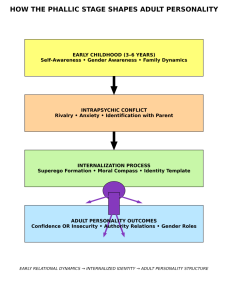 increasingly affirmed that early childhood experiences profoundly affect brain development, emotional regulation, and stress responses.
While Freud lacked access to such scientific tools, his intuitive grasp of early relational influence remains striking.
Ultimately, the phallic stage reminds us that personality is not assembled from scratch in adulthood.
It is sculpted, layer by layer, beginning in the intimate theatre of early childhood.
READ ALSO: Midterm temptations, maximum consequences: Men, stop at a handshake — Kamiti is not full
Whether one embraces Freud’s terminology or prefers modern frameworks, the central insight endures: our earliest attachments and identifications shape the adults we become.
By examining these roots with curiosity rather than discomfort, we gain a deeper understanding of ourselves — and of the invisible childhood dramas that continue to shape adult life.
Maingi M’Thuranira
M’Thuranira is an educationist, community leader & men’s empowerment advocate.
You can also follow our social media pages on Twitter: Education News KE and Facebook: Education News Newspaper for timely updates.
>>> Click here to stay up-to-date with trending regional stories
>>> Click here to read more informed opinions on the country’s education landscape