
Salary disputes involving the West Pokot branch of Kenya Union of Pre-Primary Education Teachers have now entered a decisive legal phase following proceedings at the Kitale High Court. What began as persistent engagement over unpaid and inconsistently implemented allowances has formally transitioned into a structured judicial determination, marking a turning point in the long-running standoff.
On 24th February 2026, the county government was represented by County Solicitor Philip Magal, who provided an official procedural update before the court. He clarified that the matter constitutes a fresh legal cause that requires strict compliance with established court processes.
Consequently, the employer has been directed to file a formal petition so that the dispute can proceed within a clear and enforceable legal framework regarding the disputed salary allowances.
The Core of the Dispute
At the heart of the case are three fundamental allowances for Early Childhood Development Education (ECDE) teachers: the hardship allowance, the house allowance, and the commuter allowance. While often categorised under payroll components, these benefits carry weight far beyond administrative bookkeeping. They directly impact teachers’ welfare, morale, and economic stability, tied to overall salary structures.
West Pokot County contains regions classified as hardship areas due to geographical remoteness, infrastructural limitations, and socio-economic challenges. In such contexts, hardship allowance serves as formal recognition of the sacrifices educators make while serving in difficult environments.
It compensates for challenges that go beyond routine professional expectations.
House allowance ensures access to dignified accommodation. In many hardship-designated zones, housing options are scarce, costly, or located far from duty stations.
Without adequate housing allowances, teachers may be forced into unsuitable living conditions or be compelled to reside at considerable distances from their schools.
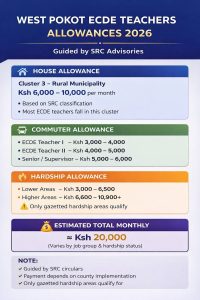
Commuter allowance addresses transport realities. Remote regions often lack adequate road infrastructure, irregular public transport, and high commuting costs. For teachers who must travel daily under such circumstances, a commuter allowance is not a luxury; it is a necessity that enables consistent service delivery and protects their overall salary value.
The union maintains that these allowances are not discretionary privileges but contractual and statutory entitlements, anchored in formal agreements and public-sector compensation structures.
SRC Frameworks and Legal Structuring of the Salary Petition
Central to the union’s argument is the advisory framework issued by the Salaries and Remuneration Commission. Across several counties in Kenya, ECDE teachers are reportedly receiving hardship, housing, and commuter allowances in line with SRC guidelines.
These implementations have created relative uniformity in compensation and enhanced staff morale in hardship-designated regions. The union contends that West Pokot should not become an outlier where comparable counties with similar hardship classifications have complied with national advisories affecting teacher salary frameworks.
READ ALSO: The clock is ticking: 38,000 P1 teachers demand clarity on their World Bank upgrade
By directing the employer to file a petition, the court has emphasised procedural discipline. A formal petition ensures that:
- Claims are clearly articulated.
- Evidence is systematically presented.
- Responses are legally framed.
- Determinations carry enforceable authority.
The next court direction has been scheduled for 18th May 2026. That date is expected to clarify the admissibility of claims, establish compliance expectations, and, where necessary, outline interim measures regarding the disputed salary review.
By Hillary Muhalya
You can also follow our social media pages on Twitter: Education News KE and Facebook: Education News Newspaper for timely updates.
>>> Click here to stay up-to-date with trending regional stories
>>> Click here to read more informed opinions on the country’s education landscape
>>> Click here to stay ahead with the latest national news.