There is a rhythm in the life of every school, one that is at once predictable and merciless. First comes anticipation — the tense wait for national examination results. Then comes reaction. In some schools, there is a celebration. In others, shock. And in a worrying number of institutions, a slow, painful realisation sets in: the numbers posted on the notice board will determine far more than academic pride. They will determine survival.
When results released by the Kenya National Examinations Council are strong, phones ring with inquiries, parents visit, and former learners return to congratulate teachers. Confidence multiplies. But when results are dismal, the response is immediate and, in many cases, automatic. Parents react not by waiting for explanations or remedial programs. They react by protecting their children’s future. Spontaneously, almost instinctively, they begin transferring learners to other high-performing schools. Enrollment begins to shrink before the administration has had a chance to respond. Classrooms that were full last term start showing empty desks, and fee collections decline sharply.
This reaction is brutally straightforward. Poor performance communicates risk, and parents act to minimise it. Even when the causes of decline — staffing gaps, transitional curriculum issues, or cohort-specific weaknesses — are temporary, perception dominates reality. Social networks amplify these decisions. When one respected parent transfers a child, others take note. Word spreads: “The school is declining.” And numbers reflect that perception with ruthless precision.
Enrollment shrinkage is not sudden; it is erosive. First, a few transfer requests trickle in. Then, one day, scholars switch schools quietly. Boarding numbers reduce. Applications for incoming classes fall. By the following term, the impact is visible in classrooms, playgrounds, and staff morale. The silence in once-bustling corridors signals more than empty seats. It signals lost trust.
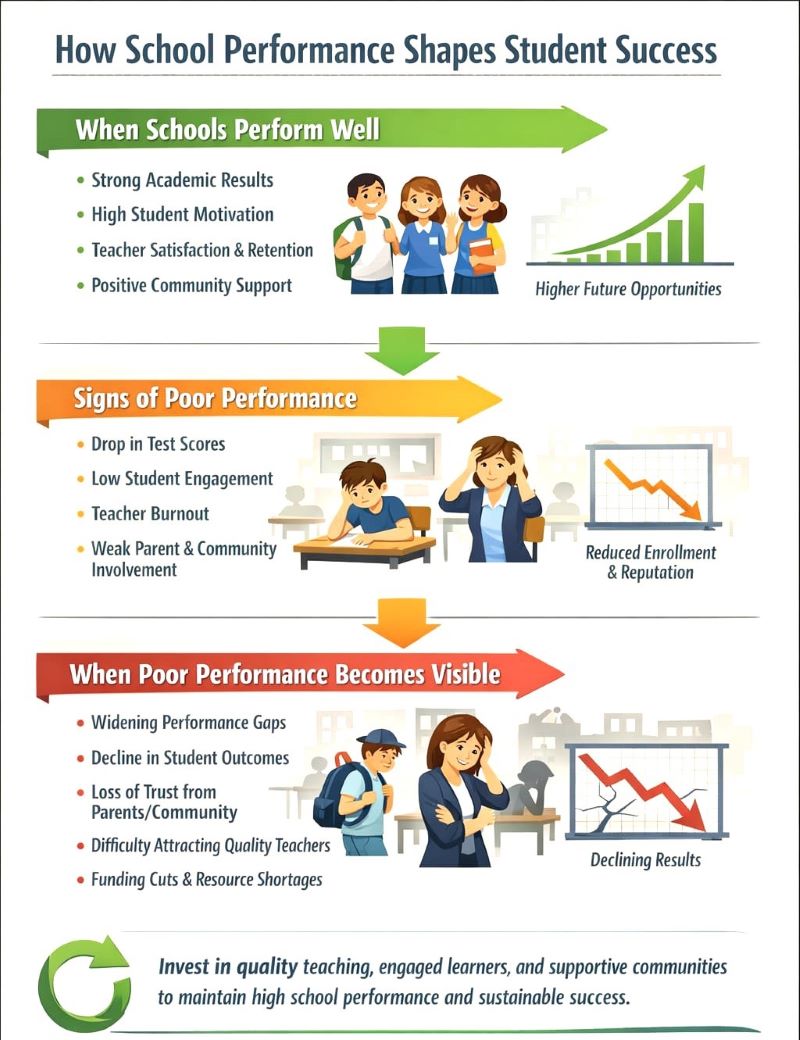
The danger is compounded because enrollment is directly tied to a school’s financial health. Fewer learners mean reduced revenue. Reduced revenue limits investment in instructional materials, teacher motivation, infrastructure upgrades, and remedial programs. Over time, these constraints can further weaken performance, creating a vicious cycle: poor results lead to shrinking enrollment, which limits investment, which contributes to further poor results. Without decisive intervention, the cycle continues.
Leadership response determines whether a school sinks or stabilises. Silence is fatal. When school administration avoids addressing poor performance, speculation fills the vacuum. Rumours of incompetence, internal conflict, or systemic collapse spread quickly. Parents who might have waited for improvement now act preemptively. Conversely, visible leadership reassures. A principal who convenes stakeholders, presents honest data, outlines recovery strategies, and commits to measurable targets begins the work of rebuilding confidence. Transparency, in this context, is a strategic tool.
Parents are not demanding perfection. They are demanding seriousness, credibility, and evidence that corrective steps are being taken. Structured remedial programs, intensified revision schedules, teacher professional development workshops, and performance monitoring systems demonstrate effort and rebuild trust. Effort, when visible and sustained, stabilises enrollment.
Academic performance, however, is only one dimension. Discipline and school culture heavily influence whether decline becomes temporary or permanent. Poor results often expose deeper institutional problems: teacher absenteeism, weak departmental coordination, learner indiscipline, and ineffective instructional supervision. Where these weaknesses persist, performance decline is repeated rather than accidental. Conversely, schools that cultivate strong culture, shared accountability, and mutual respect between staff and learners recover faster. A united staff signals to parents that the institution is committed to a turnaround.
Teacher morale plays a pivotal role. After poor results, staffrooms often become tense environments. Blame circulates, departments defend themselves, and some teachers disengage emotionally. Yet this is precisely when cohesion is needed most. Professional development — in pedagogy, learner-centred approaches, differentiated instruction, and data analysis — becomes non-negotiable. Teachers must improve continuously to reverse the decline.
Infrastructure also communicates seriousness. Broken windows, overcrowded classrooms, disorganised libraries, and neglected sanitation reinforce the perception of institutional decay. Conversely, even modest improvements — renovated classrooms, organised labs, functional libraries, clean compounds — signal leadership commitment and reinforce parental confidence. Physical evidence of care matters as much as academic plans.
The financial strategy must also be adjusted during periods of declining enrollment. Parents may hesitate to commit significant fees when performance dips. Flexible payment structures, instalment plans, targeted bursaries, and merit-based scholarships help retain learners and attract new applicants even as recovery efforts are underway. Retaining current learners is often more cost-effective than recruiting new ones. Every child retained stabilises revenue, morale, and classroom energy.
READ ALSO:
KNEC releases 2026 CBC guidelines for Grade 4 and 5 projects, sets May 29 deadline
Retention deserves deliberate focus. Schools obsessed with new admissions while ignoring dissatisfied current families are building on sand. Understanding why learners transfer — whether academic dissatisfaction, poor relational engagement, or perceived insecurity — is essential. Strengthening guidance, mentorship, and teacher-learner relationships can significantly improve retention, sometimes even before examination performance rebounds.
A school’s identity also influences resilience. Institutions with clear distinctiveness — whether in STEM innovation, sports excellence, faith-based formation, environmental stewardship, or leadership development — weather temporary academic dips better than schools with no unique profile. Multi-dimensional identity provides credibility beyond raw grades. However, identity must align with substance. Claims without measurable evidence accelerate decline.
Community engagement becomes especially critical in recovery periods. Engaging local leaders, alumni, and parent associations in addressing challenges transforms narratives from crisis to collaboration. Communities that feel involved often become allies, advocating for remedial initiatives rather than acting as critics.
The truth is stark: when results collapse, desks empty. The impact is both visible and psychological. A previously vibrant staffroom loses energy. Playground games appear quieter. Conversations at the school gate are dominated by speculation and concern. Enrollment does not forgive poor performance. Numbers do not wait. They respond immediately.
Yet decline is not destiny. Schools that act decisively after dismal results often emerge stronger. The difference lies in speed, strategy, and consistency. Data-driven planning identifies weaknesses, guides interventions, and measures progress. Remedial programs, mentorship initiatives, peer tutoring, and internal assessments strengthen weak areas. When implemented persistently, these strategies gradually restore confidence.
Recovery requires patience. Sustainable improvement often spans multiple examination cycles. One term of intervention rarely reverses lost trust. Parents observe trends, not promises. Continuous visible progress, combined with effective communication, is key. Schools that acknowledge shortcomings while presenting credible action plans earn respect. Arrogance or defensiveness alienates families.
The most critical lesson is that enrollment functions as a mirror. It reflects leadership quality, academic rigour, school culture, discipline, safety, and trust. Where these elements align, numbers rise. Where they fracture, numbers decline. Enrollment is both a symptom and a signal.
The brutality of spontaneous parental transfers after poor performance illustrates just how unforgiving education markets can be. Parents do not wait for detailed explanations or recovery plans. They act immediately to secure what they perceive as the best opportunity for their child. This instinctive response highlights the importance of proactive communication, swift remedial action, and transparent leadership. Schools that hesitate risk losing not just one cohort but an entire generation of learners.
Marketing alone cannot solve this problem. Glossy brochures and social media announcements cannot conceal dismal results. What works is evidence-backed messaging: “We have introduced remedial sessions,” “Teachers have undergone capacity-building,” “Mentorship programs are operational,” “Performance tracking has been strengthened.” Parents respond to action, not promises.
Ultimately, boosting enrollment and preventing exodus after poor results is about deliberate alignment. Academic excellence must be pursued relentlessly. Leadership must be visible, transparent, and accountable. Culture must be strong and cohesive. Safety, discipline, and guidance structures must be robust. Facilities must communicate care and organisation. Communication must be proactive, evidence-based, and reassuring. Financial strategies must remain flexible. Community engagement must be continuous.
Where these pieces come together, enrollment stabilises and grows. Where they fail, the desks tell the story — silent, unmistakable, and merciless.
The lesson is clear: when results collapse, schools cannot afford inaction. Every day of hesitation allows parents’ instinctive decisions to translate into empty classrooms. Yet with courage, strategy, and disciplined execution, even institutions that experience dramatic declines can recover. Desks can fill, classrooms can hum with energy, and trust can be rebuilt.
Enrollment is not an event. It is the result of consistent credibility, visible effort, and earned trust. Strong results attract. Poor results repel. Spontaneous parental transfers illustrate this reality more vividly than any analysis ever could. Schools must therefore treat each performance cycle as both an opportunity and a responsibility.
Where confidence is earned deliberately, enrollment grows. Where trust is rebuilt persistently, desks fill once more. And where leadership, academics, culture, and communication align, schools not only survive dismal results but emerge stronger, wiser, and more resilient than ever.
By Hillary Muhalya
You can also follow our social media pages on Twitter: Education News KE and Facebook: Education News Newspaper for timely updates.
>>> Click here to stay up-to-date with trending regional stories
>>> Click here to read more informed opinions on the country’s education landscape