For teachers in Kenya, salary is not just a number—it is the heartbeat of household survival. Every shilling counts. From paying school fees to buying groceries, from covering household bills to saving for emergencies, take-home pay is what truly matters. When Mbadis announced the new tax relief measures, teachers across the nation breathed a sigh of relief. This wasn’t just a government announcement—it was direct financial benefit, flowing straight into the pockets of every educator.
Tax relief is a reduction in the amount of income tax deducted from salaries. For teachers, this translates into more money staying in their pockets every month, allowing them to cover family needs, save for the future, or invest in personal development. While government reports often speak about the “burden” of tax relief, the truth is simple: teachers feel only the gain. Every shilling counts at home, and every shilling saved from tax relief makes life easier.
How Tax Relief Works for Teachers
Kenya’s Pay-As-You-Earn (PAYE) system is progressive. Lower incomes are taxed at lower rates, while higher salaries face higher deductions. The current bands are: 10% on the first KSh 24,000, 25% on the next bracket, 30% on higher amounts, and up to 35% for top earners. On top of this, personal relief of Ksh 2,400 per month reduces the net PAYE. This relief is immediate cash in the hands of teachers, not just a paper figure.
The effect is profound. A teacher may earn a gross salary of Ksh 60,000, but the take-home pay—the money they can actually spend—depends on how much tax is deducted. Mbadis’ tax relief ensures that more money remains in the home every month, supporting families and easing financial pressures.
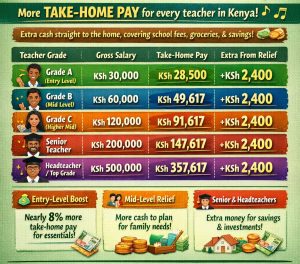
Why this matters: The “Extra Take-Home” column represents cash that teachers get to keep every month. It’s not theoretical—it hits the home, directly helping families cover expenses, save, or invest.
Entry-Level Teachers: Relief that Changes Lives
Grade A teachers, earning around Ksh 30,000, feel the relief most sharply in proportion to their salary. The Ksh 2,400 personal relief adds nearly 8% to take-home pay, enough to cover groceries, transportation, or small school expenses. For entry-level teachers who are beginning their careers and juggling household costs, this extra cash provides breathing space and confidence. They can now plan their budgets without constant worry, knowing that a portion of their hard-earned salary stays home.
Mid-Level Teachers: Stretching the Salary Further
For mid-level teachers (Grade B), earning Ksh 60,000, the added relief takes take-home pay from about Ksh 47,217 to Ksh 49,617. That extra Ksh 2,400 is money that can go directly toward school fees, household bills, or even start a small savings fund. Many mid-level teachers support extended families, and every shilling counts. The relief enhances financial flexibility, allowing families to plan, save, and avoid unnecessary financial stress.
Higher Grades: Building Security and Investments
Teachers in higher grades (Grade C and senior teachers) also benefit significantly. A Grade C teacher earning Ksh 120,000 sees take-home pay rise to Ksh 91,617, while a senior teacher earning Ksh 200,000 takes home Ksh 147,617. For headteachers earning Ksh 500,000, take-home increases to Ksh 357,617.
Even though the percentage increase is smaller than for lower grades, the relief still represents real, usable cash for households. Senior teachers can allocate this extra money to long-term investments, emergency savings, or household improvements. It’s a practical boost that strengthens financial stability at home.
ALSO READ:
Take-Home Pay: The True Measure of Financial Wellbeing
Gross salary may look impressive, but it is take-home pay that sustains households. This is what pays bills, buys groceries, covers emergencies, and funds children’s education. Treasury tax relief ensures that a larger portion of salary remains in teachers’ hands, giving educators the freedom to manage life and family more effectively.
Take-home pay is the real measure of teacher welfare. Even small increases can make a noticeable difference in daily life. This is why Hon. Mbadis’ tax relief is celebrated—because it directly increases cash flow, empowers teachers, and strengthens households.
Community and Economic Impact
More take-home pay does not just benefit individual teachers; it benefits the community and economy. Teachers with extra disposable income can support local businesses, invest in personal development, and contribute to school improvements. Financially stable teachers are more motivated, focused, and effective in their teaching, which positively impacts students and society.
While the government experiences a reduction in revenue, the long-term investment in teachers’ welfare is clear. Stronger teachers mean stronger schools, stronger students, and stronger communities.
Strategic Use of Relief
Tax relief provides extra cash, but the key is how it is used. Entry-level teachers can cover immediate household needs, mid-level teachers can save or invest, and senior teachers can plan for long-term financial security. Every shilling counts, and tax relief ensures that teachers can maximize their household income.
This is why teachers across Kenya are celebrating Mbadis’ initiative. It’s not just policy; it is financial empowerment, delivered in cash to the home every month.
ALSO READ:
Tension at Solai Boys as parents are locked out after dormitory fire
Infographic Highlights
The infographic shows visually how tax relief benefits teachers: Entry-Level Boost: Nearly 8% more take-home pay for essentials.
Mid-Level Relief: More cash to plan for family needs.
Senior & Headteachers: Extra money for savings and investments.
It emphasizes the ultimate impact: more money at home, stronger families, better schools and communities, making it instantly clear why teachers are thrilled.
Conclusion: Music to Every Teacher’s Ears
Mbadis’ tax relief is more than a figure on paper—it is real money reaching teachers’ homes. From entry-level Grade A teachers to top-grade headteachers, every educator benefits. The gains are immediate:
Entry-level teachers get breathing room to cover household essentials.
Mid-level teachers enjoy greater financial flexibility for family and savings.
Senior teachers and headteachers can invest in long-term family needs and financial security.
Take-home pay—not gross salary—is the true measure of financial wellbeing, and Hon. Mbadis’ tax relief ensures it increases for every teacher across Kenya. By putting more money directly in teachers’ hands, families are stronger, communities benefit, and the education sector is empowered.
Bottom line: This tax relief is music to every teacher’s ears. It’s cash that reaches home, strengthens households, and brings peace of mind. Every shilling counts, and now more of it stays with the people who earn it—the teachers shaping Kenya’s future.
By Hillary Muhalya
You can also follow our social media pages on Twitter: Education News KE and Facebook: Education News Newspaper for timely updates.
>>> Click here to stay up-to-date with trending regional stories
>>> Click here to read more informed opinions on the country’s education landscape