In the modern educational landscape, the emphasis has shifted from memorization to the development of practical skills, critical thinking, and problem-solving abilities. Competency-Based Education (CBE) prioritizes learning outcomes that enable students to demonstrate skills that are relevant to real-world challenges.
At the heart of this approach is the STEM (Science, Technology, Engineering, and Mathematics) laboratory, which serves not merely as a room for experiments but as a dynamic environment for innovation, collaboration, and applied learning. An ideal STEM laboratory is a space where learners are encouraged to explore, investigate, and create, translating theoretical knowledge into practical application.
The design of such a laboratory must prioritize flexibility and functionality. Traditional fixed layouts limit creativity and collaboration, but a modern CBE-focused lab features modular workstations that can be rearranged to accommodate individual experiments, small group projects, or whole-class demonstrations.
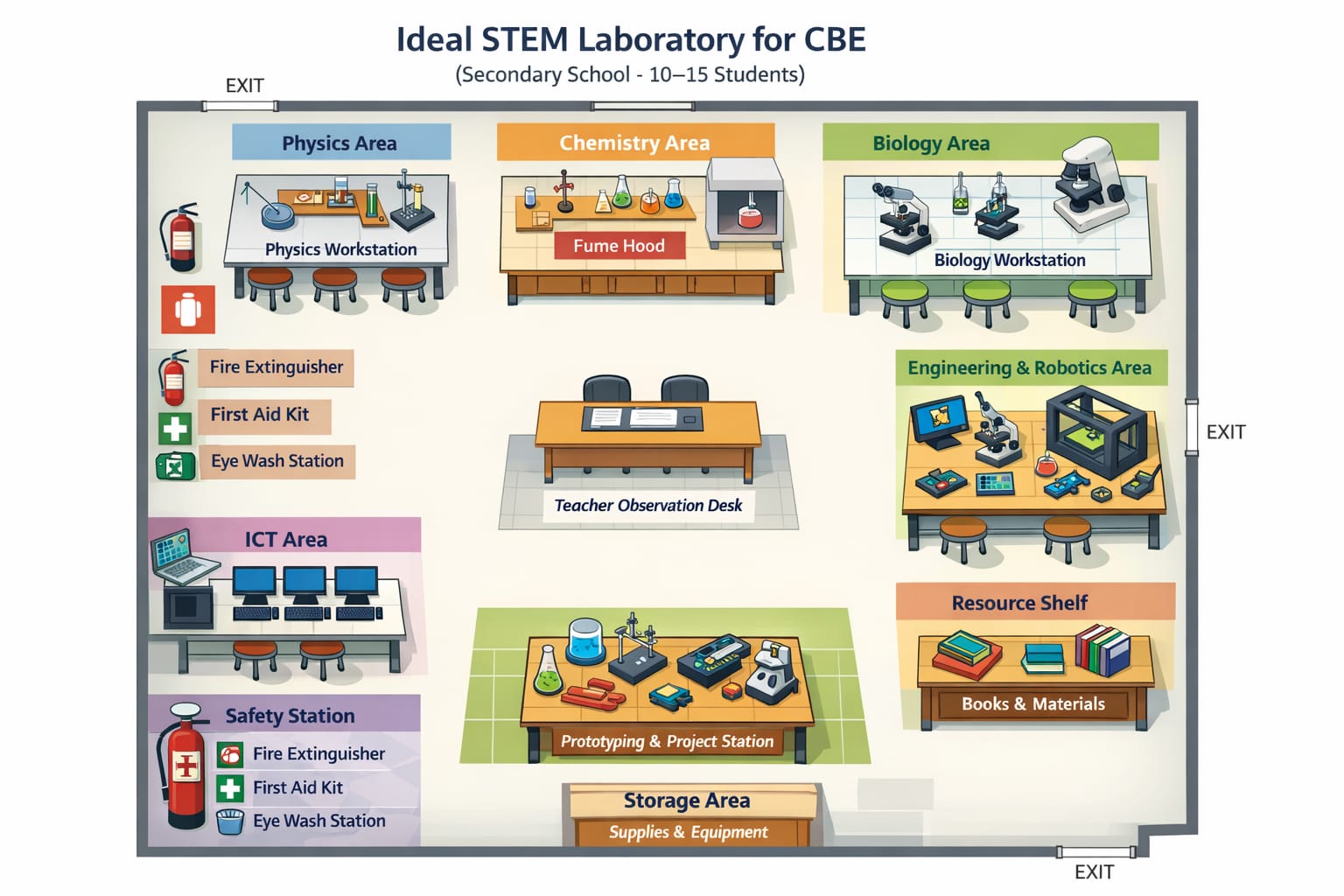
The laboratory should be divided into distinct zones for physics, chemistry, biology, engineering, robotics, and ICT, allowing learners to engage deeply in each discipline while still fostering interdisciplinary learning. Wide aisles, ergonomic furniture, non-slip flooring, adequate ventilation, and clearly marked emergency exits ensure that the space is safe and accessible for all students, including those with disabilities. Teacher observation areas allow instructors to monitor and guide students without interrupting ongoing experiments, promoting a student-centred, inquiry-driven approach to learning.
A well-equipped STEM laboratory is essential to the success of CBE. Physics workstations should include motion carts, pendulums, electrical circuits, voltmeters, oscilloscopes, and sensors, enabling learners to explore mechanics, electricity, and energy through hands-on experimentation. Chemistry areas require fume hoods, Bunsen burners, beakers, flasks, chemical reagents, and appropriate personal protective equipment such as goggles, gloves, and lab coats, allowing students to conduct experiments safely while mastering chemical concepts and laboratory procedures.
ALSO READ:
Government unveils proposals to restructure CBC for Junior and Senior Schools
Biology sections should be furnished with microscopes, slides, dissecting kits, preserved specimens, and biological reagents, facilitating the study of anatomy, physiology, microbiology, and ecology. Engineering and robotics areas should be equipped with Arduino kits, 3D printers, construction materials, motors, and gears to encourage prototyping, problem-solving, and innovation. ICT and computing stations must include computers, simulation and data analysis software, internet access, and programming platforms to ensure students acquire both digital literacy and computational thinking skills.
The furniture and fixtures in a CBE STEM laboratory must support long hours of collaborative and independent work while maintaining comfort and safety. Adjustable-height benches and stools accommodate students of different sizes and learning styles. Lockable storage cabinets safeguard chemicals, tools, and sensitive equipment, while whiteboards or interactive screens allow teachers to provide step-by-step instructions and facilitate collaborative planning. Modern labs integrate digital infrastructure, including Wi-Fi, projectors, and data sensors, which enhance the teaching and learning process. These features collectively create an environment where learners actively construct knowledge through experimentation, observation, and analysis.
Safety remains a paramount consideration in a STEM laboratory. First aid kits, eye-wash stations, fire extinguishers, and emergency alarms must be readily accessible. All chemicals, tools, and equipment should be clearly labeled with hazard warnings, and personal protective equipment must be available and worn consistently.
Safety protocols should be incorporated into the learning process, ensuring that students internalize responsible practices while conducting experiments. Such measures not only prevent accidents but also cultivate a culture of accountability and professionalism that students carry beyond the laboratory.
Learning resources must be aligned with the competencies targeted by CBE. Experiment manuals should emphasize practical skills, critical thinking, and problem-solving rather than rote memorization. Digital resources such as simulations, interactive tutorials, and virtual laboratories complement hands-on activities, providing multiple pathways for understanding complex concepts. Project kits and design-thinking challenges encourage learners to innovate, test prototypes, and develop solutions to real-world problems. These experiences enable students to demonstrate mastery of skills, document processes, and refine critical soft skills such as teamwork, communication, and leadership.
Pedagogically, the laboratory should be organized around competency-driven workstations where learners demonstrate their skills and understanding. Collaborative spaces encourage teamwork, peer learning, and communication, while observation and assessment tools enable teachers to track progress and provide timely feedback.
Innovation corners provide dedicated spaces for learners to prototype ideas, test hypotheses, and engage in creative problem-solving. This approach fosters independent inquiry while reinforcing the importance of practical application and real-world problem-solving.
The sustainability and maintenance of a STEM laboratory are equally important. Instruments must be calibrated regularly, work surfaces kept clean, and hazardous materials disposed of safely. Energy-efficient lighting, natural ventilation, and durable materials reduce operational costs while maintaining a safe and conducive learning environment.
Consumables such as chemicals, reagents, and prototyping materials must be replenished regularly to ensure uninterrupted learning. Maintaining high standards of hygiene, functionality, and environmental sustainability ensures that the laboratory remains effective over the long term.
An ideal STEM laboratory is ultimately a learning ecosystem that integrates theory with practice, fosters collaboration, and nurtures critical thinking and innovation. However, the success of such a laboratory depends heavily on the educators who guide learners through the process. Teachers and laboratory instructors must be well-trained, fairly remunerated, and professionally supported to facilitate meaningful learning experiences. Proper remuneration and professional development are critical for attracting and retaining skilled educators, motivating them to innovate, and ensuring they can mentor learners effectively.
By investing in well-designed STEM laboratories and supporting the professional growth and welfare of teachers, educational institutions can produce learners who are competent, innovative, and ready to engage with complex real-world challenges. Such learners are not only equipped with theoretical knowledge but also possess the practical skills, problem-solving abilities, and critical thinking required for higher education, technical careers, and entrepreneurship.
ALSO READ:
A modern STEM laboratory, aligned with the principles of Competency-Based Education, becomes a launchpad for creativity, innovation, and lifelong learning.
In conclusion, the ideal STEM laboratory for Competency-Based Education must integrate flexible design, state-of-the-art equipment, safety, digital resources, pedagogical innovation, and sustainability. It should empower learners to acquire and demonstrate practical competencies, foster collaboration, and encourage creativity. Equally important is the recognition that teachers and laboratory instructors are the driving force behind effective CBE.
Proper remuneration, professional support, and continuous development ensure that educators can deliver high-quality learning experiences, guide students through complex problem-solving tasks, and inspire innovation. By investing in STEM laboratories and the professionals who operate them, educational institutions equip students with the skills, confidence, and mindset to thrive in the 21st century, contributing meaningfully to society, industry, and national development.
By Hillary Muhalya
You can also follow our social media pages on Twitter: Education News KE and Facebook: Education News Newspaper for timely updates.
>>> Click here to stay up-to-date with trending regional stories
>>> Click here to read more informed opinions on the country’s education landscape
>>> Click here to stay ahead with the latest national news.