A concerned road user recently shared an observation that should trouble this nation’s conscience. He said he deliberately avoids driving at night, especially between midnight and 5:00 a.m., not because he fears darkness, but because he fears what our roads have become. At those hours, he observed, long-distance buses often turn highways into deadly racetracks — driven at terrifying speeds, overtaking blindly, and at times surging forward on the wrong side of the road as though traffic laws no longer apply.
What unsettles him most is not only the recklessness but the apparent protection these vehicles seem to enjoy. Many slow briefly at police roadblocks and are waved through without scrutiny, while ordinary motorists are stopped, questioned, and delayed. This selective enforcement sends a chilling message: that some operators are beyond accountability and that some lives are expendable. When the law appears negotiable, danger becomes policy.
He recalled an incident that still weighs heavily on him. One night, shaken by the dangerous manner in which a bus was being driven, he reported the matter to officers manning a roadblock ahead. As he spoke, the very bus he was describing approached. It slowed, rolled forward, and was allowed to pass — no inspection, no warning, no intervention. The officers did nothing. He stood there in disbelief, stripped of confidence in a system meant to protect life. In that moment, the law felt hollow, and the road felt merciless.
TThese experiences, he said, are not isolated. They reflect a deeper sickness in our road safety culture: the quiet normalisation of lawlessness. When enforcement becomes selective, recklessness flourishes. When some operators appear untouchable, discipline collapses. And when discipline collapses, death follows. Our roads then cease to be shared public spaces and become arenas where survival depends on luck rather than law.
The gravity of the situation becomes impossible to ignore when we look at the numbers. According to the National Transport and Safety Authority (NTSA), by early December, about 4,458 people had already lost their lives on Kenyan roads in 2025, a figure that surpasses last year’s total. These deaths are not abstract statistics but real lives — parents, youth, workers, and neighbours — cut short in crashes that might have been prevented.
Tragically, some of those affected are among our most vulnerable — children and educators. In June this year, a student from Tumaini Emmanuel Academy was killed, and several others were injured when their school van lost control and overturned in Embu County. In another devastating case in July, a teacher travelling with pupils from a school trip in Mombasa died, and dozens of students were injured when their vehicle was involved in a crash on the Maasai Road. Just weeks earlier in Vihiga County, a bus carrying students and teachers overturned, leaving an unknown number injured. And in Nyeri, 23 school children narrowly escaped serious harm when their bus lost control and crashed into a tree, though some were treated in hospital for injuries. These are not isolated events but part of a broader pattern in which learners and their supervisors face daily risks simply for trying to get to and from school.
READ ALSO:
KU medical students to access referral hospital after six-year stalemate ends as MoU signed
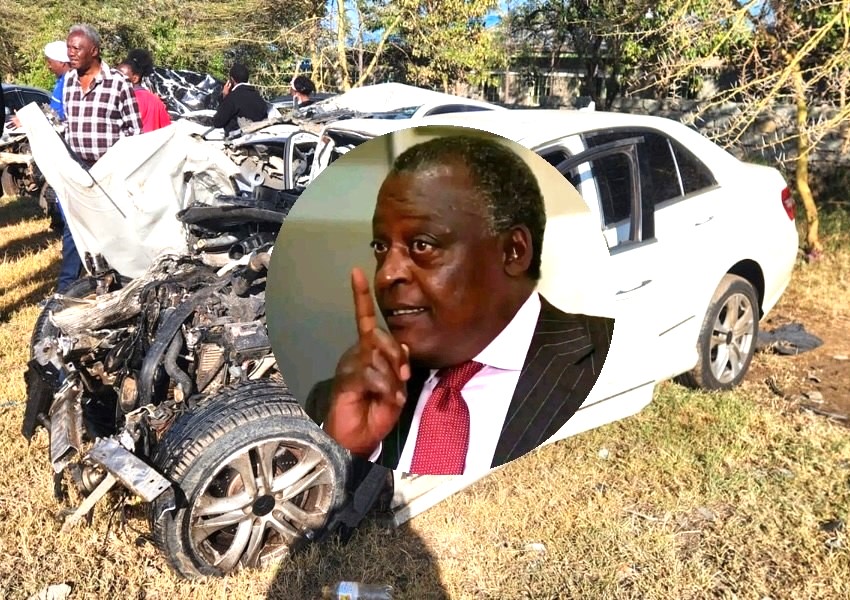
These observations gain added weight in light of recent tragedies, including the death of Hon. Cyrus Jirongo. His passing is not merely a political loss — it is a human tragedy. Yet, as so often happens, there is a rush to simplify the story, to close the file before uncomfortable questions are asked. Blame is quickly assigned, explanations are narrowed, and the public is urged to move on.
The observer warned against this dangerous habit. Attributing fatal crashes solely to intoxication may offer temporary comfort, but it does not deliver truth. Sober drivers cause many deadly accidents — drivers who were speeding, fatigued, distracted, or emboldened by a culture that rarely holds them to account. Sobriety does not equate to safety when negligence is tolerated, and speed is worshipped.
Speed, in particular, is a silent executioner on our roads. It magnifies every mistake and turns collisions into catastrophes. Metal twists, glass explodes, and bodies are broken with a violence that leaves no room for denial. When impact is severe, speed is often the unseen hand behind the devastation. Yet speed violations remain among the most casually enforced offences, especially when committed by powerful or commercially influential operators.
For this reason, the observer called for thorough, transparent, and independent investigations into serious road accidents — especially those that claim the lives of prominent or vulnerable people. We must ask the questions that matter, not the convenient questions. How fast was the vehicle travelling? Did the incident occur within a town centre, where the law clearly sets a limit of 50 km/h? Were traffic rules enforced impartially, or was enforcement compromised by fear, influence, or indifference? Without honest answers, justice is incomplete, and the next tragedy is already loading.
Beyond individual cases, he insisted that road safety is a systemic failure. Laws exist. Speed limits are posted. Campaigns are launched. But laws without consistent enforcement are meaningless. Where corruption, complacency, or selective policing takes root, road safety becomes a slogan rather than a safeguard. The reckless learn quickly that consequences are negotiable, while the law-abiding pay with their lives.
At its core, road safety is not merely a technical or administrative issue. It is a moral one. It is about whether we value human life enough to slow down, to stop when required, and to enforce the law without fear or favour. It is about whether institutions exist to serve the public or to shield the powerful. Every pedestrian crossing a road, every pupil boarding a school bus, every teacher travelling with learners, is placing trust in a system that has a sacred duty to protect life.
The observer ended with a plea that echoes far beyond a single accident or a single name. Death on our roads should never feel normal. It should never be dismissed as inevitable. Every fatal crash is a verdict — not only on a driver, but on enforcement agencies, policymakers, and a society that has learned to look away.
The deaths of thousands of Kenyans this year — including children and educators — must not fade into statistics. They must disturb us. They must provoke honesty, courage, and reform. Because until we treat road safety as a non-negotiable duty — until the law applies equally to all — our roads will continue to claim lives. History will judge us not by the rules we wrote, but by the lives we failed to protect.
President William Ruto’s administration has expressed a clear vision for modernising Kenya’s road infrastructure in line with Vision 2030, seeking to transform the country into a newly industrialising, middle-income nation with a high quality of life for all. This ambition is commendable and must be fully supported. Modern highways, expressways, and transport corridors are essential for economic growth, but modern enforcement systems, ethical policing, and a culture of responsibility among road users must keep pace with them. Progress that sacrifices lives is not actual progress.
For Vision 2030 to be meaningful, road safety must be treated as a pillar of national development rather than an afterthought. This requires strict regulation of public service vehicles, firm and impartial law enforcement, investment in intelligent transport systems, and widespread national education on the value of human life. Only when modern roads are governed by modern discipline will Kenya truly move forward. Only when safety becomes a shared national ethic will our highways cease to be sites of mourning and become pathways of opportunity and dignity.
By Hillary Muhalya