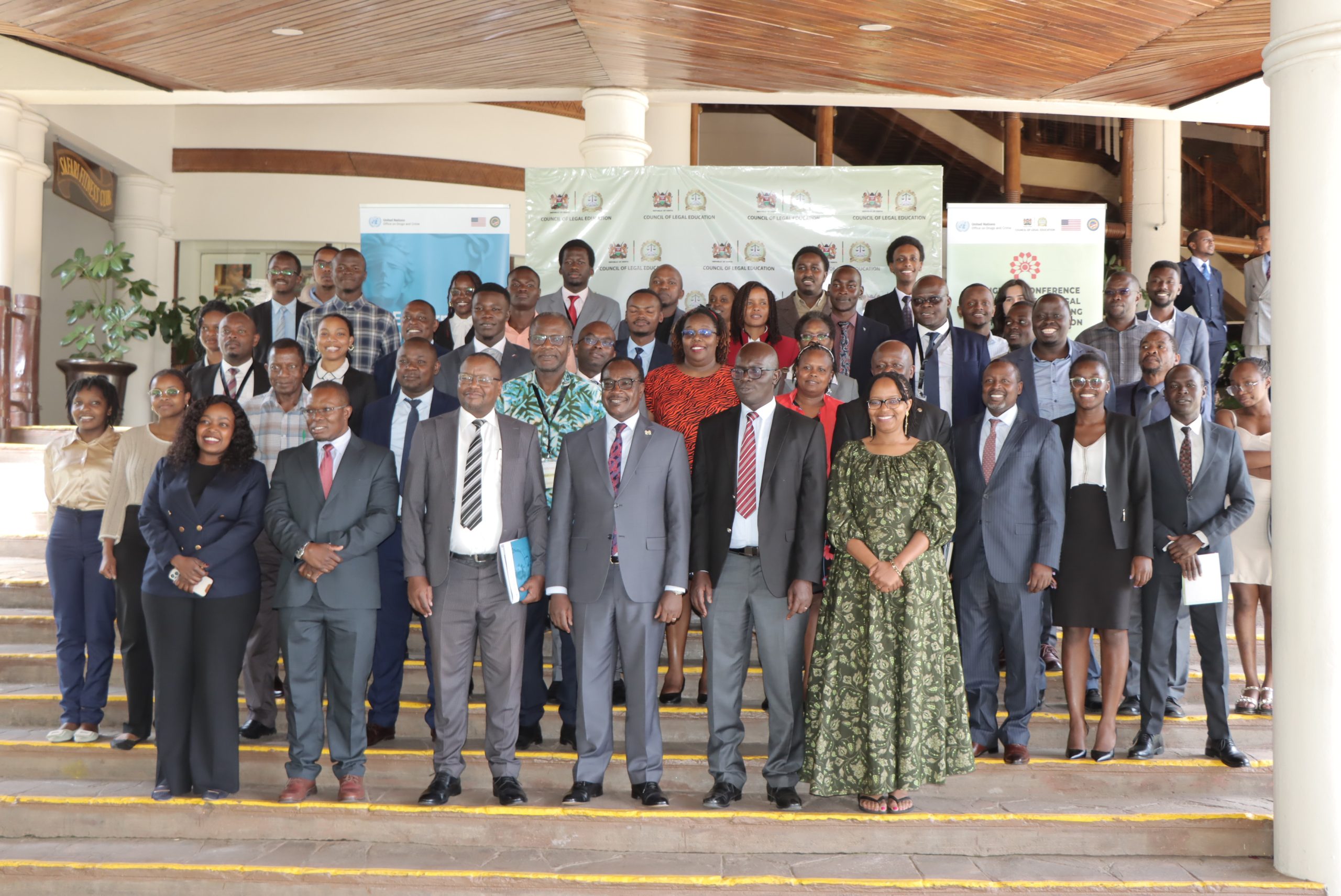
Stakeholders who attended the Inaugural Conference on the Future of Legal Education and Training in Kenya and the East African region, held in Nairobi, have called for major reforms in legal training, including the adoption of Competency-Based Education (CBE) to better prepare future lawyers for an increasingly dynamic world.
The three-day forum, organized by the Council of Legal Education (CLE) in partnership with the UNODC Anti-Corruption Hub for Africa, brought together representatives from the Judiciary, the Law Society of Kenya (LSK), academia, regulators, and international partners.
Participants agreed that legal education must transition from a theory-heavy model to one that prioritizes demonstrable skills and practical competence.
In a statement presented by CLE CEO Prof. Busalile Jack Mwimali, stakeholders emphasized the need to formally integrate experiential learning into legal training. Activities such as moot courts, legal clinics, judicial attachments, and service-based learning should be recognized and credited as part of the academic curriculum.
Prof. Mwimali added that stakeholders had also agreed on the need to embed financial literacy, digital fluency, ethics, and emotional intelligence into the curriculum alongside traditional legal subjects. They further recommended the recognition of prior learning, enhanced training in public service lawyering, and the inclusion of East African Community (EAC) Law to support regional legal practice.
ALSO READ:
KUPPET Homa Bay demands improved pay terms for JSS intern teachers
On technology and innovation, the conference highlighted the need for law graduates to be proficient in digital skills, including artificial intelligence (AI), blockchain, cybersecurity, and online dispute resolution (ODR). While acknowledging the advantages of AI, stakeholders stressed the importance of safeguarding human qualities such as empathy and emotional intelligence. Educators were encouraged to guide students many of whom already use AI toward responsible and critical engagement rather than restrictive oversight.
Ethics and integrity were also emphasized as central pillars of legal education, with speakers warning against prioritizing materialism at the expense of justice and professional virtue.
On matters of regulation and quality assurance, participants called for stronger collaboration between universities, CLE, and professional bodies to harmonize training standards and produce globally competitive lawyers. They recommended stricter regulation of lecturer qualifications, the introduction of remedial training for graduates after bar examinations, and efforts to address curriculum inconsistencies across law schools.
The conference also underscored the need for regional and global integration, urging the establishment of EAC wide agreements to enable cross border legal practice. Stakeholders noted that Kenyan lawyers must be prepared for roles in international arbitration, transnational disputes, and global financial crime. Regulators across East Africa were urged to develop shared minimum standards for legal education, covering course content and program structure.
Education Cabinet Secretary Julius Ogamba described the conference as timely, noting that it provided an opportunity to reflect on Kenya’s legal education system. He emphasized the need for educators and regulators to prepare for the rollout of CBE and Training at the tertiary level ahead of the first cohort in 2029.
“We must think carefully about how we will align legal education to the CBE system, our task is to shift from content-heavy training to skills-based, experiential, and problem-solving pedagogy.”
ALSO READ:
Ogamba stressed the need to enhance critical competencies, including legal writing, advocacy, negotiation, decision-making, ethics, and digital literacy.
He warned that a mismatch between legal training and industry needs risks producing graduates who are unprepared for modern professional demands. He further urged institutions to prepare students for practice beyond Kenya’s borders while also making the country an attractive destination for trainees from other jurisdictions.
Chief Justice Martha Koome called for a bold rethinking of legal education in Kenya one that responds to rapid growth in the profession, shifting global realities and the lived experiences of Kenyans.
CLE Chairperson Prof. Collins Odote noted that discussions on innovation, curriculum reform, quality assurance, and global alignment are essential in positioning Kenya as both a regional leader and a contributor to global legal thought.
“The deliberations and recommendations from this conference provide a strong foundation for meaningful solutions,” Prof. Odote said.
He added that CLE will benefit from the collective insights shared during the conference, and training institutions now have clearer guidance on priority areas for reform.
By Obegi Malack
You can also follow our social media pages on Twitter: Education News KE and Facebook: Education News Newspaper for timely updates.
>>> Click here to stay up-to-date with trending regional stories
>>> Click here to read more informed opinions on the country’s education landscape